

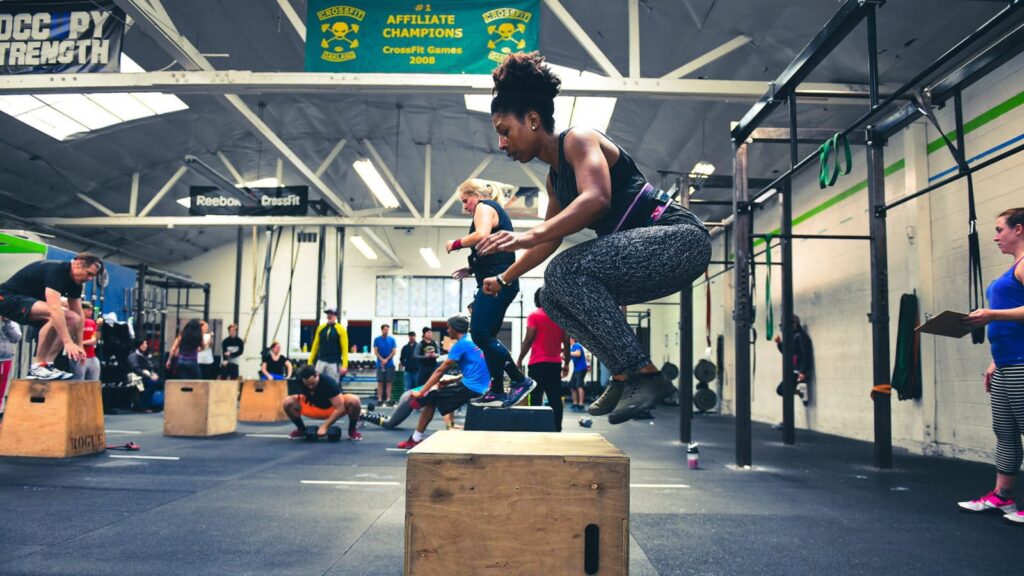
Box jumps are one of the most recognizable movements in functional fitness. They look simple: jump from the ground onto a box, stand up, step or jump down, repeat. But behind that simple appearance lies a powerful combination of strength, speed, coordination, and conditioning.
When programmed intelligently, box jumps can improve lower-body power, enhance athletic performance, increase metabolic demand, and challenge mental resilience. Research consistently shows that explosive lower-body training improves neuromuscular performance, rate of force development, and sport-specific ability. Functional fitness athletes use box jumps not just to jump higher, but to move better under fatigue.
In this article, you’ll find three challenging functional fitness workouts built around box jumps. Each session is designed with a clear physiological purpose and backed by scientific evidence. You’ll also learn why box jumps work, how to scale them safely, and what adaptations you can expect.
Why Box Jumps Work: The Science Behind Explosive Power
The Stretch-Shortening Cycle
Box jumps are a classic example of plyometric training. Plyometrics rely on the stretch-shortening cycle (SSC), which involves a rapid eccentric muscle action immediately followed by a concentric contraction. When you dip before jumping, your muscles and tendons store elastic energy. If you reverse the movement quickly, that stored energy contributes to greater force production.
Research shows that plyometric training improves vertical jump height, sprint speed, and power output by enhancing neuromuscular coordination and the efficiency of the SSC. These improvements are linked to increased motor unit recruitment, improved intermuscular coordination, and greater stiffness in the muscle-tendon unit.
In practical terms: the faster and more efficiently you can switch from loading to exploding, the more powerful you become.
Rate of Force Development and Athletic Performance
Functional fitness is not just about strength; it’s about how quickly you can apply that strength. Rate of force development (RFD) is a key determinant of performance in jumping, sprinting, and Olympic lifting.
Plyometric training has been shown to significantly increase RFD. Faster force production improves not only vertical jump performance but also change of direction and acceleration. These qualities are essential in sport and transferable to compound lifts like cleans and snatches.
Box jumps train RFD without the heavy joint stress associated with maximal barbell lifts. Because you land on an elevated surface, ground reaction forces are lower than when landing back on the floor, making box jumps a joint-friendlier option compared to depth jumps.
Strength, Power, and Conditioning
High-intensity functional training (HIFT), which often includes movements like box jumps, improves both aerobic and anaerobic capacity. Research on functional circuit training shows significant improvements in VO2max, muscular endurance, and body composition.
When box jumps are combined with strength and cyclical movements, they increase heart rate rapidly, challenge the phosphagen and glycolytic systems, and improve metabolic conditioning.
The result? You build power and conditioning at the same time.
Injury Risk and Safe Progression
Plyometrics can be safe and effective when programmed correctly. Research indicates that structured plyometric training reduces injury risk in athletes by improving neuromuscular control and landing mechanics.
However, excessive volume or poor technique increases risk, particularly for the Achilles tendon and knees. Stepping down from the box instead of rebounding reduces eccentric stress and lowers injury risk. Progressive loading, appropriate box height, and adequate rest between high-intensity sessions are critical.
Now let’s put the science into action.
Workout 1: Power Under Pressure
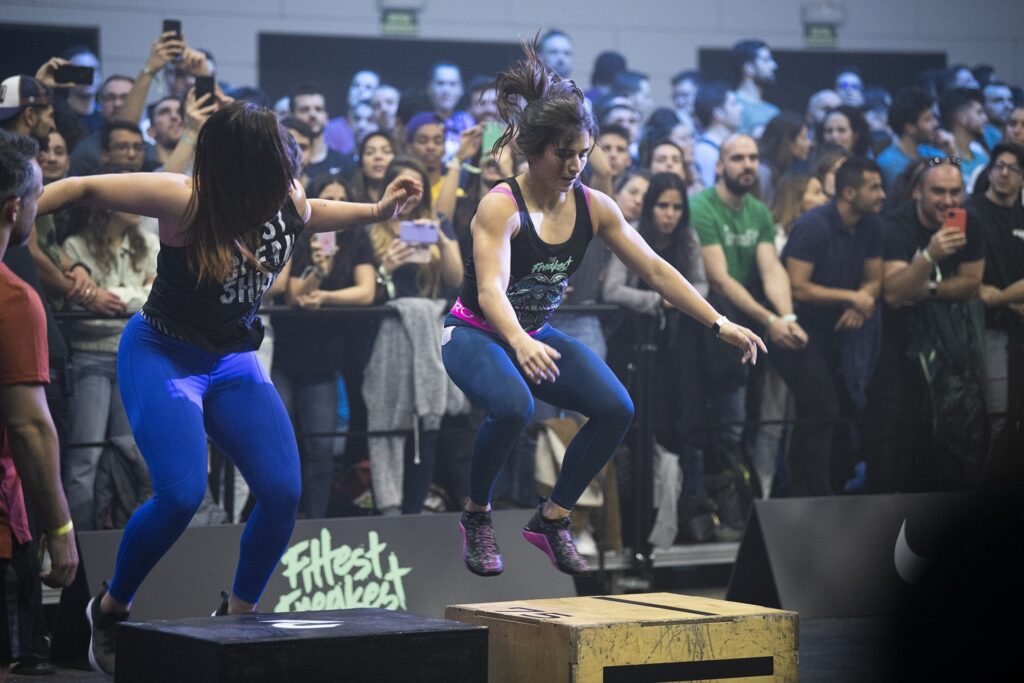
This workout focuses on lower-body power expression under moderate fatigue. It combines box jumps with barbell cycling and core stability work.
Structure
For Time:
5 Rounds:
- 12 Box Jumps (24/20 inches)
- 10 Power Cleans (135/95 lbs)
- 200-meter Run
Time cap: 18–20 minutes
Training Goal
The goal is to maintain explosive output across all five rounds. This session targets:
- Rate of force development
- Lower-body power endurance
- Anaerobic capacity
- Core stability under fatigue
Why It Works
Box jumps at the start of each round prime the nervous system. Post-activation performance enhancement (PAPE) suggests that explosive movements can temporarily increase force output in subsequent efforts. By placing box jumps before power cleans, you may enhance barbell velocity and power output.
The power clean itself is one of the most studied movements for developing total-body power. Research shows strong correlations between Olympic lift derivatives and vertical jump performance.
The 200-meter run challenges the glycolytic energy system. High-intensity intervals of this duration increase lactate production and improve buffering capacity, enhancing performance in repeated high-intensity efforts.
Coaching Notes
- Step down from the box to reduce Achilles and knee strain.
- Choose a load that allows unbroken or near-unbroken cleans.
- Focus on soft, quiet landings to improve neuromuscular control.
- Maintain posture during the run; avoid collapsing the chest.
Scaling Options
- Reduce box height to 20/16 inches.
- Substitute kettlebell swings for power cleans.
- Shorten the run to 150 meters.
This workout is ideal for intermediate to advanced athletes who want to improve power endurance without sacrificing technique.
Workout 2: Aerobic Engine Meets Explosiveness
This session blends aerobic capacity with repeated explosive efforts. It is structured as an interval-based workout to allow partial recovery while maintaining high intensity.
Structure
Every 4 Minutes for 5 Rounds:
- 15 Box Jump Overs (24/20 inches)
- 12 Toes-to-Bar
- 250-meter Row
Rest for the remainder of each 4-minute window.
Training Goal
This workout develops:
- Aerobic power
- Muscular endurance
- Repeated jump capacity
- Core strength under metabolic stress
Why It Works
High-intensity interval training (HIIT) has been shown to significantly improve VO2max and cardiovascular health in less time than traditional steady-state training. Four-minute intervals are long enough to stress both aerobic and anaerobic systems.
Box jump overs increase movement efficiency and demand coordination. Unlike standard box jumps, athletes move continuously over the box, increasing metabolic cost.
Toes-to-bar add a midline stability challenge. Research shows that core stability contributes to force transfer in explosive movements. A stronger, more stable trunk improves jumping and lifting efficiency.
The row reinforces aerobic development. Rowing engages large muscle groups, increasing oxygen demand and stimulating cardiovascular adaptation.
Pacing Strategy
- Aim to finish each round in 3:00–3:30.
- Maintain consistent splits across all five intervals.
- Avoid sprinting the first round at the expense of later performance.
Scaling Options
- Replace toes-to-bar with hanging knee raises.
- Reduce box height.
- Shorten the row to 200 meters.
This workout teaches you to recover quickly between high-output efforts, a critical skill in functional fitness competition.
Workout 3: Mental Grit and Lactate Tolerance
This final workout is designed to test your ability to produce power while deep in the pain cave. It emphasizes lactate tolerance and neuromuscular resilience.
Structure
AMRAP 20 Minutes:
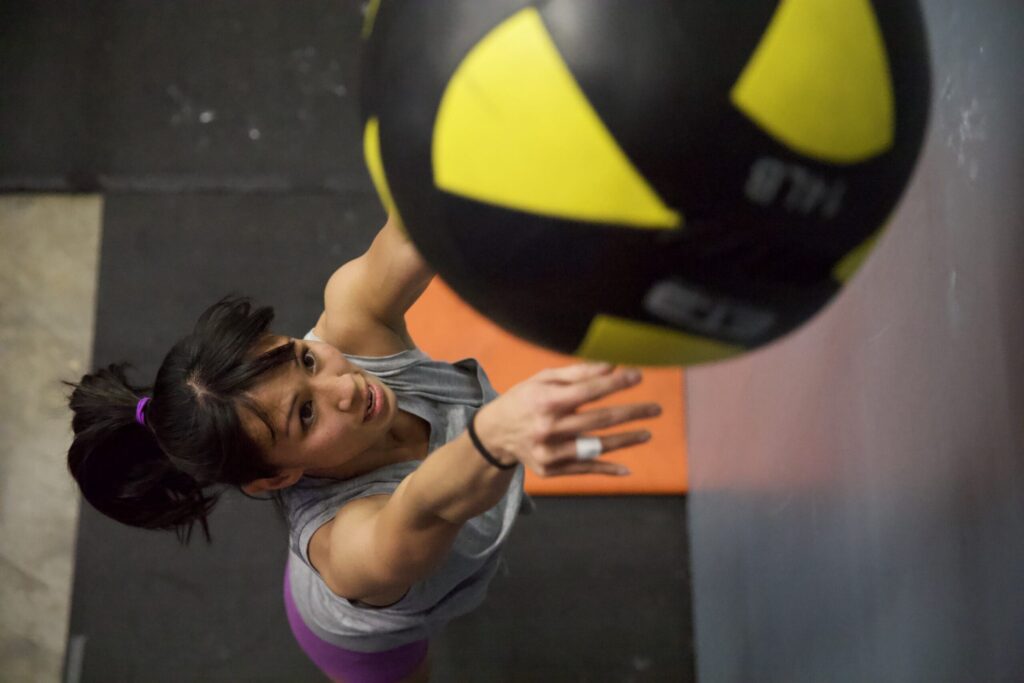
- 20 Wall Balls (20/14 lbs)
- 15 Box Jumps (24/20 inches)
- 10 Deadlifts (225/155 lbs)
- 5 Burpee Box Jump Overs (24/20 inches)
Training Goal
This workout develops:
- Lactate tolerance
- Total-body muscular endurance
- Explosive power under fatigue
- Psychological resilience
Why It Works
Continuous high-intensity efforts elevate blood lactate levels. Research shows that repeated exposure to high lactate concentrations improves buffering capacity and delays fatigue.
Wall balls create a high heart rate early in each round. Deadlifts add posterior chain strength demands. Box jumps and burpee box jump overs force you to repeatedly express power despite systemic fatigue.

Studies on high-intensity functional training demonstrate improvements in aerobic capacity, muscular endurance, and body composition when sessions combine strength and plyometric elements.
The burpee box jump over is especially demanding. It requires a rapid transition from horizontal to vertical force production, challenging coordination and rate of force development under fatigue.
Movement Standards and Safety
- Maintain neutral spine during deadlifts.
- Step down from the box to manage eccentric load.
- Break wall balls early if necessary to avoid excessive heart rate spikes.
Scaling Options
- Reduce deadlift load.
- Perform regular burpees without a jump over the box.
- Lower box height.
This session is ideal for advanced athletes who want to push conditioning and mental toughness while reinforcing explosive mechanics.
Programming Considerations for Box Jump Workouts
Volume and Frequency
Research suggests that plyometric training 1–3 times per week is sufficient to improve power. Excessive volume can increase tendon stress. Quality should always come before quantity.
For most athletes:
- 40–80 total jumps per session is effective.
- Allow at least 48 hours between high-volume plyometric sessions.
Box Height Selection
Higher is not always better. Optimal box height allows you to jump explosively without excessive hip flexion upon landing. Excessively high boxes often encourage tucking rather than true vertical power development.
Step-Down vs. Rebound
Rebounding box jumps increase stretch-shortening cycle stress and tendon loading. While effective for advanced athletes, research indicates higher ground reaction forces with repeated rebounds. Stepping down reduces injury risk and preserves long-term training consistency.
Warm-Up Recommendations
A proper warm-up improves jump performance and reduces injury risk. Dynamic warm-ups increase muscle temperature and enhance nerve conduction velocity.
Include:
- Glute activation drills
- Ankle mobility work
- Submaximal pogo jumps
- Practice jumps at lower height
Expected Adaptations from Consistent Training
If you incorporate box jump workouts like these 1–2 times per week for 8–12 weeks, research suggests you can expect:
- Increased vertical jump height
- Improved sprint acceleration
- Enhanced rate of force development
- Improved VO2max
- Greater lactate tolerance
- Improved neuromuscular coordination
These adaptations transfer directly to Olympic lifting, sprinting, field sports, and competitive functional fitness.
Final Thoughts
Box jumps are more than a flashy movement in a workout. When programmed intelligently, they improve explosive strength, coordination, conditioning, and resilience.
The three workouts above challenge different physiological systems:
- Workout 1 builds power endurance.
- Workout 2 develops aerobic recovery and repeated explosiveness.
- Workout 3 enhances lactate tolerance and mental grit.
Explosive training demands respect. Focus on quality mechanics, manage volume, and recover properly. When you do, box jumps become one of the most powerful tools in your functional fitness arsenal.
Train hard. Land soft. Stay explosive.
Key Takeaways
| Topic | Key Point | Practical Application |
|---|---|---|
| Stretch-Shortening Cycle | Rapid eccentric-to-concentric action increases power output | Minimize ground contact time and land softly |
| Rate of Force Development | Faster force production improves athletic performance | Place box jumps early in workouts |
| Conditioning Benefits | HIFT improves VO2max and anaerobic capacity | Combine jumps with cyclical and strength movements |
| Injury Prevention | Proper plyometric training improves neuromuscular control | Step down from the box and manage volume |
| Programming | 1–3 sessions per week is effective | Keep total jumps between 40–80 per workout |
| Recovery | 48 hours between intense plyometric sessions | Alternate heavy jump days with aerobic or strength focus |
References
- Adams, K., O’Shea, J.P., O’Shea, K.L. and Climstein, M. (1992) ‘The effect of six weeks of squat, plyometric and squat-plyometric training on power production’, Journal of Applied Sport Science Research, 6(1), pp. 36–41.
- Markovic, G. (2007) ‘Does plyometric training improve vertical jump height? A meta-analytical review’, British Journal of Sports Medicine, 41(6), pp. 349–355.
- de Villarreal, E.S., Kellis, E., Kraemer, W.J. and Izquierdo, M. (2009) ‘Determining variables of plyometric training for improving vertical jump height performance: A meta-analysis’, Journal of Strength and Conditioning Research, 23(2), pp. 495–506.
- Cormie, P., McGuigan, M.R. and Newton, R.U. (2011) ‘Developing maximal neuromuscular power: Part 1 – Biological basis of maximal power production’, Sports Medicine, 41(1), pp. 17–38.
- Cormie, P., McGuigan, M.R. and Newton, R.U. (2011) ‘Developing maximal neuromuscular power: Part 2 – Training considerations for improving maximal power production’, Sports Medicine, 41(2), pp. 125–146.
- Buchheit, M. and Laursen, P.B. (2013) ‘High-intensity interval training, solutions to the programming puzzle’, Sports Medicine, 43(5), pp. 313–338.
- Feito, Y., Heinrich, K., Butcher, S. and Poston, W. (2018) ‘High-intensity functional training (HIFT): Definition and research implications for improved fitness’, Sports, 6(3), pp. 76.