

Powerful shoulders are more than a visual statement. They are central to athletic performance, injury resilience, and everyday function. Whether you are pressing a barbell overhead, throwing a ball, climbing a rope, or simply lifting groceries into a car, your shoulders are doing complex, high-demand work.
The shoulder joint is the most mobile joint in the human body. That mobility comes at a cost: stability. To build strong, resilient shoulders, you need exercises that challenge strength, coordination, and control across multiple planes of motion. That is where functional fitness shines.
This article breaks down the three best functional fitness exercises for powerful shoulders, based on biomechanics and peer-reviewed research. We will look at why they work, how to perform them correctly, and how to program them for strength and longevity.
What Makes an Exercise “Functional” for the Shoulders?
Before jumping into the exercises, we need to define “functional.”
A functional exercise:
- Trains movement patterns, not just isolated muscles
- Involves multiple joints
- Requires coordination and stability
- Transfers to sport and real-world tasks
The shoulder complex includes:
- The glenohumeral joint (ball-and-socket joint)
- The scapulothoracic articulation (shoulder blade movement on the rib cage)
- The acromioclavicular and sternoclavicular joints
Optimal shoulder function depends on coordinated movement between the humerus and the scapula. This is known as scapulohumeral rhythm. Research shows that proper scapular motion is essential for maintaining subacromial space and reducing injury risk during overhead movement.

Exercises that challenge both the rotator cuff and the larger global muscles (deltoids, trapezius, latissimus dorsi, serratus anterior) while reinforcing scapular control are key.
With that in mind, here are the three best functional exercises for powerful shoulders.
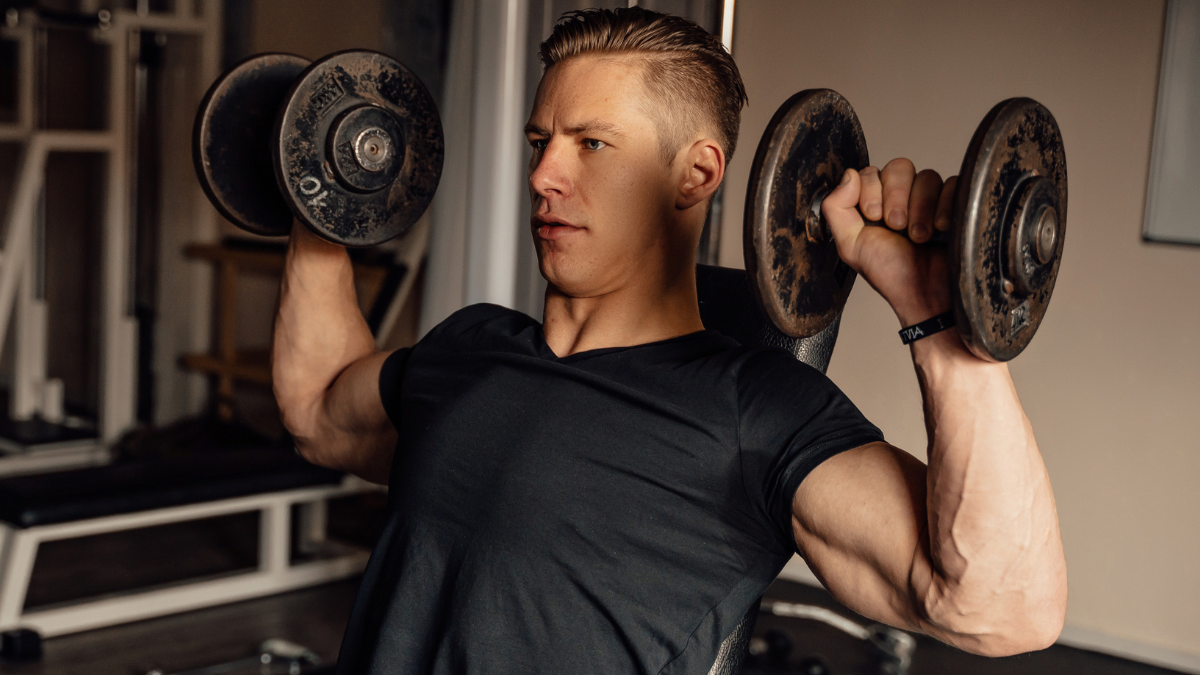
1. The Strict Overhead Press
Why the Overhead Press Builds Powerful Shoulders
The strict overhead press is one of the most effective compound movements for developing shoulder strength.
Unlike push presses or jerks, the strict press removes lower-body assistance. That means the shoulders, triceps, and upper back must generate force without help from the legs.
Electromyography (EMG) research shows high activation of the anterior and middle deltoid during overhead pressing movements. In addition, the upper trapezius and serratus anterior are heavily involved in upward scapular rotation, which is essential for safe overhead mechanics.
Upward rotation of the scapula during pressing helps maintain the subacromial space and reduces the likelihood of impingement. Research examining scapular muscle function highlights the critical role of the serratus anterior and trapezius in overhead motion.
In short, the strict press does three important things:
- Develops maximal shoulder strength
- Reinforces proper scapular upward rotation
- Challenges core stability in a standing position
Standing overhead pressing also increases trunk muscle activation compared to seated variations, improving force transfer and total-body stability.
Biomechanics: Why It Transfers to Real Life
Overhead strength is essential in sport and life. Throwing, striking, swimming, gymnastics, and Olympic lifting all require strong overhead positioning.
The strict press trains:
- Shoulder flexion and abduction
- Scapular upward rotation
- Rotator cuff stabilization
- Anti-extension core strength
Because the load is directly overhead, the body must maintain alignment from the wrists down to the feet. This teaches force transmission through the kinetic chain.
How to Perform the Strict Overhead Press
- Stand with feet about hip-width apart.
- Hold a barbell at shoulder height with elbows slightly in front of the bar.
- Brace your core and squeeze your glutes.
- Press the bar overhead in a straight line.
- Finish with the bar over the midfoot, biceps near the ears.
- Lower under control.
Key cues:
- Avoid leaning back excessively.
- Keep ribs down.
- Actively shrug at the top to promote upward rotation.
Programming for Strength
For building powerful shoulders:
- 3–5 sets
- 3–6 reps
- 2–3 minutes rest
For hypertrophy:
- 3–4 sets
- 6–10 reps
- 90–120 seconds rest
Progress gradually. Shoulder tissues are sensitive to rapid load increases.
2. The Push Press

Why the Push Press Is Essential for Explosive Shoulder Power
If the strict press builds raw strength, the push press builds power.
Power is force multiplied by velocity. Athletic performance depends heavily on the ability to produce force quickly.
The push press uses a shallow dip and drive from the legs to accelerate the bar upward, then requires the shoulders to finish the press overhead.
Research on ballistic and explosive training consistently shows that high-velocity resistance training improves rate of force development and neuromuscular performance. The push press fits squarely in this category.
Because of the leg drive, the load used in the push press is typically heavier than in the strict press. That overload stimulates higher motor unit recruitment in the shoulder complex.
The movement also requires dynamic scapular control and rapid stabilization at lockout.
Neuromuscular Demands and Motor Unit Recruitment
Heavy, high-velocity training increases recruitment of high-threshold motor units, which are responsible for producing large amounts of force.
Studies examining explosive resistance training show improvements in power output and neuromuscular efficiency when athletes train with fast concentric intent.
The push press trains:
- Triple extension (ankles, knees, hips)
- Rapid force transfer to the upper body
- Overhead stabilization under load
This is particularly relevant in functional fitness settings, where movements are rarely isolated.
Injury Resilience and Overhead Control
Catching the bar overhead in a push press requires coordinated co-contraction of the rotator cuff and scapular stabilizers. This dynamic stabilization strengthens the shoulder complex in a way that mirrors sport-specific demands.
Proper overhead positioning reduces shear forces and improves joint congruency.
How to Perform the Push Press
- Start with the barbell at shoulder height.
- Dip straight down a few inches, keeping torso vertical.
- Drive explosively through the legs.
- As the bar accelerates upward, press to full lockout.
- Finish with strong overhead alignment.
- Lower under control and reset.
Common mistakes:
- Turning it into a squat.
- Pressing too early.
- Catching with soft or unstable shoulders.
Programming for Power
For explosive development:
- 4–6 sets
- 2–4 reps
- 2–3 minutes rest
Focus on bar speed, not fatigue. Stop sets when velocity drops significantly.
You can also pair push presses with plyometric movements in contrast training formats to enhance power output.
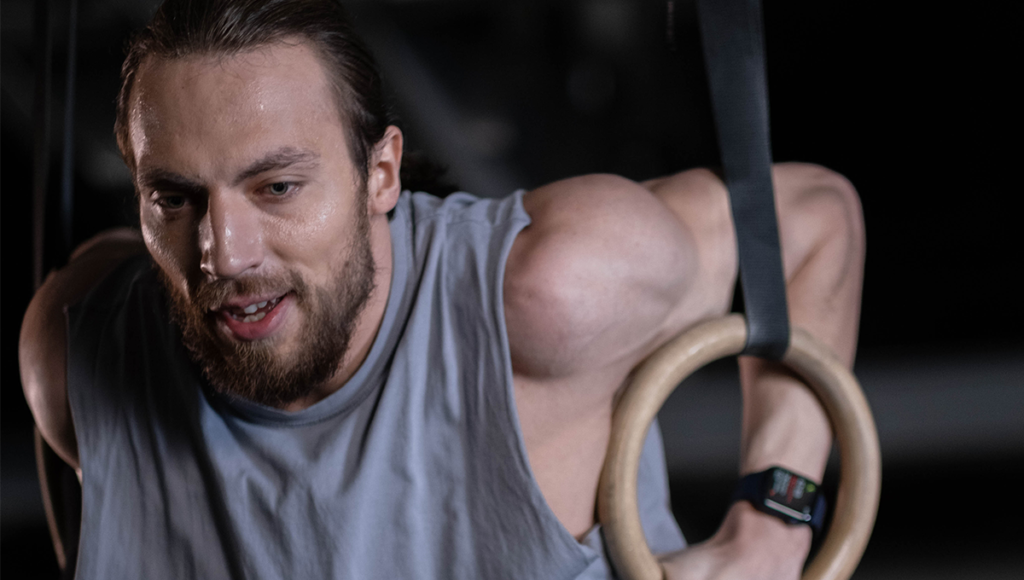
3. The Pull-Up (and Chest-to-Bar Variation)
Why Vertical Pulling Is Crucial for Shoulder Power
Powerful shoulders are not built by pressing alone. Balanced development requires strong pulling mechanics.
The pull-up is one of the most effective functional exercises for shoulder strength and stability.
EMG studies show high activation of the latissimus dorsi, lower trapezius, and biceps during pull-ups. The lower trapezius and serratus anterior play major roles in scapular depression and posterior tilt, both critical for shoulder health.
Research on scapular dyskinesis shows that insufficient lower trapezius activation can contribute to shoulder pain and dysfunction. Pull-ups train these stabilizers in a closed-chain environment.
Closed-chain exercises often improve joint stability and proprioception due to increased co-contraction around the joint.
Biomechanical Advantages
The pull-up trains:
- Shoulder adduction and extension
- Scapular depression and retraction
- Grip strength
- Core tension
In contrast to lat pulldowns, pull-ups require full-body stabilization. There is no seat or pad to brace against. That increases neuromuscular demand.
Chest-to-bar variations increase range of motion and scapular retraction demands, further challenging shoulder extensors and stabilizers.
Shoulder Health and Balanced Development
Research on strength ratios indicates that maintaining balanced strength between anterior and posterior shoulder musculature is important for injury prevention.
Overemphasis on pressing can lead to anterior dominance. Pull-ups counteract this by strengthening posterior structures.
Strong posterior shoulder muscles also help maintain proper humeral head positioning during overhead movement.
How to Perform a Strict Pull-Up
- Grip the bar slightly wider than shoulder-width.
- Hang with active shoulders (slight scapular depression).
- Pull elbows down and back.
- Bring chin over the bar (or chest to bar for advanced).
- Lower under control to full extension.
Avoid:
- Excessive swinging.
- Partial range of motion.
- Shrugging excessively at the bottom.
Programming for Strength

For maximal strength:
- 4–5 sets
- 3–6 reps
- Add weight if needed
For hypertrophy:
- 3–4 sets
- 6–10 reps
If strict pull-ups are not yet possible, use band assistance or controlled eccentric reps.
Why These Three Exercises Work Together
Each of these movements trains the shoulders differently:
- Strict press builds maximal strength.
- Push press builds power and rate of force development.
- Pull-ups build posterior strength and scapular control.
Together, they create a balanced, high-functioning shoulder complex.
Research consistently supports the idea that multi-joint, compound movements produce greater overall strength gains compared to isolation exercises. They also improve intermuscular coordination.
Functional fitness demands shoulders that can:
- Produce force
- Absorb force
- Stabilize under load
- Move efficiently through full range
These three exercises cover all those demands.
The Science of Progressive Overload and Shoulder Adaptation
Strength gains occur through a combination of neural adaptations and muscular hypertrophy.
Early improvements are largely neural: improved motor unit recruitment and coordination. Over time, increases in muscle cross-sectional area contribute more significantly.
Mechanical tension is a primary driver of hypertrophy. Compound exercises like presses and pull-ups create high levels of mechanical tension across multiple shoulder muscles.
Progressive overload remains essential:
- Increase load gradually.
- Increase volume strategically.
- Avoid sudden spikes in intensity.
Tendon adaptation occurs more slowly than muscle adaptation. Gradual progression reduces injury risk.
Common Mistakes That Limit Shoulder Power
Even great exercises can fail if executed poorly.
- Neglecting full range of motion
- Ignoring scapular control
- Overemphasizing pressing over pulling
- Training to failure too often
- Poor thoracic mobility
Thoracic extension plays a critical role in overhead positioning. Limited thoracic mobility can increase shoulder stress during pressing.
Mobility and strength must develop together.
Sample Weekly Shoulder-Focused Template
Day 1
Strict Overhead Press: 5 x 5
Weighted Pull-Ups: 4 x 5
Accessory: Lateral raises, 3 x 12
Day 2
Push Press: 6 x 3
Chest-to-Bar Pull-Ups: 4 x 6
Accessory: Face pulls, 3 x 12
This approach balances intensity, power, and structural support.
Final Thoughts
Building powerful shoulders is not about chasing isolation exercises or endless volume. It is about mastering fundamental movement patterns that challenge strength, power, and control.
The strict overhead press develops raw strength.
The push press builds explosive power.
The pull-up ensures balance and structural integrity.
These three exercises are supported by biomechanics, neuromuscular science, and practical transfer to real-world performance.
Train them consistently, progress intelligently, and your shoulders will not only look powerful — they will perform powerfully.
References
- Andersen, L.L., Andersen, J.L., Zebis, M.K. and Aagaard, P. (2010) ‘Effect of scapular function training on chronic pain in the neck/shoulder region’, Journal of Applied Physiology, 109(5), pp. 1470–1476.
- Behm, D.G. and Sale, D.G. (1993) ‘Velocity specificity of resistance training’, Sports Medicine, 15(6), pp. 374–388.
- Cools, A.M., Witvrouw, E.E., Declercq, G.A., Danneels, L.A. and Cambier, D.C. (2003) ‘Scapular muscle recruitment patterns: trapezius muscle latency with and without impingement symptoms’, American Journal of Sports Medicine, 31(4), pp. 542–549.
- Escamilla, R.F., Yamashiro, K., Paulos, L. and Andrews, J.R. (2009) ‘Shoulder muscle activity and function in common shoulder rehabilitation exercises’, Sports Medicine, 39(8), pp. 663–685.
- McGill, S.M., Karpowicz, A. and Fenwick, C.M.J. (2009) ‘Ballistic abdominal exercises and spine stability’, Journal of Strength and Conditioning Research, 23(3), pp. 733–741.
- Schoenfeld, B.J. (2010) ‘The mechanisms of muscle hypertrophy and their application to resistance training’, Journal of Strength and Conditioning Research, 24(10), pp. 2857–2872.