Building bigger biceps is one of the most common training goals in the gym. But in functional fitness and CrossFit-style training, pure isolation work like concentration curls often takes a back seat to multi-joint movements.
That does not mean you cannot grow your arms with functional training. In fact, some of the best biceps-building exercises are compound, athletic movements that challenge grip strength, core stability, coordination, and pulling power at the same time.


This article breaks down the three best functional fitness exercises for building bigger biceps — based on biomechanics, muscle activation research, and hypertrophy science. You will also learn how to program them effectively for maximum arm growth.
Understanding Biceps Growth: What the Science Says
Before choosing exercises, you need to understand what actually causes biceps hypertrophy.
The Role of Mechanical Tension
Mechanical tension is the primary driver of muscle growth. When muscle fibers are exposed to high levels of force — especially under stretch — they initiate signaling pathways that promote protein synthesis and hypertrophy.
Heavy resistance training increases muscle fiber recruitment, particularly high-threshold motor units associated with type II fibers, which have greater growth potential.

Training with moderate to heavy loads (roughly 6–12 repetitions per set) has consistently been shown to maximize hypertrophy when sets are taken close to failure.
Volume and Proximity to Failure
Total weekly training volume is one of the strongest predictors of muscle growth. Research shows that performing multiple sets per muscle group per week produces greater hypertrophy than a single set.
Additionally, training close to failure increases motor unit recruitment and metabolic stress, both important for maximizing growth.
Exercise Selection and Muscle Activation
The biceps brachii performs three main functions:
- Elbow flexion
- Forearm supination
- Shoulder flexion
Exercises that challenge elbow flexion under load — especially when the forearm is supinated — produce high biceps activation.
Electromyography (EMG) research consistently shows greater biceps activation during supinated pulling compared to pronated pulling.
Functional fitness movements that incorporate heavy supinated pulling, grip demand, and large ranges of motion can therefore drive serious biceps growth.
With that foundation, let’s break down the three best functional exercises for bigger biceps.
1. Weighted Chin-Ups
If you only did one exercise for biceps growth, weighted chin-ups would be a strong candidate.
Why Chin-Ups Build Big Biceps
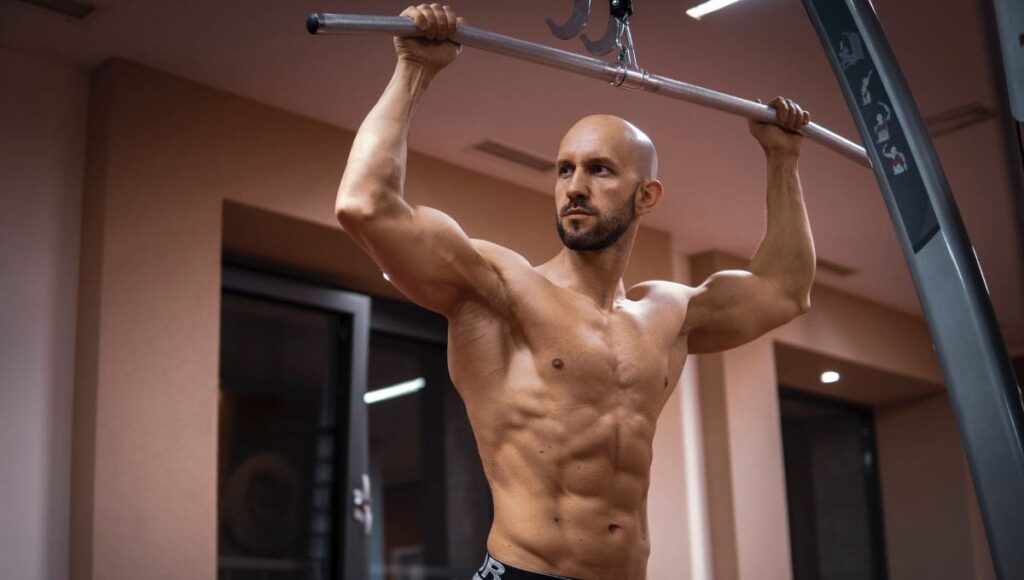
Chin-ups use a supinated grip (palms facing you). This increases biceps involvement compared to pronated pull-ups.
EMG studies show significantly higher biceps activation in supinated chin-ups compared to pronated pull-ups. The supinated grip aligns with the primary function of the biceps: elbow flexion combined with supination.
Chin-ups also allow for progressive overload. Once bodyweight becomes manageable, adding weight with a belt or vest dramatically increases mechanical tension — the primary driver of hypertrophy.
Unlike isolation curls, chin-ups load the biceps in a lengthened position at the bottom. Research suggests training muscles at longer muscle lengths may produce greater hypertrophy compared to shortened positions.
Functional Benefits
Weighted chin-ups also improve:
- Grip strength
- Lat strength
- Core stability
- Shoulder stability
In functional fitness settings, this translates directly to improved rope climbs, bar muscle-ups, and heavy pulling in workouts.
How to Perform Weighted Chin-Ups Correctly
- Use a shoulder-width supinated grip.
- Start from a dead hang with full elbow extension.
- Pull your chest toward the bar while keeping elbows driving down.
- Avoid excessive kipping or leg movement.
- Lower under control to full extension.
Control the eccentric (lowering) phase for at least 2–3 seconds to increase time under tension.
Programming for Biceps Growth
For hypertrophy:
- 3–5 sets
- 6–10 reps
- 2–3 minutes rest
- Train close to failure
You can also use slow eccentrics or paused reps to increase tension without excessive load.
If you cannot yet do bodyweight chin-ups, use band assistance or controlled eccentrics until you build the strength.
2. Barbell Bent-Over Rows (Supinated Grip)
Rows are often thought of as a back exercise. But when performed with a supinated grip and strict technique, they become a powerful biceps builder.
Why Supinated Rows Work
The biceps are strongly involved in elbow flexion during rowing movements. When you switch from a pronated to a supinated grip, biceps activation increases significantly.
Research comparing grip variations shows greater biceps brachii activation during supinated rows compared to pronated variations.

Unlike curls, barbell rows allow heavy loading. That means greater mechanical tension — a key ingredient for growth.
Supinated rows also load the biceps dynamically throughout a full range of motion, particularly when pulling the bar toward the lower ribs or upper abdomen.
The Functional Carryover
In functional fitness, pulling strength matters.
Supinated barbell rows improve:
- Deadlift lockout strength
- Clean pulls
- Midline stability
- Postural endurance
The bent-over position forces the core and posterior chain to stabilize, making this a total-body exercise with serious arm benefits.
Execution Tips
- Use a hip-width stance.
- Hinge at the hips until your torso is roughly 30–45 degrees forward.
- Grip the bar shoulder-width with palms facing up.
- Pull the bar toward your lower ribs.
- Lower under control.
Avoid jerking the bar with momentum. The goal is tension on the elbow flexors, not moving maximal weight with poor form.
Programming Guidelines
For hypertrophy:
- 3–4 sets
- 8–12 reps
- 90–120 seconds rest
Keep the reps controlled and avoid bouncing the bar off the torso.
If lower back fatigue becomes limiting, chest-supported supinated rows are an effective alternative that maintain biceps tension while reducing spinal loading.
3. Rope Climbs
Rope climbs are a staple in functional fitness. They are also severely underrated for biceps development.
The Biomechanics of Rope Climbing
Rope climbs combine:
- Elbow flexion
- Isometric grip
- Shoulder flexion
- Bodyweight resistance
Every pull requires powerful elbow flexion under load. The biceps work concentrically to pull you upward and eccentrically to control descent.
The thick rope increases grip demand, which enhances overall forearm and upper arm activation. High grip activation has been shown to increase neural drive to surrounding musculature, including elbow flexors.
Time Under Tension and Hypertrophy
Unlike single repetitions of a curl, rope climbs often involve prolonged time under tension. Each climb may last 15–30 seconds, especially when performed strictly.
Longer time under tension — when performed close to muscular failure — contributes to hypertrophic signaling through metabolic stress and sustained motor unit recruitment.
Strict rope climbs (minimal leg drive) place even greater demand on the biceps compared to J-hook assisted versions.
Functional Benefits
Rope climbs develop:
- Real-world pulling strength
- Grip endurance
- Upper body coordination
- Core control
Few exercises demand as much integrated upper-body strength.
How to Emphasize Biceps
To bias biceps growth:
- Use strict or minimal leg assistance
- Control your descent
- Perform partial climbs for higher reps
- Avoid excessive kipping
Slow eccentrics on the way down significantly increase biceps loading.
Programming Suggestions
For hypertrophy emphasis:
- 4–6 climbs
- 2–3 minutes rest
- Add weighted vest if advanced
Alternatively, perform rope pull-ups or seated rope pulls if full climbs are not available.
Why These Exercises Beat Isolation Alone
Isolation curls absolutely build muscle. But in functional fitness, time efficiency matters.
These three exercises:
- Allow heavier loading
- Recruit more total muscle mass
- Improve athletic performance
- Transfer directly to sport
Compound pulling movements recruit high-threshold motor units effectively. Research consistently shows that multi-joint exercises are at least as effective as isolation exercises for hypertrophy when volume is equated.
That does not mean you must eliminate curls. But if your goal is bigger arms within functional training, prioritize heavy supinated pulling first.
Optimizing Biceps Growth in Functional Training
Choosing the right exercises is only part of the equation.
Train at Long Muscle Lengths
Emerging evidence suggests that training muscles in lengthened positions enhances hypertrophy.
Chin-ups and rows load the biceps more in a stretched position compared to preacher curls or short-range cable work.
Focus on full extension at the bottom of each rep.
Use Progressive Overload
To grow, you must increase:
- Load
- Repetitions
- Total volume
- Time under tension
Track your chin-up weight and row strength weekly. Small increases compound over time.
Train Biceps Twice Per Week
Higher frequency training allows you to accumulate more high-quality volume.
You might include:
- Heavy chin-ups early in the week
- Rows and rope climbs later
Total weekly sets for direct and indirect biceps work should fall between 10–20 sets for most athletes.
Take Sets Close to Failure
Stopping too far from failure reduces motor unit recruitment.
For hypertrophy:
- Leave 0–2 reps in reserve
- Avoid grinding maximal singles
- Focus on controlled, challenging sets
Sample Functional Biceps-Focused Session
Warm-Up
Light band curls
Scapular pull-ups
Shoulder mobility
Strength Block
Weighted Chin-Ups
4 x 8
Supinated Barbell Rows
4 x 10
Accessory
Strict Rope Climbs
5 climbs

Optional Finisher
Slow eccentric chin-ups
3 x 5
This structure emphasizes mechanical tension first, then metabolic stress.
Recovery and Nutrition for Bigger Biceps
Training is only half the equation.
Protein Intake
Muscle protein synthesis is maximized with adequate daily protein intake. Research supports consuming roughly 1.6–2.2 grams of protein per kilogram of bodyweight per day to optimize hypertrophy.
Distribute protein evenly across meals.
Caloric Surplus
To maximize muscle growth, a small caloric surplus is beneficial. Severe deficits impair hypertrophy even with adequate protein.
Sleep
Sleep restriction reduces muscle protein synthesis and impairs recovery. Aim for 7–9 hours per night.
Common Mistakes That Limit Biceps Growth
- Only doing high-rep metabolic workouts
- Never training heavy
- Avoiding supinated pulling
- Not progressing load
- Relying solely on kipping movements
Functional fitness often emphasizes conditioning. But hypertrophy requires intentional tension and progression.
Final Thoughts
You do not need endless curls to build bigger biceps.
Weighted chin-ups, supinated barbell rows, and rope climbs deliver:
- High mechanical tension
- Strong biceps activation
- Functional carryover
- Progressive overload potential
Train them hard, train them consistently, eat enough, and recover properly.
If you apply the principles outlined above, your arms will grow — and your pulling strength will skyrocket at the same time.
References
- Burd, N.A., Andrews, R.J., West, D.W.D., Little, J.P., Cochran, A.J.R., Hector, A.J., Cashaback, J.G.A., Gibala, M.J., Potvin, J.R., Baker, S.K. and Phillips, S.M., 2012. Muscle time under tension during resistance exercise stimulates differential muscle protein sub-fractional synthetic responses in men. The Journal of Physiology, 590(2), pp.351–362.
- Dankel, S.J., Jessee, M.B., Mattocks, K.T., Mouser, J.G., Counts, B.R., Buckner, S.L. and Loenneke, J.P., 2017. Training to fatigue: the answer for standardization when assessing muscle hypertrophy? Sports Medicine, 47(6), pp.1021–1027.
- Gentil, P., Soares, S. and Bottaro, M., 2015. Single vs. multi-joint resistance exercises: effects on muscle strength and hypertrophy. Asian Journal of Sports Medicine, 6(2), e24057.
- Grgic, J., Schoenfeld, B.J., Orazem, J. and Sabol, F., 2018. Effects of resistance training performed to repetition failure or non-failure on muscular strength and hypertrophy: a systematic review and meta-analysis. Journal of Sport and Health Science, 10(2), pp.202–211.
- Maeo, S., Ando, Y., Kanehisa, H. and Kawakami, Y., 2021. Greater hypertrophy in response to lengthened compared to shortened muscle position resistance training: a systematic review and meta-analysis. Sports Medicine, 51(1), pp.1–15.
- Schoenfeld, B.J., 2010. The mechanisms of muscle hypertrophy and their application to resistance training. Journal of Strength and Conditioning Research, 24(10), pp.2857–2872.