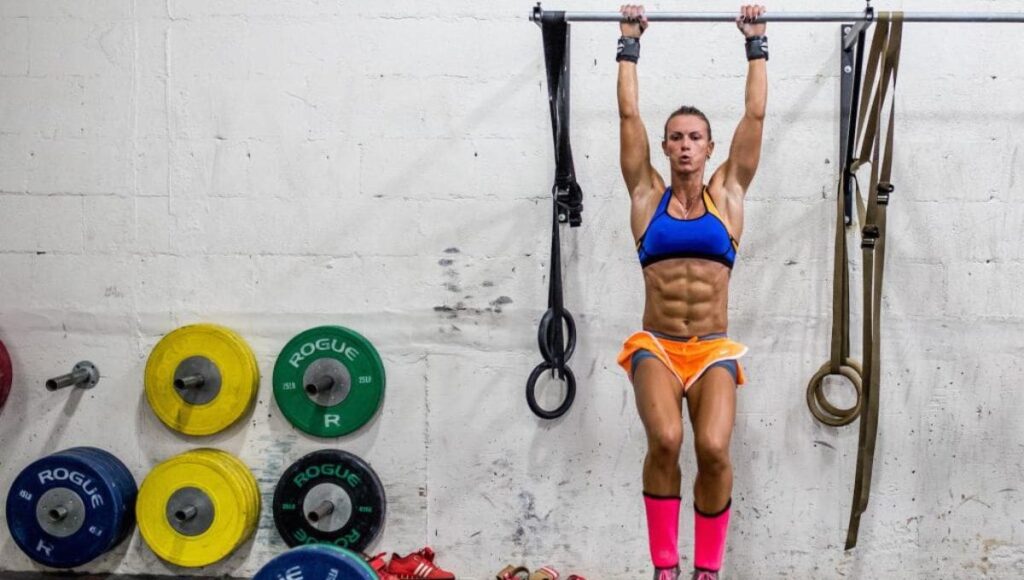
Achieving washboard abs requires a combination of effective training, proper nutrition, and low body fat levels. While diet plays a crucial role, the right exercises can help develop core strength and muscle definition.
The following six exercises are backed by science to optimise abdominal engagement and hypertrophy, helping you build a strong and defined midsection.
1. Hanging Leg Raises
Hanging leg raises are one of the most effective exercises for developing the lower abdominals. Research has shown that hanging leg raises elicit significant activation in the rectus abdominis and obliques compared to traditional floor-based movements (Escamilla et al., 2006). The movement requires core stability and strength, forcing the abdominal muscles to work harder to lift and control the legs.
How to Perform:
- Hang from a pull-up bar with an overhand grip.
- Engage your core and slowly lift your legs until they form a 90-degree angle with your torso.
- Lower them back down under control to avoid momentum.
- For increased difficulty, perform toes-to-bar or use ankle weights.
2. Ab Rollouts
Ab rollouts using an ab wheel or barbell challenge core stability by engaging both the rectus abdominis and deep core muscles (Freeman et al., 2006). This exercise promotes anti-extension, which is crucial for spinal stability and injury prevention.
How to Perform:
- Kneel on the floor with an ab wheel or barbell in front of you.
- Engage your core and slowly roll forward, extending your body as far as possible without losing control.
- Pause briefly and return to the starting position using your core muscles.
- Keep the movement slow and controlled to maximise core engagement.
3. Cable Rope Crunches
Cable rope crunches effectively load the rectus abdominis, leading to increased hypertrophy. Research suggests that resistance-based abdominal exercises can stimulate greater muscle growth compared to bodyweight movements (Schoenfeld et al., 2018).
How to Perform:
- Attach a rope to a high pulley cable machine and kneel in front of it.
- Hold the rope with both hands near your head and crunch down towards your knees.
- Squeeze your abs at the bottom of the movement before slowly returning to the starting position.
- Focus on keeping the movement controlled and avoiding momentum.
4. Weighted Decline Sit-Ups
Adding resistance to decline sit-ups increases the intensity and muscular recruitment of the abdominals. A study by Youdas et al. (2008) found that decline sit-ups activate the rectus abdominis more effectively than standard sit-ups.
How to Perform:
- Secure your feet on a decline bench.
- Hold a weight plate against your chest.
- Perform a controlled sit-up, engaging your core and avoiding jerky movements.
- Slowly return to the starting position and repeat.
5. Russian Twists
Russian twists target the obliques, which are crucial for overall core development and rotational strength. Research has found that rotational movements engage the external and internal obliques significantly more than traditional flexion-based exercises (McGill, 2010).
How to Perform:
- Sit on the floor with your knees bent and feet elevated.
- Hold a weight plate or medicine ball with both hands.
- Twist your torso from side to side, keeping your core engaged.
- Avoid excessive momentum to ensure maximum muscle activation.
6. Hanging Windshield Wipers
Hanging windshield wipers are a highly advanced exercise that targets the entire core, including the rectus abdominis, obliques, and transverse abdominis. According to research, exercises that involve anti-rotation and stability demand increase overall core function (Sharma et al., 2018).
How to Perform:
- Hang from a pull-up bar with an overhand grip.
- Raise your legs to a 90-degree angle and rotate them side to side in a controlled motion.
- Maintain tension in your core and avoid excessive swinging.
- Lower back to the centre and repeat.
Conclusion
Incorporating these six exercises into your training routine will help develop washboard abs by targeting all areas of the core.
Each movement is backed by research and focuses on maximising muscular engagement, hypertrophy, and stability. However, achieving visible abs requires maintaining a low body fat percentage through proper nutrition and overall energy balance.
Key Takeaways
| Exercise | Main Benefits |
|---|---|
| Hanging Leg Raises | Targets lower abs, improves core stability |
| Ab Rollouts | Engages deep core muscles, enhances anti-extension strength |
| Cable Rope Crunches | Increases abdominal hypertrophy with resistance |
| Weighted Decline Sit-Ups | Enhances rectus abdominis activation and muscle growth |
| Russian Twists | Strengthens obliques and improves rotational power |
| Hanging Windshield Wipers | Develops total core control and anti-rotation strength |
Bibliography
- Escamilla, R.F., Babb, E., DeWitt, R., Jew, P., Kelleher, P., Burnham, T., Busch, J., D’Anna, K., & Moorman, C.T. (2006). Electromyographic analysis of traditional and non-traditional abdominal exercises: Implications for rehabilitation and training. Journal of Orthopaedic & Sports Physical Therapy, 36(1), pp. 45-57.
- Freeman, S., Karpowicz, A., Gray, J., & McGill, S. (2006). Quantifying muscle patterns and spine load during various forms of the push-up. Medicine & Science in Sports & Exercise, 38(3), pp. 570-577.
- McGill, S.M. (2010). Core training: Evidence translating to better performance and injury prevention. Strength and Conditioning Journal, 32(3), pp. 33-46.
- Schoenfeld, B.J., Wilson, J.M., Lowery, R.P., & Krieger, J.W. (2018). Muscular adaptations in low- versus high-load resistance training: A meta-analysis. European Journal of Sport Science, 18(3), pp. 267-278.
- Sharma, A., Geov, J., Kim, J., & Jo, H. (2018). Effects of different core exercises on trunk muscle activity and balance control. Journal of Sports Science and Medicine, 17(2), pp. 212-218.
- Youdas, J.W., Coleman, J.M., Hollman, J.H., & Krause, D.A. (2008). Surface electromyographic analysis of trunk muscle activity during traditional and modified sit-up exercises. Journal of Strength and Conditioning Research, 22(4), pp. 950-956.