

A strong core is more than just a chiseled midsection; it’s a foundation for stability, posture, athletic performance, and injury prevention. Two of the most popular bodyweight exercises for targeting the core are sit ups and the plank.
[wpcode id=”229888″]But which one is more effective? The answer lies in understanding how each exercise activates muscles, builds endurance or strength, and contributes to overall functional fitness. This article explores the physiological, biomechanical, and practical distinctions between sit ups and planks, referencing peer-reviewed studies and empirical evidence to determine which is better for developing a stronger core.
Understanding the Core

The Anatomy of the Core
The core includes more than just the rectus abdominis (“six-pack”). It encompasses the transverse abdominis, internal and external obliques, erector spinae, multifidus, diaphragm, pelvic floor, and even the glutes. Effective core training should target these muscle groups synergistically. A study by Akuthota and Nadler (2004) emphasized the importance of core stability in both athletic performance and injury prevention, underscoring the need for comprehensive core engagement.
Core Function
The primary function of the core is stabilization—keeping the spine and pelvis aligned during movement. It also plays a role in force transmission between the upper and lower body. Exercises that promote isometric strength (like the plank) and dynamic movement (like sit ups) each train the core differently, influencing their efficacy depending on the training goal.
The Sit Up: Mechanics and Efficacy

How Sit Ups Work
Sit ups involve dynamic spinal flexion, where the rectus abdominis contracts to lift the torso off the ground. Secondary muscles include the hip flexors (especially the iliopsoas) and the obliques. Variations like weighted sit ups and decline sit ups increase intensity and range of motion.
Benefits
- Rectus Abdominis Activation: Sit ups heavily recruit the rectus abdominis. According to Escamilla et al. (2006), sit ups generate significant activation of this muscle group, particularly in comparison to static exercises.
- Dynamic Movement: As a movement-based exercise, sit ups improve muscular endurance and flexibility in the lumbar spine.
- Simplicity and Accessibility: Minimal space and no equipment are needed, making sit ups convenient for most users.
Limitations
- Spinal Compression: The repetitive flexion of the lumbar spine may lead to spinal disc issues over time, especially if performed with poor form. McGill (2007) highlighted that repeated spinal flexion is a leading contributor to disc herniation.
- Hip Flexor Dominance: When the rectus abdominis fatigues, the hip flexors can dominate the movement, reducing core effectiveness.
- Limited Core Engagement: Sit ups predominantly target the rectus abdominis and overlook the transverse abdominis and multifidus.
The Plank: Mechanics and Efficacy
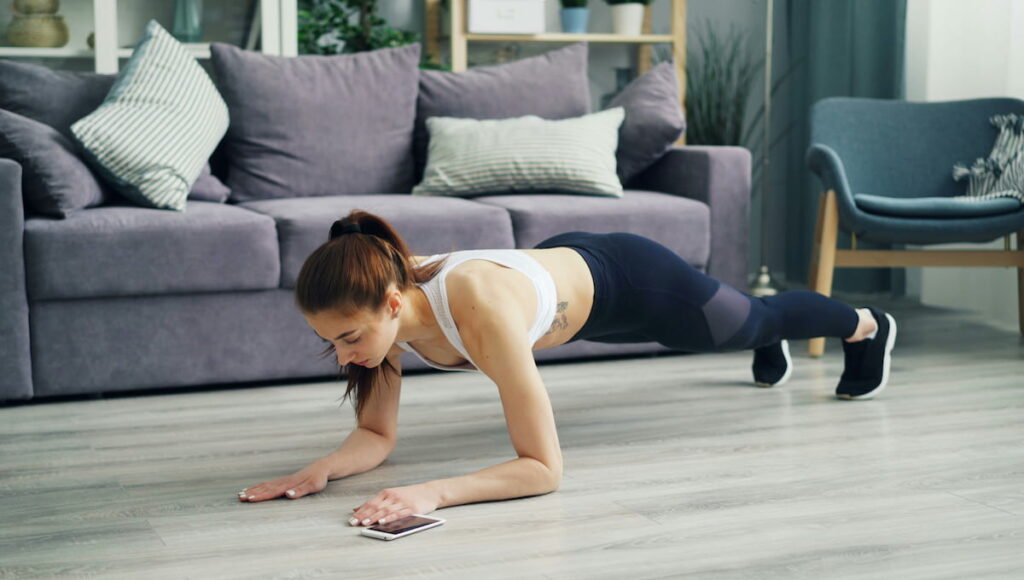
How Planks Work
Planks are isometric exercises where the body is held in a straight line from head to heels. Core muscles work to maintain spinal alignment without movement. The transverse abdominis, rectus abdominis, obliques, and multifidus are all engaged. Planks can be performed in various forms: forearm, side, extended, and dynamic variations such as plank shoulder taps.
Benefits
- Global Core Activation: A study by Ekstrom et al. (2007) found that planks activate the transverse abdominis and multifidus more effectively than sit ups.
- Spinal Safety: As there is no spinal flexion, the risk of disc injury is significantly lower. McGill (2001) recommended planks as a spine-friendly core stabilization exercise.
- Functional Stability: Planks mimic the core’s primary function: stabilization. This translates better to most athletic and everyday movements.
Limitations
- Progression Challenges: Once a basic plank is mastered, progression requires creative variation rather than increased load or range of motion.
- Static Nature: Planks may not train the core through its full range of motion, limiting dynamic strength development.
- Form Degradation: Poor technique due to fatigue can compromise effectiveness and cause shoulder or lower back strain.
Scientific Comparison: Sit Ups vs Plank
Muscle Activation Studies
- Rectus Abdominis: According to a comparative electromyography (EMG) study by Vera-Garcia et al. (2000), sit ups show higher activation of the rectus abdominis, particularly in the concentric phase.
- Transverse Abdominis and Obliques: The same study found greater activation of the transverse abdominis and internal obliques during plank exercises.
- Multifidus and Erector Spinae: Ekstrom et al. (2007) demonstrated that planks elicit higher engagement from posterior stabilizing muscles, contributing to lower back health.
Spinal Load and Injury Risk
- Sit Ups: McGill (2007) estimated that a single sit up can impose a compressive load of 3,300N on the lumbar spine, nearing the limit of safety thresholds.
- Planks: Planks distribute load evenly across the spine and are thus favored for rehabilitation and long-term spinal health.
Endurance vs Strength
- Planks for Endurance: A randomized trial by Hibbs et al. (2008) showed that planks significantly improved core endurance, which correlates with lower injury risk.
- Sit Ups for Strength: Dynamic movements like sit ups provide hypertrophic stimuli to superficial core muscles but do not significantly improve endurance.
Practical Considerations
Goals and Athlete Type
- General Fitness: For overall fitness and injury prevention, planks are superior due to comprehensive core activation and spinal safety.
- Bodybuilding: Sit ups may be better for hypertrophy of the rectus abdominis, especially when loaded.
- Rehabilitation: Planks are often prescribed in physical therapy for patients with lower back pain or postural issues due to their safety and efficacy.
- Sport-Specific Training: Athletes requiring explosive core movement (e.g., gymnasts or wrestlers) may benefit from incorporating both exercises strategically.
Progression and Programming
- Plank Progressions: Side planks, RKC planks, weighted planks, and instability tools (e.g., Swiss ball) can add challenge.
- Sit Up Variations: Weighted, twisting, V-ups, or incline sit ups can intensify the movement, but care must be taken with spinal alignment.
- Combined Approaches: Periodizing core training to include both isometric and dynamic movements leads to more robust development.
Individual Differences
- Injury History: Those with lumbar disc issues or spinal instability should avoid sit ups in favor of planks.
- Postural Deficiencies: Planks correct anterior pelvic tilt and poor posture more effectively due to posterior chain engagement.
- Time Efficiency: A well-performed 60-second plank can engage more muscle groups in less time than a set of sit ups.
Conclusion: Which Is Better?
The answer depends on the individual’s goals, current fitness level, and injury history. Scientifically, planks provide more comprehensive core engagement, lower injury risk, and superior transfer to functional movement. Sit ups, while effective for isolating the rectus abdominis, carry a higher risk of spinal stress and offer limited activation of deeper stabilizers. For a stronger and more functional core, the plank holds the edge. However, the most effective core training programs incorporate both types of exercises alongside compound lifts, rotational movements, and anti-rotational drills for balanced development.
Bibliography
Akuthota, V. and Nadler, S. F., 2004. Core strengthening. Archives of physical medicine and rehabilitation, 85(3), pp.86-92.
Escamilla, R. F., McTaggart, M. S., Fricklas, E. J., DeWitt, R., Kelleher, P., Taylor, M. K., Hreljac, A. and Moorman, C. T., 2006. An electromyographic analysis of commercial and common abdominal exercises: implications for rehabilitation and training. The Journal of Orthopaedic and Sports Physical Therapy, 36(2), pp.45-57.
Ekstrom, R. A., Donatelli, R. A. and Carp, K. C., 2007. Electromyographic analysis of core trunk, hip, and thigh muscles during 9 rehabilitation exercises. Journal of Orthopaedic and Sports Physical Therapy, 37(12), pp.754-762.
Hibbs, A. E., Thompson, K. G., French, D. N., Wrigley, A. and Spears, I. R., 2008. Optimizing performance by improving core stability and core strength. Sports Medicine, 38(12), pp.995-1008.
McGill, S. M., 2001. Low back stability: from formal description to issues for performance and rehabilitation. Exercise and Sport Sciences Reviews, 29(1), pp.26-31.
McGill, S. M., 2007. Low Back Disorders: Evidence-Based Prevention and Rehabilitation. 2nd ed. Champaign, IL: Human Kinetics.
Vera-Garcia, F. J., Grenier, S. G. and McGill, S. M., 2000. Abdominal muscle response during curl-ups on both stable and labile surfaces. Physical Therapy, 80(6), pp.564-569.