

Sprinting is one of the purest expressions of athletic power. Whether you are chasing a new 100-meter PR, trying to accelerate past a defender, or improving your CrossFit performance, faster sprinting comes down to one thing: producing more force into the ground in less time.
That’s not opinion. It’s biomechanics.
Research consistently shows that sprint velocity is primarily determined by how much horizontal force an athlete can apply to the ground and how effectively they can do it during extremely short ground contact times. The faster you sprint, the less time your foot spends on the ground—often under 100 milliseconds at top speed. If you cannot generate high force quickly, you will not sprint fast.
Functional fitness athletes often train strength and conditioning, but not all exercises transfer equally to sprinting performance. To sprint faster, your training must improve:
- Horizontal force production
- Rate of force development
- Posterior chain power
- Lower limb stiffness and reactive strength
- Intermuscular coordination
This article breaks down the three best functional fitness exercises for faster sprinting, backed by scientific evidence. No fluff. Just what works.
The Science of Sprinting: What Actually Makes You Faster?
Before diving into the exercises, it’s important to understand what sprinting performance depends on.
Force Production Is King
Research analyzing elite sprinters shows that faster athletes do not necessarily move their legs faster. Instead, they apply greater force to the ground, especially in the horizontal direction. Faster sprinters produce higher ground reaction forces and maintain force application as velocity increases.

Studies examining sprint mechanics show that maximal sprint velocity is strongly correlated with the ability to generate high horizontal force during acceleration and high vertical force at top speed.
In simple terms:
- Acceleration = horizontal force dominance
- Max velocity = vertical force dominance
- Both require high force in very short time windows
Rate of Force Development (RFD)
You do not have 500 milliseconds to produce force during sprinting. You have roughly 80–150 milliseconds depending on speed. That means strength alone is not enough. You need to produce force rapidly.
Research shows that rate of force development and explosive strength are critical determinants of sprint performance, particularly in acceleration phases.
Stiffness and Elastic Return
At top speed, sprinting becomes increasingly elastic. The ankle and lower leg act like springs. Tendon stiffness and reactive strength contribute significantly to sprint velocity. Athletes who can store and release elastic energy efficiently tend to run faster.
With that framework in mind, let’s look at the three most effective functional fitness exercises for faster sprinting.
1. Heavy Barbell Hip Thrusts
If you want to sprint faster, you need a stronger and more powerful posterior chain. And when it comes to horizontal force production, few exercises rival the barbell hip thrust.
Why Hip Thrusts Improve Sprint Speed
The hip thrust directly trains hip extension—the primary movement responsible for propulsion during sprinting.
Electromyography (EMG) studies show that the hip thrust produces high levels of gluteus maximus activation. The glutes are the largest hip extensors and are heavily involved in both acceleration and maximal sprinting.
Biomechanical analyses show that during sprint acceleration, the hip extensors are critical for producing backward-directed force. Athletes with greater hip extensor strength tend to demonstrate better sprint acceleration.
Research comparing hip thrust strength to sprint performance has found strong correlations between hip thrust 1RM strength and sprint acceleration performance. Athletes with stronger hip thrusts typically sprint faster over short distances.
Horizontal Force Transfer
One reason the hip thrust transfers well to sprinting is joint angle specificity.
Unlike the back squat, which loads the athlete vertically and emphasizes deeper knee flexion, the hip thrust loads the hips in a more horizontal plane and at angles similar to late-stance sprinting mechanics.
Research examining force vector theory suggests that exercises that more closely match the direction of force application in sport may have superior transfer. Sprint acceleration requires high horizontal force, and hip thrusts emphasize horizontal force production.
Evidence Supporting Hip Thrusts for Sprinting
Intervention studies have shown that athletes who improved hip thrust strength also improved sprint times. Heavy hip thrust training has been shown to significantly enhance sprint acceleration over short distances.
Additionally, studies comparing hip thrusts and squats suggest that hip thrust training may lead to greater improvements in short sprint performance than squats alone, likely due to its horizontal force emphasis.
How to Program Hip Thrusts for Sprint Speed
To maximize transfer:
- Load heavy (3–6 reps per set)
- Focus on maximal intent on the concentric phase
- Use full hip extension
- Rest 2–3 minutes between sets
A simple protocol:
4–5 sets of 3–5 reps at 80–90% 1RM
Explode up, controlled down
Train them 1–2 times per week.
2. Sled Pushes and Sled Sprints
If acceleration is your weakness, sled training may be the most direct way to improve it.
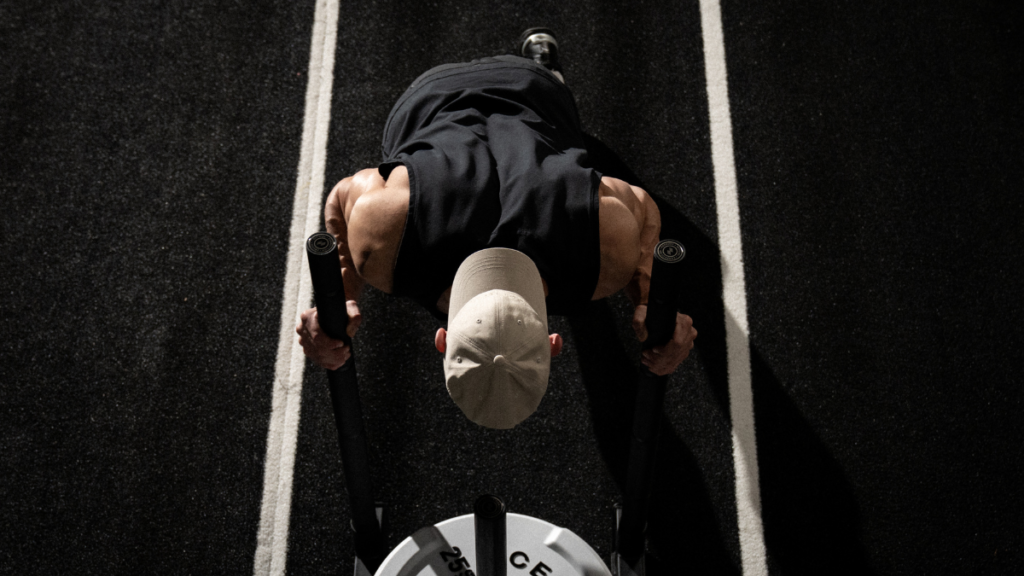
Why Sled Work Improves Acceleration
During early acceleration, sprinting requires high horizontal force production and forward body lean. Sled pushes and sled sprints overload this exact pattern.
Research shows that resisted sprint training increases horizontal force application during acceleration. Athletes who train with sled resistance often improve short sprint times, particularly over 10–20 meters.
Unlike traditional strength exercises, sled work preserves sprint mechanics while increasing force demands.
Horizontal Force and Technical Reinforcement
Sled training encourages:
- Greater forward lean
- Stronger backward push
- Longer force application times
These are critical during early acceleration.
Biomechanical studies show that sprint acceleration performance is strongly associated with the ability to orient force horizontally. Sled training reinforces this orientation under load.
Optimal Loading for Sprint Transfer
Research suggests that moderate to heavy sled loads (reducing sprint velocity by 10–50%) can significantly improve acceleration performance.
Heavier loads appear particularly effective for early acceleration improvements. Lighter loads may be better for maintaining mechanics at higher velocities.
A key finding in resisted sprint research is that sled loads individualized to an athlete’s force-velocity profile produce the greatest improvements.
Evidence Supporting Sled Training
Multiple studies have shown that resisted sprint training improves:
- 10-meter sprint time
- 20-meter sprint time
- Horizontal force production
- Rate of force development
Systematic reviews conclude that resisted sprint training is an effective method for improving acceleration performance across team sport athletes.
How to Program Sled Work
For acceleration focus:
- 6–10 sprints
- 10–20 meters
- Load that reduces velocity by 20–40%
- Full recovery (2–3 minutes)
Perform 1–2 times per week.
Quality over fatigue.
3. Depth Jumps and Reactive Plyometrics
Once acceleration improves, top speed becomes the limiter. And top speed is largely about stiffness and reactive strength.
This is where depth jumps come in.
Why Reactive Strength Matters
At maximal sprint speed:
- Ground contact times are extremely short
- Vertical forces are extremely high
- Elastic energy return is critical
Research shows that sprint velocity is strongly correlated with reactive strength index (RSI), a measure of explosive power during stretch-shortening cycle actions.
Athletes who can absorb force and reapply it rapidly tend to sprint faster.
Depth Jumps and the Stretch-Shortening Cycle
Depth jumps involve stepping off a box and immediately rebounding upward upon ground contact. This trains:
- Rapid force absorption
- High eccentric stiffness
- Explosive concentric output
- Neuromuscular efficiency
Studies show that plyometric training significantly improves sprint performance, particularly maximal velocity.
Meta-analyses confirm that plyometric training improves sprint speed in athletes across multiple sports.
Tendon Stiffness and Elastic Return
Research indicates that increased Achilles tendon stiffness is associated with improved sprinting performance.
Plyometric training enhances tendon stiffness and neuromuscular efficiency, both critical for high-speed sprinting.
Unlike heavy strength training, plyometrics specifically improve the stretch-shortening cycle, which dominates top-speed sprinting.
Evidence Supporting Plyometrics for Sprinting
Intervention studies consistently show that plyometric training improves:
- 10-meter sprint times
- 20-meter sprint times
- 40-meter sprint times
- Maximal velocity
Depth jumps are particularly effective due to their high eccentric demand and rapid transition requirement.
How to Program Depth Jumps
Keep quality high.
- 3–5 sets
- 3–5 reps per set
- Box height 12–24 inches
- Full recovery (2–3 minutes)
Focus on minimal ground contact time and maximal rebound height.
Perform 1–2 times per week.
Why These Three Exercises Work Together
Each of these exercises targets a specific sprint quality:
- Hip thrusts = maximal horizontal force production
- Sled sprints = acceleration-specific force application
- Depth jumps = reactive strength and stiffness
Together, they improve:
- Acceleration
- Max velocity
- Force production
- Rate of force development
- Elastic efficiency
Research consistently shows that combining heavy strength training with plyometrics produces superior sprint improvements compared to either alone.
This combination enhances both maximal force and explosive transfer.
What About Squats, Olympic Lifts, and Deadlifts?
Traditional lifts absolutely improve sprint performance. Studies show strong correlations between squat strength and sprint speed.

However, the three exercises listed above offer higher specificity:
- Hip thrusts emphasize horizontal force.
- Sled work overloads acceleration mechanics.
- Depth jumps target top-speed reactive strength.
That does not mean you should abandon squats or cleans. It means if sprinting speed is your priority, these three movements deserve focus.
Practical Weekly Template for Functional Fitness Athletes
Example:
Day 1
Heavy Hip Thrusts
Sled Sprints
Accessory posterior chain work
Day 2
Depth Jumps
Max velocity sprint work
Light strength work
Keep total sprint volume controlled. Quality and recovery matter.
Common Mistakes That Kill Sprint Gains
- Training sprint speed while fatigued
- Using sled loads that destroy mechanics
- Doing too much plyometric volume
- Ignoring rest intervals
- Neglecting maximal strength
Sprint performance is neural. It requires high quality output.
Final Thoughts
Faster sprinting is not about moving your legs faster. It is about applying more force into the ground in less time and directing that force correctly.
The three best functional fitness exercises for faster sprinting are:
- Heavy barbell hip thrusts
- Sled pushes or sled sprints
- Depth jumps
Each is supported by scientific evidence. Each targets a specific sprint performance quality. And together, they create a powerful transfer to real-world speed.
If your goal is to sprint faster, train for force. Train for speed. Train with intent.
Then sprint.
Key Takeaways
| Exercise | Primary Benefit | Sprint Phase Improved | Programming Focus |
|---|---|---|---|
| Barbell Hip Thrust | Max horizontal force and glute strength | Acceleration | 3–5 reps, heavy load, explosive intent |
| Sled Push/Sprint | Horizontal force application and acceleration mechanics | Early acceleration (0–20m) | 6–10 sprints, 10–20m, full recovery |
| Depth Jumps | Reactive strength and stiffness | Max velocity | 3–5 sets of 3–5 reps, minimal ground contact |
References
- Bezodis, I.N., Salo, A.I.T. and Trewartha, G. (2014) ‘Relationships between lower-limb kinematics and sprint velocity in high-level sprinters’, Journal of Sports Sciences, 32(9), pp. 834–842.
- Cronin, J., Hansen, K. and Kawamori, N. (2008) ‘Effects of weighted sled towing on sprint kinematics’, Journal of Strength and Conditioning Research, 22(4), pp. 1248–1254.
- Cross, M.R., Brughelli, M., Samozino, P., Brown, S.R., Morin, J.B. and Samozino, P. (2017) ‘Optimal loading for maximizing power during sled-resisted sprinting’, International Journal of Sports Physiology and Performance, 12(8), pp. 1069–1077.
- Delecluse, C. (1997) ‘Influence of strength training on sprint running performance’, Sports Medicine, 24(3), pp. 147–156.
- Markovic, G. (2007) ‘Does plyometric training improve vertical jump height? A meta-analytical review’, British Journal of Sports Medicine, 41(6), pp. 349–355.
- Morin, J.B., Bourdin, M., Edouard, P., Peyrot, N., Samozino, P. and Lacour, J.R. (2012) ‘Mechanical determinants of 100-m sprint running performance’, European Journal of Applied Physiology, 112(11), pp. 3921–3930.