Rotation is one of the most overlooked elements in strength training. Yet, nearly every athletic movement — sprinting, throwing, striking, cutting, even walking — relies on the ability to create, control, and resist rotational force. If you train but ignore rotation, you are leaving strength, power, and resilience on the table.
Kettlebells are uniquely suited for rotational training. Their offset center of mass increases torque demands, challenges stability, and forces the body to coordinate force production through the hips, core, and shoulders. When used correctly, kettlebells develop rotational power, anti-rotational strength, and transverse plane control in ways that traditional barbells and machines cannot.


This article breaks down the three best kettlebell rotation exercises, explains why they work, and backs every key point with scientific evidence. You will also learn how to perform them correctly, how to program them, and why they matter for both performance and injury prevention.
Why Rotational Training Matters
Human Movement Is Three-Dimensional
Most gym programs focus on the sagittal plane: squats, deadlifts, presses, and curls. However, sport and life occur in all three planes of motion. The transverse plane, where rotation occurs, is essential for transferring force from the lower body to the upper body.

Research on trunk muscle function shows that rotational and anti-rotational control is central to efficient movement and spinal stability. The deep core muscles, including the transverse abdominis and internal obliques, activate in anticipation of limb movement to stabilize the spine. This feed-forward mechanism helps maintain spinal integrity during dynamic tasks.
When you train rotation, you improve the coordination between hips, torso, and shoulders — often referred to as the kinetic chain.
Rotational Power Drives Athletic Performance
Throwing velocity, bat speed, and change-of-direction ability all depend on rotational power. Studies examining rotational medicine ball throws show strong correlations between trunk rotational power and sport performance markers.
Hip and trunk rotation are especially important because the hips generate force that is transferred through the core to the upper extremities. Research on baseball pitching and golf swings consistently demonstrates that effective sequencing of hip-to-torso rotation is critical for maximizing power output while minimizing stress on the shoulder and elbow.
Kettlebell rotational exercises train that sequencing.
Rotational Strength Reduces Injury Risk
Low back pain and many non-contact athletic injuries are associated with poor trunk control and insufficient hip function. Research shows that deficits in core endurance and rotational stability increase injury risk in athletes.
Additionally, excessive or uncontrolled spinal rotation under load can contribute to disc stress. Training the ability to resist unwanted rotation — anti-rotation — is just as important as producing it.
Kettlebells, because of their dynamic nature and offset load, are excellent tools for teaching both rotation and anti-rotation.
What Makes Kettlebells Ideal for Rotation?
Offset Center of Mass
Unlike dumbbells, kettlebells have a displaced center of mass. This increases rotational torque and challenges joint stability, especially at the shoulder and core.
Studies examining kettlebell swings show high activation of the posterior chain and significant demands on trunk musculature compared to traditional resistance exercises.
Ballistic and Grind Capabilities
Kettlebells allow both ballistic (dynamic) and grind (slow, controlled) movements. Ballistic movements improve rate of force development — a key marker of athletic performance. Grind movements enhance time under tension and motor control.
Research shows that ballistic training improves power output and neuromuscular efficiency, especially when hip extension is emphasized.
Grip and Shoulder Stability
Grip strength correlates strongly with overall strength and even long-term health outcomes. Kettlebell movements demand sustained grip engagement, which increases neuromuscular drive throughout the upper body.
Shoulder stability is also enhanced because the load constantly pulls the arm into external rotation and downward force, requiring co-contraction of stabilizing muscles.
Now let’s break down the three best rotational kettlebell exercises.
1. Kettlebell Rotational Swing (Transverse Swing)
The rotational swing builds explosive hip power while teaching the body to transfer force diagonally across the torso.
Why It Works
The standard kettlebell swing is primarily sagittal. By adding rotation, you integrate transverse plane power and improve coordination between hips and core.

Hip-driven ballistic training has been shown to significantly increase power output and vertical jump performance. When rotation is added, you train the obliques and deep stabilizers to transmit force efficiently.
Electromyography (EMG) studies show that kettlebell swings activate the gluteus maximus and hamstrings at high levels, comparable to or exceeding traditional strength exercises. Adding rotation increases oblique activation due to the transverse loading pattern.
How to Perform It
- Start in a hip-hinged position with the kettlebell between your legs.
- Hike the bell back like a standard swing.
- As you drive the hips forward, allow your torso and hips to rotate slightly toward the side opposite the working arm.
- The bell travels diagonally across the body.
- Keep the spine neutral. Rotation comes from the hips and thoracic spine, not lumbar flexion.
- Control the descent and repeat.
Coaching Cues
- Snap the hips.
- Rotate through the upper back, not the lower back.
- Brace before each rep.
- Let the feet pivot naturally.
Programming
Perform 3–5 sets of 6–10 reps per side. Rest 60–90 seconds between sets. Focus on crisp, explosive reps rather than fatigue.
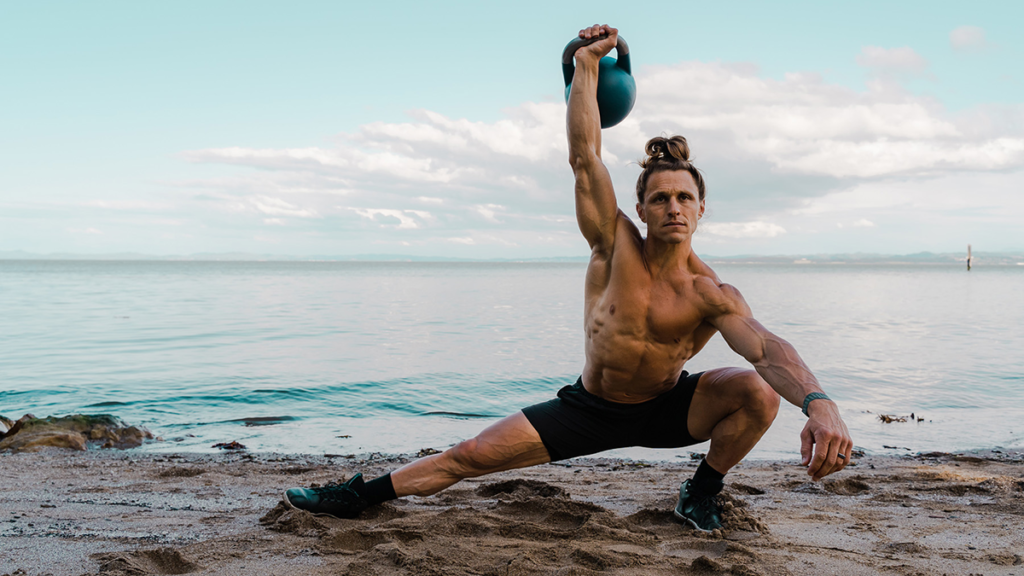
2. Kettlebell Windmill
The windmill is a controlled rotational grind that improves thoracic mobility, hip stability, and shoulder strength.
Why It Works
The windmill challenges the body in the frontal and transverse planes simultaneously. The overhead load increases shoulder stabilization demands, while the rotational hinge improves hip mobility.
Research on shoulder stability shows that overhead loading increases activation of the rotator cuff and scapular stabilizers. Unilateral overhead loading also increases trunk muscle activation due to anti-lateral flexion and anti-rotation demands.
Thoracic spine mobility is critical for proper rotation. Limited thoracic mobility forces compensation at the lumbar spine, increasing injury risk. The windmill encourages rotation through the thoracic region while maintaining lumbar stability.
How to Perform It
- Press the kettlebell overhead and lock the elbow.
- Turn the feet about 45 degrees away from the loaded arm.
- Push the hips back and shift weight into the rear hip.
- Slide the free hand down the inside of the front leg.
- Keep eyes on the kettlebell.
- Lower as far as mobility allows without spinal flexion.
- Drive through the hip to stand.
Coaching Cues
- Stack shoulder over shoulder.
- Keep the loaded arm vertical.
- Rotate from the thoracic spine.
- Hips move back, not down.
Programming
Perform 3–4 sets of 5–8 reps per side. Move slowly and with control. This is a mobility-strength hybrid.
3. Kettlebell Russian Twist (Loaded Seated Rotation)
When done correctly, the Russian twist trains controlled trunk rotation and anti-rotation endurance.
Why It Works
The obliques are primary contributors to trunk rotation. EMG studies show significant activation of the external and internal obliques during rotational trunk exercises.
However, many people perform this movement incorrectly by excessively flexing and twisting the lumbar spine. The goal is controlled thoracic rotation with a braced core.
Research on spinal biomechanics shows that repeated loaded lumbar flexion and rotation can increase disc stress. Therefore, the Russian twist must be performed with a neutral spine and controlled tempo.
When executed properly, this exercise improves rotational endurance and core stiffness, which are essential for force transfer and injury prevention.
How to Perform It
- Sit with knees bent and feet lightly on the floor.
- Hold the kettlebell by the horns.
- Lean back slightly while maintaining a neutral spine.
- Brace the core.
- Rotate the torso side to side in a controlled manner.
- Move slowly and avoid collapsing the chest.
Coaching Cues
- Rotate the ribcage, not the lower back.
- Keep the chest tall.
- Move under control.
- Exhale during rotation.
Programming
Perform 2–4 sets of 8–15 controlled reps per side. Focus on quality rather than speed.
Programming Rotational Kettlebell Training
Frequency
2–3 times per week is sufficient. Rotational work can be placed:
- After your warm-up
- As a power block
- As accessory work
- In conditioning circuits
Load Selection
Ballistic exercises should feel powerful and fast. Grind exercises should challenge stability but allow perfect form.
Volume Guidelines
- Power movements: low reps, high intent.
- Stability/mobility: moderate reps, slow tempo.
- Endurance: higher reps, strict control.
Common Mistakes
Over-Rotating the Lumbar Spine
The lumbar spine is built for stability, not excessive rotation. Most rotation should occur at the hips and thoracic spine.
Using Too Much Weight
If form breaks down, the benefit disappears. Rotational control matters more than load.
Ignoring Anti-Rotation
Exercises like suitcase carries and half-kneeling presses complement rotational work by teaching the body to resist unwanted movement.
Who Should Use These Exercises?
- Field and court athletes
- Combat sport athletes
- Lifters seeking a stronger core
- Anyone wanting better movement quality
Research supports that trunk strength and endurance correlate with reduced injury risk and improved athletic performance across multiple sports.
Final Thoughts
Rotational training is not optional if you care about performance, longevity, and total-body strength.
The kettlebell rotational swing builds explosive transverse power.
The windmill enhances mobility and shoulder stability.
The Russian twist develops controlled rotational endurance.
Together, they cover power, control, and resilience — the three pillars of effective rotational training.
References
- Behm, D.G., Drinkwater, E.J., Willardson, J.M. and Cowley, P.M., 2010. The use of instability to train the core musculature. Applied Physiology, Nutrition, and Metabolism, 35(1), pp.91–108.
- Hibbs, A.E., Thompson, K.G., French, D., Hodgson, D. and Spears, I., 2008. Optimizing performance by improving core stability and core strength. Sports Medicine, 38(12), pp.995–1008.
- McGill, S.M., 2007. Low back disorders: evidence-based prevention and rehabilitation. Human Kinetics.
- McGill, S.M., Grenier, S., Kavcic, N. and Cholewicki, J., 2003. Coordination of muscle activity to assure stability of the lumbar spine. Journal of Electromyography and Kinesiology, 13(4), pp.353–359.
- Sekendiz, B., Cug, M., Korkusuz, F. and Bayrakci Tunay, V., 2010. Effects of Swiss-ball core strength training on strength, endurance, flexibility, and balance in sedentary women. Journal of Strength and Conditioning Research, 24(11), pp.3032–3040.
- Lake, J.P. and Lauder, M.A., 2012. Kettlebell swing training improves maximal and explosive strength. Journal of Strength and Conditioning Research, 26(8), pp.2228–2233.