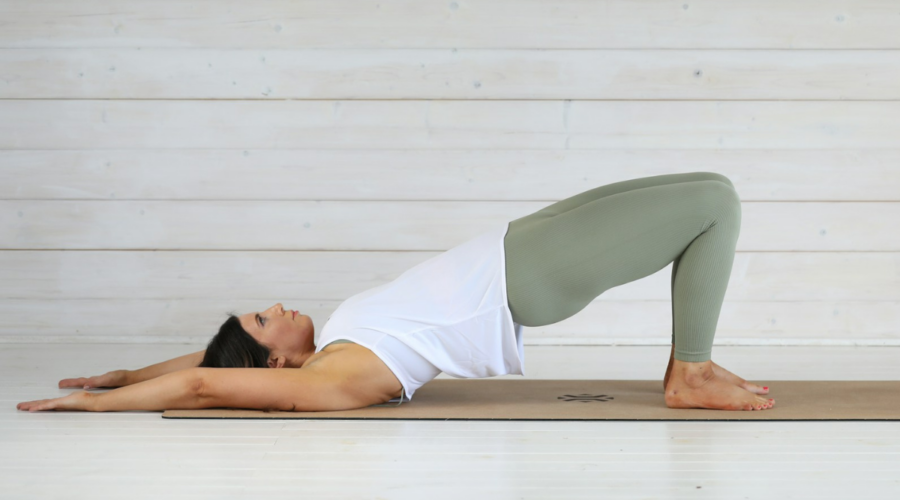


Building stronger glutes does not require a complicated routine or a different exercise for every part of your hips. A few well-chosen movements can train the gluteus maximus, the largest glute muscle, while also developing the strength and control needed for everyday activities and other gym exercises. For a beginner, the best choices are exercises that are easy to learn, can be adjusted to your current ability, and can be progressively made more challenging.
The three exercises below are the hip thrust, squat, and Romanian deadlift. They train hip extension in different ways, giving you a practical starting point for glute training. Research comparing squats and hip thrusts found similar glute growth after nine weeks of training, while a review of exercise studies identified hip thrusts, squats, and deadlift variations among movements that can strongly activate the gluteus maximus. Muscle activation measurements do not prove that one exercise will produce the most growth, however, so the best choice is one you can perform consistently with good technique.


What Beginners Should Know About Glute Training
The glutes help extend the hip, which means they contribute when you stand up, climb stairs, and move your thigh behind your body. The gluteus maximus also contributes to movement at the hip in more than one direction. Exercises that involve hip extension under resistance can therefore be useful for building glute strength and size.
A single workout does not determine your results. Muscle growth develops over time through regular training, gradually increasing the challenge, and allowing your body to recover. Beginners do not need to start with heavy weights or train to the point where every repetition becomes difficult to finish. Choose a load that lets you control the movement and complete your planned repetitions with steady technique.
A sensible starting point is two or three sets of each exercise, performed for about eight to twelve controlled repetitions. You can begin with a lighter load or a bodyweight variation while you learn the movement. When you can complete all your repetitions with good control, increase the weight by a small amount or choose a slightly harder variation. The goal is gradual progress, not a test of how much you can lift on your first day.
1. Hip Thrust
The hip thrust is a focused way to practice hip extension while supporting your upper back on a bench. It is often a comfortable starting point because you can begin with body weight, then add resistance as your control improves. Research has found higher gluteus maximus muscle activity during hip thrusts than during back squats in some comparisons. Separate training research found similar glute growth from hip thrust and squat programs over nine weeks, so the hip thrust is a useful option without being the only exercise you need.
How to Perform a Hip Thrust
Sit on the floor with your upper back resting against the side of a stable bench. Place your feet flat on the floor about hip width apart, with your knees bent. If you are using a barbell, place it across the crease of your hips with a pad for comfort. Beginners can first learn the movement without a barbell or use a light dumbbell held securely across the hips.
Brace your midsection, press through your feet, and raise your hips until your torso and thighs form a roughly straight line. Keep your ribs from flaring upward and avoid arching your lower back to lift higher. Pause briefly at the top, then lower your hips under control. The movement should come from extending your hips, rather than pushing your head back or using momentum.
Your foot position can change how the movement feels, so adjust it until you can reach the top without your heels lifting or your knees feeling uncomfortable. If you feel the exercise mostly in your lower back, reduce the range of motion, lower the weight, and check that you are not overextending at the top. You can also ask a qualified trainer to check your setup.
How to Progress the Hip Thrust
Start with two or three sets of eight to twelve repetitions. Once you can complete the sets with a controlled pause at the top, add a small amount of weight. A machine hip thrust or glute drive machine can also work if your gym has one and the setup feels comfortable. The machine does not need to be a specific brand or model. What matters is that you can position yourself securely and perform the movement through a comfortable range.
2. Squat
The squat is a practical lower-body exercise that trains the glutes along with the muscles that straighten the knees. It also teaches a movement pattern that appears in everyday tasks such as sitting down and standing up. In a study of previously untrained young adults, squat training and hip thrust training produced similar glute growth over nine weeks.
A separate squat-depth study found greater gluteus maximus growth from full squats than half squats in a small group of men. These findings support including squats when they suit your mobility and comfort, but they do not mean you should force yourself into a depth you cannot control.
How to Perform a Squat
Stand with your feet around shoulder width apart, then turn your toes slightly outward if that feels natural. Keep your chest comfortable and your weight balanced across your feet. Bend at the hips and knees to lower yourself, as if sitting toward a chair behind you. Keep your knees tracking in the same general direction as your toes, and stop at a depth where you can maintain balance and control.
Press through your feet to stand. Keep your torso steady and avoid letting your knees collapse inward as you rise. You can begin with a bodyweight squat, a box squat to a bench, or a goblet squat holding one light dumbbell close to your chest. A box or bench gives you a clear depth target, while the goblet position may help some beginners keep the weight centered.
Do not assume that every person must squat to the same depth. Your comfortable range can depend on your proportions, mobility, and experience. Use the deepest position you can reach while keeping your feet grounded and your movement controlled. If you feel pain, stop and adjust the movement or seek help from a qualified professional.
How to Progress the Squat
Once bodyweight repetitions feel steady, hold a light dumbbell in front of your chest or use a leg press or squat machine if that is easier to set up. Add weight gradually while keeping the same controlled depth. The squat trains more than the glutes, which is useful for balanced lower-body strength. If glute training is your main priority, pair it with a hip thrust and a hip hinge exercise rather than relying on squats alone.
3. Romanian Deadlift
The Romanian deadlift is a hip hinge exercise that trains the glutes and hamstrings as you move your hips backward and then stand tall. It complements the squat because it emphasizes hip movement without requiring as much bending at the knees. A study comparing squats, Romanian deadlifts, and hip thrusts found that the Romanian deadlift and hip thrust produced similar glute activity under the study conditions, while the squat involved both hip and knee extensors. The study involved experienced men, so its results should not be treated as a guarantee of exactly how every beginner will respond.
How to Perform a Romanian Deadlift
Stand with your feet about hip width apart and hold a pair of light dumbbells in front of your thighs. Keep a soft bend in your knees, brace your midsection, and push your hips backward. Let the dumbbells travel close to your legs as your torso inclines forward. Stop when you feel a comfortable stretch in the backs of your thighs or when your back begins to round, whichever comes first.
To return to standing, press your feet into the floor and bring your hips forward. Finish upright without leaning backward or forcing your lower back into an arch. The movement is a hinge at the hips, not a squat. Your knees bend slightly, but they should not keep moving forward as you lower.
If you are new to the hinge pattern, practice with a dowel or without weights before using dumbbells. You can also perform the movement with a light barbell once you understand the pattern. Keep the range of motion small at first if that helps you maintain a steady back position. You do not need to lower the weights to the floor for the exercise to be effective.
How to Progress the Romanian Deadlift
Start with two or three sets of eight to twelve repetitions using a load you can control. Add weight only when you can keep the dumbbells close to your body and maintain the same hinge pattern throughout each set. If you feel sharp pain or persistent discomfort, stop the exercise and ask a qualified professional for guidance.
How to Combine the Three Exercises
You can train all three movements in one lower-body workout, or spread them across your weekly routine. For a simple session, perform the squat first, then the hip thrust, and finish with the Romanian deadlift. This order places a multi-joint exercise early in the session, followed by movements that focus more directly on hip extension. Rest long enough between sets to regain control and perform the next set with consistent technique.
3 Best Dumbbell Exercises for Bigger Bicep Peaks
A beginner might start with two sets of each exercise twice per week. If soreness or fatigue makes it hard to train well, reduce the number of sets or leave more time between sessions. As your technique and recovery improve, you can add a set or increase the weight gradually. Consistency matters more than changing exercises every week.
You do not need to feel an intense burn for a workout to be productive. Surface electromyography studies measure electrical activity during a particular exercise, but that measurement alone cannot tell you how much muscle growth you will get over time. Long-term progress depends on the training program as a whole, including the load, number of challenging sets, and how consistently you train.
Key Takeaways
| Topic | Takeaway |
|---|---|
| Hip thrust | A beginner-friendly way to practice loaded hip extension and train the glutes. |
| Squat | Builds lower-body strength and includes the glutes and knee-extending muscles. |
| Romanian deadlift | Teaches the hip hinge while training the glutes and hamstrings. |
| Starting plan | Begin with two or three sets of eight to twelve controlled repetitions. |
| Progress | Add a small amount of weight when you can complete your repetitions with steady technique. |
References
- American College of Sports Medicine (2009) ‘American College of Sports Medicine position stand. Progression models in resistance training for healthy adults’, Medicine & Science in Sports & Exercise, 41(3), pp. 687-708.
- Delgado, J., Drinkwater, E.J., Banyard, H.G., Haff, G.G. and Nosaka, K. (2019) ‘Comparison between back squat, Romanian deadlift and barbell hip thrust for leg and hip muscle activities during hip extension’, Journal of Strength and Conditioning Research, 33(10), pp. 2595-2601.
- Kubo, K., Ikebukuro, T. and Yata, H. (2019) ‘Effects of squat training with different depths on lower limb muscle volumes’, European Journal of Applied Physiology, 119, pp. 1933-1942.
- Plotkin, D.L., Rodas, M.A., Vigotsky, A.D., McIntosh, M.C., Breeze, E., Ubrik, R., Robitzsch, C., Agyin-Birikorang, A., Mattingly, M.L., Michel, J.M., Kontos, N.J., Lennon, S., Frugé, A.D., Wilburn, C.M., Weimar, W.H., Bashir, A., Beyers, R.J., Henselmans, M., Contreras, B.M. and Roberts, M.D. (2023) ‘Hip thrust and back squat training elicit similar gluteus muscle hypertrophy and transfer similarly to the deadlift’, Frontiers in Physiology, 14, article 1279170.
- Santos, C.E.S., et al. (2020) ‘Gluteus maximus activation during common strength and hypertrophy exercises: a systematic review’, Journal of Sports Science and Medicine, 19(1), pp. 195-203.