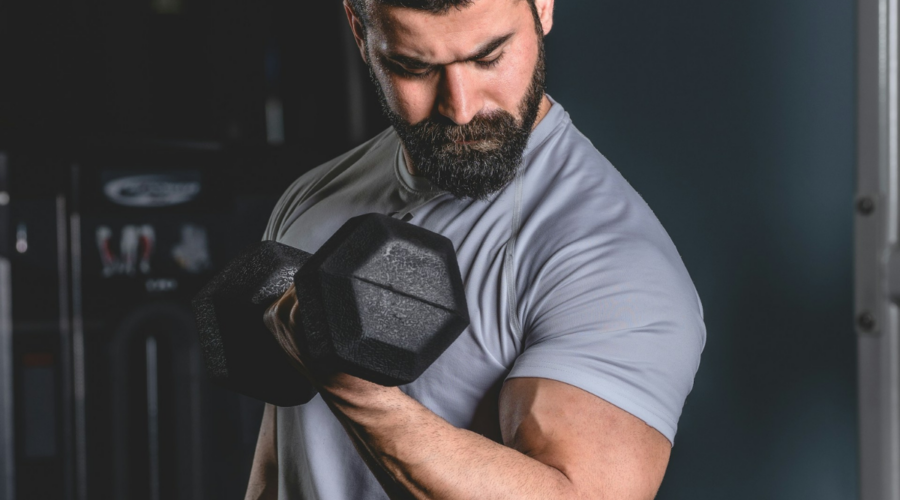


A higher, more defined biceps peak is a common training goal, but no curl can reshape the muscle’s natural structure. The biceps has two heads, and the way its muscle belly and tendons are shaped affects how it looks. Training can make the muscle bigger, which may make its peak more noticeable, but exercise selection cannot change where the muscle attaches.

The best approach is to build the biceps with controlled, progressive training and use curl variations that challenge the muscle in different arm positions. Research comparing incline and preacher curls suggests that exercise choice can affect where growth occurs along the arm. That does not mean one curl isolates a single biceps head or guarantees a particular look. It does support including more than one curl variation in a well planned program.


These three dumbbell exercises offer useful options: the incline dumbbell curl, the dumbbell preacher curl, and the standing alternating supinating curl. Together, they train elbow flexion with the upper arm behind, in front of, and beside the torso.
What Creates the Biceps Peak?
The biceps brachii sits on the front of the upper arm and has a long head and a short head. Both heads help bend the elbow and rotate the forearm so the palm faces upward. They work alongside other elbow flexors, including the brachialis and brachioradialis, so a curl is not a movement that only involves the biceps.
The visible shape of a biceps peak depends partly on individual anatomy. Resistance training can increase muscle size, but it cannot change tendon attachment points or the basic shape of a person’s muscle belly. That is why two people can follow similar training plans and develop different looking arms.
You can still make the most of your own structure by training consistently and using exercises that challenge the elbow flexors through a useful range of motion. Research reviews indicate that full range of motion, or training in the earlier part of a movement where the muscle is more lengthened, can support muscle growth. That makes controlled repetitions, including a comfortable stretch at the bottom of a curl, a sound choice for most people.
1. Incline Dumbbell Curl
The incline dumbbell curl places the upper arm slightly behind the torso. This lengthens the biceps at the shoulder compared with a curl performed with the arm in front of the body.
An electromyography study comparing dumbbell curl variations found that incline curls and standard dumbbell curls produced similar biceps activation patterns across the movement. A separate training study found that incline curls produced greater growth in the proximal elbow flexor region than preacher curls, while preacher curls produced greater growth in the distal region. Those results suggest that the two exercises can provide different stimuli, rather than one being universally superior.
How to Perform the Incline Dumbbell Curl
Set an adjustable bench at a moderate incline and sit with your back supported. Let your arms hang down beside your torso, with your palms facing forward or slightly turned inward. Keep your shoulders relaxed and your upper arms still as you bend your elbows and curl the dumbbells toward your shoulders.
Lower the weights slowly until your arms are close to straight and you feel a mild stretch through the front of your upper arms. Do not force the shoulder into an uncomfortable position or let the dumbbells pull your arms into a painful stretch. Keep your wrists steady, and avoid swinging your torso to get the weights moving.
The 3 Exercises that Make Your Shoulders Look Wider
The incline position makes it harder to use body movement to help complete a repetition. Choose a load that lets you control both the lifting and lowering phases. If your shoulders roll forward or your elbows drift far behind your body, reduce the weight or shorten the range to a comfortable position.
Why It Belongs in a Biceps Routine
The incline curl gives you a way to train with the upper arm behind the torso while using dumbbells that move freely. It can also help you notice whether one arm is working differently from the other. Perform the exercise one arm at a time if that helps you maintain control, or curl both arms together if you can keep your posture steady.
The research does not show that incline curls alone create a bigger peak. Instead, it supports the practical idea of including a curl that trains the elbow flexors in a different shoulder position from a preacher curl. Use it as one part of a broader routine.
2. Dumbbell Preacher Curl
The dumbbell preacher curl supports the upper arm in front of the torso. You can perform it using a preacher bench or by bracing the back of your upper arm against the inside of your thigh while seated. The supported position limits momentum and makes it easier to focus on bending the elbow.
In a training study that compared preacher curls with incline curls, preacher curls led to greater growth in the distal elbow flexor region, while incline curls led to greater growth in the proximal region. The study involved young women over eight weeks, so the results should not be treated as a guarantee for every lifter. They do offer a reason to consider preacher curls as a useful variation.
How to Perform the Dumbbell Preacher Curl
Adjust the bench so your upper arm rests securely on the pad without your shoulder being pushed into an uncomfortable position. Hold a dumbbell with your palm facing up and begin with the elbow slightly bent rather than locked. Curl the weight toward your shoulder while keeping the upper arm in contact with the pad.
Lower the dumbbell slowly until your elbow is almost straight and your biceps feels lengthened. Keep the movement controlled near the bottom, where the exercise can feel most demanding. Do not bounce out of the stretched position, and do not let the shoulder lift away from the pad to finish the repetition.
You can train one arm at a time, which makes it easier to choose a suitable dumbbell for each side. If you do not have a preacher bench, brace your upper arm against your inner thigh while seated. Keep your back comfortable and avoid pressing your arm forcefully into your leg.
Common Mistakes to Avoid
The preacher curl can tempt lifters to use a heavy weight and drop it quickly through the lower part of the repetition. That makes it harder to control the exercise and may irritate the elbow. Use a load that allows a steady lowering phase and a smooth reversal at the bottom.
Avoid forcing the elbow into a fully locked position. A comfortable near straight position is enough to train the biceps through a long range without making the joint take unnecessary stress. If you feel sharp pain, stop and adjust the setup or choose another curl variation.
3. Standing Alternating Supinating Curl
The standing alternating supinating curl is a flexible option for training both arms with dumbbells. You begin with a neutral grip, then rotate the forearm as you curl so the palm faces upward near the top. Because the biceps helps rotate the forearm as well as bend the elbow, this movement trains both of those actions together.
Research on elbow flexion shows that forearm position changes how the elbow flexor muscles contribute to the movement. A supinated palm position gives the biceps a favorable role in elbow flexion compared with a pronated grip. The standing alternating version is not proven to produce a greater biceps peak than other curls, but it is a practical way to train elbow flexion and forearm rotation with dumbbells.
How to Perform the Standing Alternating Supinating Curl
Stand tall with a dumbbell in each hand and your arms at your sides. Begin with your palms facing your body. Keep your upper arms close to your torso as you bend one elbow and turn the working palm upward during the curl. At the top, squeeze the biceps briefly without lifting the shoulder or leaning backward.
Lower the dumbbell under control and rotate your hand back toward the starting position. Alternate arms, or complete all repetitions on one side before switching. Keep your knees soft and torso still. If your hips swing or your shoulders move to lift the dumbbells, choose a lighter weight.
You can also begin with your palm already facing forward, as in a traditional dumbbell curl. The alternating supinating version is useful when you want to practice a smooth rotation, but neither grip needs to be forced. Keep the wrist comfortable throughout the movement.
Making Each Repetition Count
The goal is not to rotate the hand aggressively or twist the wrist at the top. Let the forearm turn naturally as the elbow bends. Control the lowering phase and keep the elbow from drifting forward to finish the repetition. A consistent range of motion makes it easier to track progress over time.
How to Use These Exercises
You do not need to perform all three exercises in every workout. A simple starting point is to choose two variations and perform two or three sets of each. A set of roughly 8 to 15 controlled repetitions can work well for many people, provided the dumbbell is challenging and your form stays consistent. Beginners can start with fewer sets while learning the movements.
Finish most sets when you feel you could complete only a few more good repetitions. Training every set to the point where you cannot lift the dumbbell can add fatigue and make it harder to keep technique steady. As the current weight becomes manageable for the top of your target repetition range, increase the load by the smallest practical amount and build the repetitions again.
Train your biceps as part of a balanced resistance training plan. Pulling exercises such as rows and pulldowns also involve the elbow flexors, so account for them when deciding how much direct arm training you can recover from. Allow enough recovery between challenging sessions, and pay attention to persistent joint discomfort rather than trying to train through it.
Build the Peak You Can Build
Incline curls, preacher curls, and standing alternating supinating curls give you three different ways to train the elbow flexors with dumbbells. The incline variation works with the upper arm behind the torso, preacher curls support the arm in front, and standing curls keep the arm beside the body while allowing forearm rotation.
No exercise can promise a specific peak shape. Focus on repeatable technique, a comfortable range of motion, and gradual progress in repetitions or weight. Over time, these basics can help you build larger, stronger biceps that show the best shape your anatomy allows.
Key Takeaways
| Training point | Practical takeaway |
|---|---|
| Incline dumbbell curl | Trains the biceps with the upper arm behind the torso. |
| Dumbbell preacher curl | Supports the upper arm and challenges the elbow flexors with the arm in front. |
| Standing alternating supinating curl | Combines elbow bending with forearm rotation. |
| Biceps peak shape | Training can increase muscle size, but it cannot change tendon attachments or basic muscle shape. |
| Progression | Use controlled repetitions and gradually add repetitions or weight when your form stays consistent. |
References
- Kassiano, W., Costa, B., Kunevaliki, G., Lisboa, F., Stavinski, N., Prado, A., Tricoli, I., Francsuel, J., Lima, L., Nunes, J.P., Ribeiro, A.S. and Cyrino, E.S. (2025). Distinct muscle growth and strength adaptations after preacher and incline biceps curls. International Journal of Sports Medicine, 46(5), pp. 334-343.
- Kassiano, W., Costa, B., Nunes, J.P., Ribeiro, A.S., Schoenfeld, B.J. and Cyrino, E.S. (2023). Which ROMs lead to Rome? A systematic review of the effects of range of motion on muscle hypertrophy. Journal of Strength and Conditioning Research, 37(5), pp. 1135-1144.
- Murray, W.M., Delp, S.L. and Buchanan, T.S. (1995). Variation of muscle moment arms with elbow and forearm position. Journal of Biomechanics, 28(5), pp. 513-525.
- Oliveira, L.F., Matta, T.T., Alves, D.S., Garcia, M.A.C. and Vieira, T.M.M. (2009). Effect of the shoulder position on the biceps brachii EMG in different dumbbell curls. Journal of Sports Science and Medicine, 8(1), pp. 24-29.
- Zabaleta-Korta, A., Fernández-Peña, E., Torres-Unda, J., Francés, M., Zubillaga, A. and Santos-Concejero, J. (2023). Regional hypertrophy: The effect of exercises at long and short muscle lengths in recreationally trained women. Journal of Human Kinetics, 87, pp. 145-154.
- de Souza, L.M.L., Vieira, A., de Oliveira, N.T.B., de Paula, L.V., de Souza, V.C. and Marchetti, P.H. (2023). Training in the initial range of motion promotes greater muscle adaptations than at final in the arm curl. Journal of Strength and Conditioning Research, 37(6), pp. 1177-1183.