

Small biceps frustrate a lot of lifters. You train curls every week, chase the pump, add extra sets at the end of pull days, and still struggle to build noticeable arm size. The problem is rarely effort. Most people simply choose the wrong exercises, use poor technique, or fail to understand how the biceps actually grow.
The good news is that science gives us clear answers. Muscle hypertrophy responds best to exercises that create high levels of tension, challenge muscles through long ranges of motion, and allow progressive overload over time. For the biceps, exercise selection matters more than many people realize because the muscle crosses both the shoulder and elbow joints. Small changes in arm position can significantly alter muscle recruitment and growth potential.


If your biceps have stubbornly refused to grow, you do not need 12 curl variations. You need a few highly effective movements performed correctly and consistently. The three exercises in this article stand out because they target the biceps through different strength curves and muscle lengths while maximizing mechanical tension. Together, they create a complete strategy for building bigger, fuller arms.
Why Most People Fail to Grow Their Biceps
A lot of training programs treat biceps work as an afterthought. Lifters often throw in random curls at the end of a workout when energy and focus are already low. Others rely on momentum, excessively heavy weights, or partial repetitions that limit muscular tension.

Another common issue is overemphasizing short muscle length training. Many traditional curls challenge the biceps hardest in the middle or shortened position, but newer evidence suggests that training muscles at longer lengths may produce superior hypertrophy outcomes. Research consistently shows that muscle growth is strongly influenced by:
• Mechanical tension
• Sufficient training volume
• Progressive overload
• Full range of motion
• Proximity to muscular failure
For the biceps specifically, exercise variation also matters because different positions emphasize different regions of the muscle and supporting elbow flexors such as the brachialis and brachioradialis. The biceps brachii has two heads:
• The long head, which contributes heavily to the peak appearance
• The short head, which adds width and fullness
A well designed arm program should train both.
The Science of Biceps Growth
The biceps brachii performs two major actions:
• Elbow flexion
• Forearm supination
It also assists shoulder flexion because the muscle crosses the shoulder joint. This anatomy matters because exercises that combine elbow flexion with supination tend to produce greater biceps activation. Electromyography studies repeatedly show higher activation during supinated curls compared to neutral or pronated grips.
Range of motion is another key factor. Recent hypertrophy research suggests that training at longer muscle lengths may stimulate greater muscle growth than training only in shortened positions. Exercises that stretch the biceps under load appear especially effective.
Volume also matters. Most evidence suggests that around 10 to 20 challenging weekly sets per muscle group is effective for hypertrophy in trained individuals. However, quality matters more than blindly adding volume.
If you are performing junk volume with poor technique, your biceps will not grow optimally.
Exercise 1: Incline Dumbbell Curl
Why This Exercise Works
The incline dumbbell curl is one of the most effective biceps builders ever studied because it places the muscle under tension in a lengthened position.
When you sit back on an incline bench with your arms hanging behind your torso, the long head of the biceps experiences a greater stretch. This increases passive tension and may enhance hypertrophic signaling. Unlike standing curls, the incline position also reduces cheating and momentum. Your biceps must do the majority of the work.
This movement strongly targets the long head, which contributes to the prized biceps peak.
How to Perform It Correctly
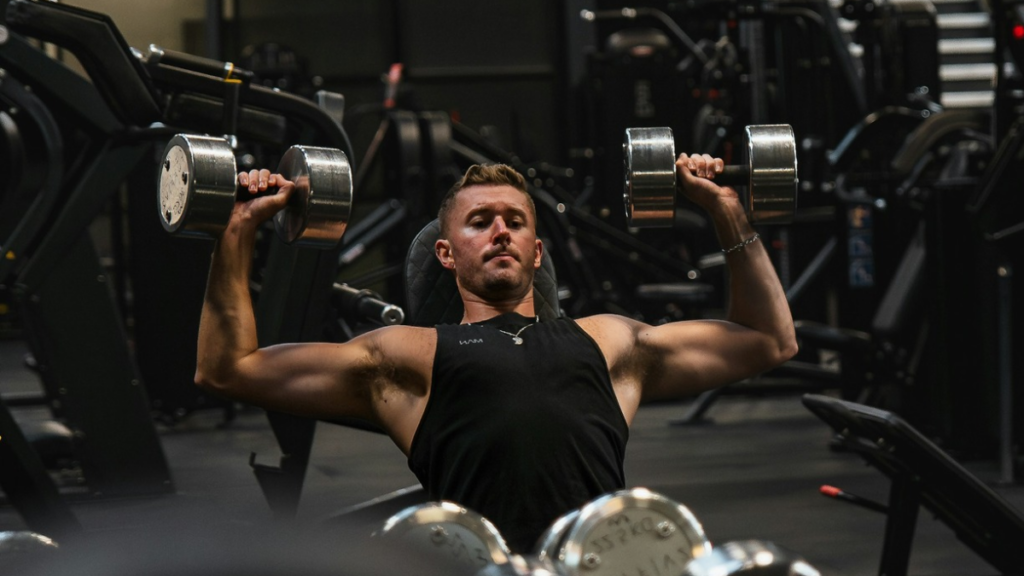
Set an adjustable bench to roughly 45 to 60 degrees. Sit back with a dumbbell in each hand and allow your arms to hang naturally.
Key execution points:
• Keep your shoulders pinned back
• Let your arms stay behind your torso throughout the set
• Fully extend your elbows at the bottom
• Curl while supinating hard through the movement
• Control the lowering phase slowly
The biggest mistake people make is allowing the elbows to drift forward. Once this happens, the movement becomes a standard dumbbell curl and loses much of its unique benefit.
Best Rep Range
The incline curl responds well to moderate repetitions because the stretched position creates substantial tension and fatigue.
A strong approach is:
• 3 to 4 sets
• 8 to 12 repetitions
• Controlled tempo
• Train close to failure
Avoid excessively heavy weights. Maintaining tension and range of motion matters more.
Exercise 2: Bayesian Cable Curl
Why This Exercise Works
The Bayesian cable curl has become increasingly popular among physique athletes and evidence based coaches for good reason. It combines two powerful hypertrophy advantages:
• Constant cable tension
• Loaded stretch in the lengthened position
This exercise is essentially the cable version of the incline curl, but with one major upgrade. The cable maintains tension throughout the entire movement instead of losing resistance near the top. The setup places your arm behind your body, stretching the long head similarly to incline curls while allowing smoother resistance.
For many people, this creates an incredible stimulus with less joint irritation than heavy free weight curls.
How to Perform It Correctly
Attach a single handle to a low cable pulley. Stand facing away from the machine and grasp the handle with one hand. Step forward so your arm moves slightly behind your torso.
Execution tips:
• Keep your chest tall
• Do not rotate your torso
• Let the shoulder remain extended
• Curl with full supination
• Squeeze hard at the top
• Lower slowly into the stretch
You should feel a deep stretch at the bottom position.
Avoid rushing the eccentric phase. The lowering portion is where substantial hypertrophy stimulus occurs.
Best Rep Range
Cable work often responds especially well to slightly higher repetitions because of continuous tension.
Recommended setup:
• 3 to 4 sets
• 10 to 15 repetitions
• 1 to 2 reps short of technical failure
This exercise also works well with advanced hypertrophy methods such as:
• Drop sets
• Lengthened partials
• Slow eccentrics
Exercise 3: Preacher Curl
Why This Exercise Works
The preacher curl remains one of the best exercises for isolating the biceps and minimizing momentum. By bracing the arms against a pad, the movement prevents shoulder involvement and body swinging. This forces the elbow flexors to perform nearly all the work.
Preacher curls also challenge the muscle significantly in the stretched position near the bottom, especially when performed with proper control. Another advantage is improved mind muscle connection. Many lifters report feeling the biceps more intensely during preacher curls than standard standing curls.
Dumbbells, Barbells, or EZ Bars?
All variations can work effectively, but EZ bars are often the most joint friendly option because they reduce wrist strain. Dumbbells allow independent arm movement and may improve symmetry. Machines can also work very well because they provide stability and consistent tension. The best option is the one you can perform pain free while progressively overloading over time.
How to Perform It Correctly
Position your upper arms securely against the preacher pad. Lower the weight under control until your elbows nearly reach full extension.
Execution cues:
• Keep the chest stable against the pad
• Avoid bouncing from the bottom
• Curl smoothly without jerking
• Squeeze at the top without losing tension
• Control the eccentric phase carefully
The bottom position is where the exercise becomes most challenging and effective. Many people cut the range of motion short to avoid discomfort, but doing so limits the hypertrophy stimulus.
Best Rep Range
Preacher curls can create significant muscle damage because of the stretch involved. Moderate loading is usually ideal. Recommended approach:
• 3 sets
• 8 to 12 repetitions
• Controlled eccentric
• Full range of motion
You do not need maximal weight here. Precision matters more than ego lifting.
Why These Three Exercises Work Better Together
One exercise alone rarely solves stubborn muscle growth issues. The real power comes from combining complementary movements. These three exercises work together because they target the biceps through slightly different resistance profiles and muscle lengths.
Incline Dumbbell Curl
Primary advantages:
• Lengthened tension
• Strong long head emphasis
• Excellent stretch stimulus
Bayesian Cable Curl
Primary advantages:
• Constant tension
• Smooth resistance curve
• High hypertrophy efficiency
Preacher Curl
Primary advantages:
• Strict isolation
• Reduced momentum
• Strong contraction and stretch combination
Together, they create a balanced hypertrophy strategy that addresses multiple growth mechanisms.
The Most Important Training Variables for Bigger Biceps
Exercise selection matters, but execution and programming determine whether growth actually occurs.
Train Close to Failure
Research consistently shows that hypertrophy is maximized when sets are performed near muscular failure. You do not need to fail on every set, but most working sets should end with roughly:
• 0 to 3 reps in reserve
If your set ends comfortably, the stimulus is probably too low.
Use Full Range of Motion
Partial reps have specific uses, but full range training remains foundational for muscle growth.
A larger range of motion generally produces:
• Greater muscle activation
• More stretch mediated tension
• Better hypertrophy outcomes
For biceps, fully extending the elbow under control is extremely important.
Control the Eccentric
The lowering phase contributes significantly to hypertrophy.
Instead of dropping the weight quickly:
• Lower under control for 2 to 4 seconds
• Maintain tension throughout
• Avoid relaxing at the bottom
This becomes especially important in stretch based exercises like incline and preacher curls.
Prioritize Progressive Overload
Your biceps will not grow indefinitely using the same weights and repetitions.
Over time, aim to gradually improve:
• Load
• Repetitions
• Set quality
• Technical execution
Progressive overload does not always mean adding huge amounts of weight. Even small improvements accumulate over months of training.
How Often Should You Train Biceps?
Most evidence suggests that training a muscle group at least twice weekly is effective for hypertrophy.
A practical setup could be:
Day 1
• Incline dumbbell curl
• Preacher curl
Day 2
• Bayesian cable curl
• Optional hammer curls
This frequency allows enough stimulus while maintaining recovery.
Because the biceps also assist during pulling exercises such as rows and pull ups, total weekly volume should account for indirect work as well.
A Sample Science Based Biceps Workout
Here is a simple but highly effective weekly template.
Workout A
Incline Dumbbell Curl
• 4 sets
• 8 to 12 reps
Preacher Curl
• 3 sets
• 10 to 12 reps
Hammer Curl
• 3 sets
• 10 to 15 reps
Workout B
Bayesian Cable Curl
• 4 sets
• 10 to 15 reps
EZ Bar Curl
• 3 sets
• 8 to 10 reps
Reverse Curl
• 2 to 3 sets
• 12 to 15 reps
This setup balances:
• Lengthened tension
• Constant tension
• Heavy loading
• Isolation work
• Brachialis development
The Bottom Line
Small biceps are rarely the result of bad genetics alone. More often, they come from poor exercise selection, inconsistent progression, and ineffective training execution.
The incline dumbbell curl, Bayesian cable curl, and preacher curl stand out because they align closely with current hypertrophy science. They train the biceps through challenging ranges of motion, emphasize lengthened tension, reduce momentum, and create the mechanical loading necessary for growth.
Instead of wasting time on endless random curl variations, focus on mastering a few highly effective exercises and progressively improving them over time. Train hard, recover properly, eat enough protein, and stay patient. That combination finally gives stubborn biceps a real reason to grow.
Key Takeaways
| Key Point | Why It Matters |
|---|---|
| Incline dumbbell curls emphasize the stretched position | Lengthened tension may improve hypertrophy |
| Bayesian cable curls provide constant resistance | Continuous tension increases muscle stimulus |
| Preacher curls reduce momentum | Better isolation improves biceps recruitment |
| Full range of motion is critical | Greater muscle activation supports growth |
| Training close to failure improves results | High effort recruits more muscle fibers |
| Twice weekly biceps training is effective | Higher frequency supports muscle growth |
| Progressive overload drives hypertrophy | Muscles must face increasing demands |
| Protein intake supports muscle repair | Adequate amino acids are essential for growth |
| Sleep and recovery affect adaptation | Muscles grow outside the gym |
| Consistency matters more than variety | Long term progression produces visible results |
References
• Ahtiainen, J.P., Pakarinen, A., Alen, M., Kraemer, W.J. and Hakkinen, K. (2003) ‘Muscle hypertrophy, hormonal adaptations and strength development during strength training in strength trained and untrained men’, European Journal of Applied Physiology, 89(6), pp. 555 to 563.
• Burd, N.A., Andrews, R.J., West, D.W., Little, J.P., Cochran, A.J., Hector, A.J., Cashaback, J.G., Gibala, M.J., Potvin, J.R., Baker, S.K. and Phillips, S.M. (2012) ‘Muscle time under tension during resistance exercise stimulates differential muscle protein sub fraction synthetic responses in men’, Journal of Physiology, 590(2), pp. 351 to 362.
• Gentil, P., Soares, S. and Bottaro, M. (2015) ‘Single versus multi joint resistance exercises: Effects on muscle strength and hypertrophy’, Asian Journal of Sports Medicine, 6(2), pp. 1 to 6.
• Maeo, S., Ando, Y., Kanehisa, H. and Kawakami, Y. (2021) ‘Muscular adaptations to lengthened partial range of motion resistance training’, Frontiers in Physiology, 12, pp. 1 to 10.
• Nunes, J.P., Grgic, J., Cunha, P.M., Ribeiro, A.S., Schoenfeld, B.J. and Cyrino, E.S. (2020) ‘What influences muscle hypertrophy? A systematic review of resistance training variables and strategies’, Journal of Strength and Conditioning Research, 34(8), pp. 2339 to 2351.
• Oliveira, L.F., Matta, T.T., Alves, D.S., Garcia, M.A.C. and Vieira, T.M. (2009) ‘Effect of the shoulder position on biceps brachii EMG in different dumbbell curls’, Journal of Sports Science and Medicine, 8(1), pp. 24 to 29.