Building a muscular torso does not require an expensive gym membership or a room full of specialized equipment. A pair of dumbbells can provide everything a beginner needs to develop a bigger chest, stronger shoulders, a thicker back, and more defined arms. The key is choosing exercises that train multiple muscle groups, allow steady progression, and are supported by scientific research.
Compound dumbbell exercises have several advantages for beginners. They challenge multiple joints and muscles at the same time, improve coordination, increase overall training efficiency, and allow progressive overload, which is the primary driver of muscle growth. Research consistently shows that resistance training increases muscle size and strength in beginners when exercises are performed consistently and with sufficient effort.
How Long Should You Be Able to Hold a Plank at Your Age?
This article covers three of the best dumbbell exercises for beginners who want to build a muscular torso. Each movement delivers a high return on investment, teaches important movement patterns, and creates the foundation for years of productive strength training.
Why Dumbbells Are Ideal for Beginners
Dumbbells allow each arm to work independently, reducing strength imbalances that often develop when using barbells or machines. They also require greater stabilization, which increases activation of supporting muscles around the shoulders and upper back.
Research comparing free weights with machine based resistance training has found that free weights improve functional strength while promoting similar gains in muscle mass. For beginners, dumbbells also encourage better movement control and can be adjusted gradually as strength improves.
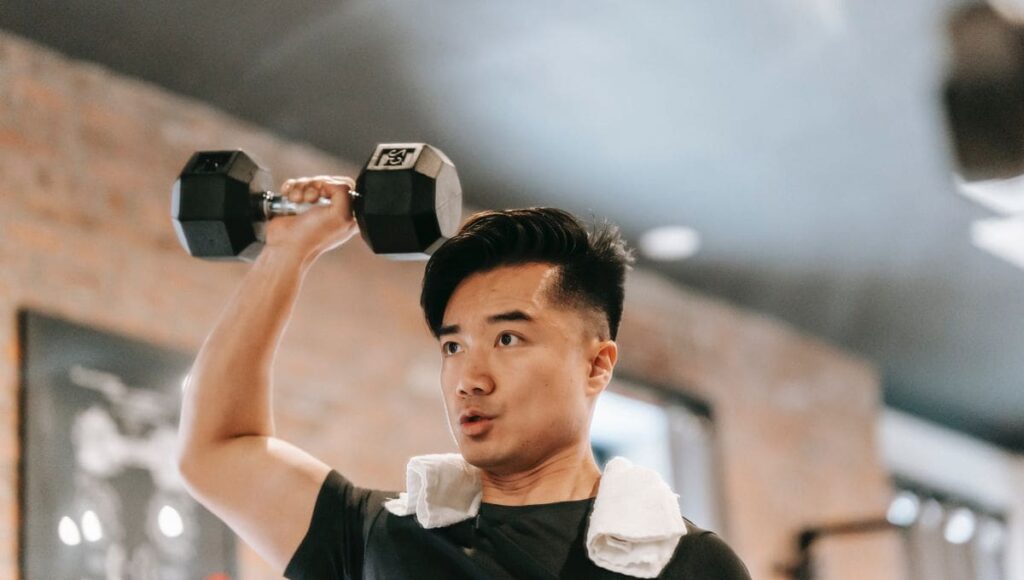
Muscle growth is primarily driven by mechanical tension, training volume, and progressive overload. As long as these principles are applied, dumbbells can be just as effective as more advanced equipment for building an impressive upper body.
Exercise 1. Dumbbell Bench Press
The dumbbell bench press is arguably the best upper body pushing exercise for beginners. It targets the chest while also developing the shoulders and triceps. Because each arm moves independently, it also improves muscular balance and shoulder stability.

Muscles Worked
The primary muscle is the pectoralis major. The anterior deltoids and triceps brachii assist throughout the movement. The muscles around the shoulder blades also work to stabilize the shoulders during each repetition.
Electromyography research has shown that the bench press produces high activation of the chest muscles while effectively recruiting the triceps and front deltoids.
How to Perform It
Lie flat on a bench while holding a dumbbell in each hand. Position the dumbbells beside your chest with your palms facing forward. Keep your feet firmly planted on the floor and your shoulder blades pulled slightly together.
Press both dumbbells upward until your arms are almost fully extended. Lower the weights slowly until your elbows reach approximately ninety degrees or slightly below, depending on your shoulder mobility. Repeat while maintaining control throughout every repetition.
Avoid bouncing the weights or allowing your shoulders to roll forward during the lowering phase.
Why It Builds a Bigger Torso
The chest is one of the largest muscles of the upper body. Developing it creates immediate improvements in overall physique. Dumbbells also allow a greater range of motion than a traditional barbell because the hands can move independently around the torso.
Studies comparing dumbbell and barbell pressing have demonstrated similar levels of chest muscle activation, while dumbbells often require greater stabilizer muscle involvement.
For beginners, this means more muscles contribute to every repetition while also improving shoulder control.
Beginner Programming
Perform three to four sets of eight to twelve repetitions.
Choose a weight that allows you to complete the final repetitions with good technique while feeling challenged. Once you can complete all planned repetitions comfortably, increase the dumbbell weight slightly during your next session.
Exercise 2. Single Arm Dumbbell Row
Many beginners focus almost entirely on chest exercises while neglecting their back. This creates muscular imbalances and limits overall torso development. The single arm dumbbell row builds thickness throughout the upper and middle back while strengthening the lats, rear shoulders, and biceps. A strong back also improves posture and creates the wide appearance that makes the waist look smaller.

Muscles Worked
The latissimus dorsi performs most of the pulling work. The rhomboids, middle trapezius, posterior deltoids, teres major, and biceps all contribute throughout the movement. The core muscles also stabilize the trunk.
Research examining rowing exercises consistently demonstrates high activation of the latissimus dorsi and middle trapezius, making rows essential for balanced upper body development.
How to Perform It
- Place one knee and the same side hand on a bench for support.
- Hold the dumbbell with your free hand while allowing your arm to hang straight beneath your shoulder.
- Pull the dumbbell toward your lower ribs while keeping your elbow close to your body.
- Pause briefly at the top by squeezing your shoulder blade toward your spine.
- Lower the weight under control until your arm is fully extended before beginning the next repetition.
- Avoid twisting your torso or using momentum to lift the weight.
Why It Builds a Bigger Torso
Well developed back muscles add significant thickness and width to the torso. They also support healthier shoulder mechanics by balancing the pushing movements that dominate many beginner routines.
Research has shown that balanced training between pushing and pulling movements reduces muscular imbalances while improving shoulder function. The unilateral nature of the exercise also exposes left to right strength differences that can be corrected over time.
Beginner Programming
Complete three to four sets of eight to twelve repetitions per arm. Focus on moving through a full range of motion while maintaining control rather than using the heaviest possible dumbbell.
Exercise 3. Standing Dumbbell Overhead Press
The overhead press develops the shoulders, upper chest, triceps, and core simultaneously. Broad shoulders are one of the defining characteristics of a muscular torso, making this exercise an essential part of any beginner program.
Unlike seated versions, the standing overhead press also requires significant stabilization from the abdominal muscles, lower back, and hips.
Muscles Worked
The anterior and middle deltoids generate most of the pressing force. The triceps extend the elbows while the upper trapezius and serratus anterior assist with shoulder blade movement. The abdominal muscles and spinal stabilizers work continuously to maintain an upright posture. Electromyography studies have consistently found high activation of the deltoids during overhead pressing exercises.
How to Perform It
- Stand with your feet approximately shoulder width apart while holding a dumbbell at each shoulder.
- Brace your core and press both dumbbells overhead until your arms are nearly straight.
- Lower them slowly back to shoulder level under control.
- Keep your ribs down and avoid leaning backward excessively during the press.
- Focus on smooth movement rather than speed.
Why It Builds a Bigger Torso
Wide shoulders create the classic V shaped upper body that many people associate with an athletic physique.
The standing overhead press also improves coordination between the shoulders, arms, and core. Because the body must stabilize throughout the movement, more muscles contribute compared with seated variations. Research suggests that standing free weight exercises generally require greater stabilization and neuromuscular coordination than supported machine exercises.
Beginner Programming
Perform three sets of six to ten repetitions. Use a controlled tempo throughout every repetition and prioritize proper technique over heavier weights.
Common Beginner Mistakes
Many beginners believe heavier weights always produce better results. In reality, technique should always come before loading. Poor movement quality increases injury risk and reduces the effectiveness of each exercise.
Another common mistake is constantly changing workouts. Scientific evidence consistently shows that progressive overload on the same foundational exercises produces superior long term results compared with frequently switching movements.
Neglecting pulling exercises is another problem. An excessive focus on chest training without sufficient rowing work can contribute to shoulder discomfort and muscular imbalance.
Finally, many beginners underestimate consistency. A simple program performed three times each week for several months will almost always outperform an advanced routine followed inconsistently.
Final Thoughts
Beginners often overcomplicate strength training by searching for the perfect exercise or the newest training method. The reality is much simpler. A small number of proven compound movements performed consistently delivers outstanding results.
The dumbbell bench press develops a bigger chest while strengthening the shoulders and triceps. The single arm dumbbell row builds a wider, thicker back that balances upper body development. The standing dumbbell overhead press creates stronger, broader shoulders while reinforcing full body stability. Combined with progressive overload, adequate protein intake, quality sleep, and consistent training, these three exercises provide everything most beginners need to build a stronger, more muscular torso.
Instead of chasing endless exercise variations, focus on mastering these foundational lifts, improving your technique, and becoming slightly stronger every week. Those small improvements compound into impressive results over time.
Key Takeaways
| Topic | Key Takeaway |
|---|---|
| Best chest exercise | The dumbbell bench press effectively builds the chest, shoulders, and triceps while improving muscular balance. |
| Best back exercise | The single arm dumbbell row develops back width, thickness, posture, and pulling strength. |
| Best shoulder exercise | The standing dumbbell overhead press builds broader shoulders while strengthening the core. |
| Training frequency | Perform these exercises two to three times per week with at least one recovery day between sessions. |
| Repetition range | Most beginners should perform six to twelve repetitions per set depending on the exercise. |
| Progressive overload | Increase weight or repetitions gradually as strength improves to continue building muscle. |
| Recovery | Prioritize adequate protein intake, sleep, and recovery to maximize muscle growth. |
References
- American College of Sports Medicine. (2009). Progression models in resistance training for healthy adults. Medicine & Science in Sports & Exercise, 41(3), 687 to 708.
- Gentil, P., Bottaro, M., Oliveira, E., Veloso, J., Amorim, N. and Wagner, D. (2015). Effects of resistance training using free weights versus machines on muscle mass, strength, free testosterone, and free cortisol levels. Journal of Human Kinetics, 47, 115 to 121.
- Grgic, J., Schoenfeld, B.J., Orazem, J. and Sabol, F. (2022). Effects of resistance training performed to repetition failure or nonfailure on muscular strength and hypertrophy. Scandinavian Journal of Medicine & Science in Sports, 32(11), 1427 to 1445.
- Morton, R.W., Murphy, K.T., McKellar, S.R., Schoenfeld, B.J., Henselmans, M., Helms, E., Aragon, A.A., Devries, M.C., Banfield, L., Krieger, J.W. and Phillips, S.M. (2018). A systematic review, meta analysis and meta regression of protein supplementation on resistance training induced gains in muscle mass and strength in healthy adults. British Journal of Sports Medicine, 52(6), 376 to 384.
- Saeterbakken, A.H., Fimland, M.S., van den Tillaar, R. and Andersen, V. (2011). A comparison of muscle activity and one repetition maximum strength of three chest press exercises with different stability requirements. Journal of Strength and Conditioning Research, 25(2), 533 to 538.
- Schoenfeld, B.J. (2010). The mechanisms of muscle hypertrophy and their application to resistance training. Journal of Strength and Conditioning Research, 24(10), 2857 to 2872.