

You do not need a long list of chest exercises to start building your pecs. A few movements you can perform with good control, repeat consistently, and gradually make more challenging are enough to build a useful beginner routine.
The three exercises below cover a horizontal press, an incline press, and a bodyweight press. Together, they give you options for training at the gym or at home, while keeping the focus on learning good technique and making steady progress. No single exercise is essential, and the best choices are the ones you can perform comfortably and keep progressing.


1. Machine Chest Press
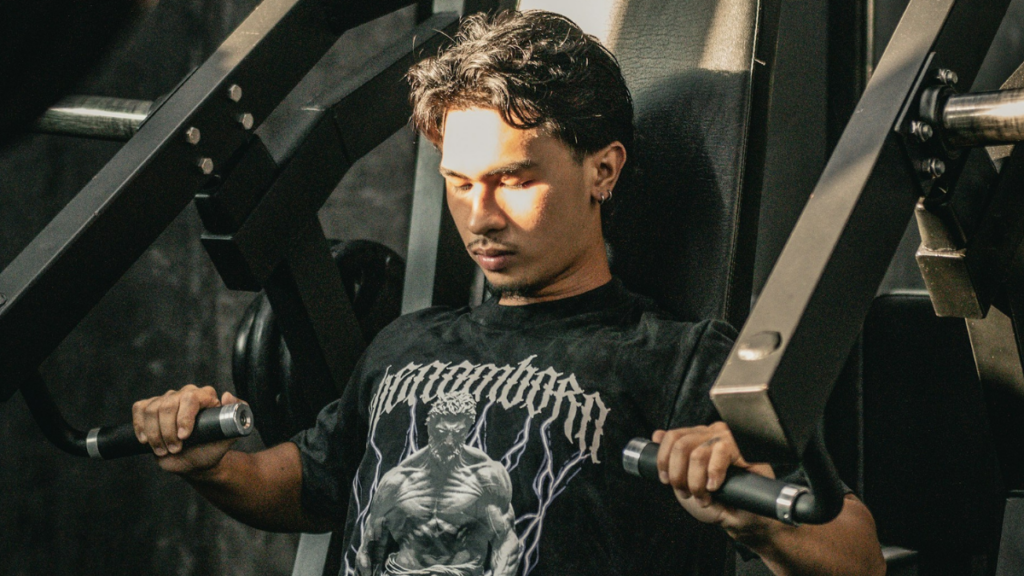
A machine chest press is a practical place for beginners to learn the pressing pattern. The machine guides the movement, which can make it easier to focus on pressing smoothly without having to balance a barbell. It also lets you adjust the load in small increments as you get stronger.
Set the seat so the handles are around mid-chest level when you begin. Sit with your back against the pad and your feet flat on the floor. Hold the handles, draw your shoulders gently back against the pad, and press forward until your arms are nearly straight. Avoid forcefully locking your elbows. Bring the handles back under control until you feel a comfortable stretch across your chest.
The chest press trains the pectoralis major along with the triceps and the muscles at the front of the shoulders. Horizontal pressing is a useful foundation for chest training, and research on untrained adults has examined adaptations to horizontal and incline bench pressing. Machine and free weight options can both be used in a resistance training program, so beginners can choose equipment that feels stable and manageable.
Use a load that allows you to complete each repetition with the same controlled motion. If your shoulders roll forward, your back lifts away from the pad, or you have to bounce the handles to finish a repetition, lower the weight. The goal is to challenge your chest while keeping your technique consistent.
If your gym does not have a chest press machine, use a dumbbell bench press as the horizontal pressing option. Start with light dumbbells and practice lowering them under control. A spotter can help if you are unsure about handling the weights safely.
2. Incline Dumbbell Press
The incline dumbbell press adds a pressing angle that places more emphasis on the upper region of the pectoralis major. It also gives each arm its own weight to control. That can make it useful for learning how to press evenly, although the dumbbells may feel less stable than a machine at first.
Set an adjustable bench to a low incline, around 15 to 30 degrees. Sit with a dumbbell on each thigh, then bring the weights up to the sides of your upper chest as you lie back. Keep your feet planted and your shoulder blades resting against the bench. Press the dumbbells upward until your arms are nearly straight, then lower them slowly until your upper arms are just below or level with your torso, depending on your mobility and comfort.
A steep incline tends to turn the movement into more of a shoulder press. A low incline keeps the exercise closer to a chest press while changing the angle of the movement. Research comparing horizontal and incline bench pressing in untrained men found that these pressing variations produce different training responses, supporting the use of more than one angle when a program aims to train the chest broadly.
Choose a weight that lets you lower the dumbbells smoothly and keep your wrists stacked over your elbows. Do not force a deep stretch if it causes discomfort in your shoulders. If the dumbbells feel difficult to control, reduce the load or use a machine incline press until you are more confident.
3. Push-Up
The push-up is an effective chest exercise that requires little or no equipment. It trains the pectorals, triceps, and front shoulders while asking you to keep your trunk steady. You can also adjust the difficulty by changing the angle of your body.
For a standard push-up, place your hands slightly wider than shoulder width and set your body in a straight line from head to heels. Brace your abdomen, bend your elbows, and lower your chest toward the floor. Keep your elbows at a comfortable angle rather than flaring them directly out to the sides. Press the floor away to return to the starting position.
If a floor push-up is too difficult, place your hands on a sturdy bench or elevated surface. The higher your hands, the less body weight you need to press. As you get stronger, lower the hand support until you can perform the exercise from the floor. If standard push-ups become easy, you can make them harder by slowing the lowering phase or choosing a more demanding variation.
A small study of untrained young men found similar chest muscle thickness and strength improvements from push-ups and low-load bench pressing when the exercises were matched for load and performed over eight weeks. The study was limited in size and duration, but it supports push-ups as a legitimate option for beginners who can scale the movement to a challenging level.
How to Put the Exercises Together
Start with two workouts per week, leaving at least a day between them. In each workout, perform two sets of each exercise for about 8 to 15 controlled repetitions. For push-ups, choose a version that allows you to stay within that range without losing your body position. If you can complete more than 15 repetitions easily, use a lower hand support or a harder variation.
Rest long enough between sets to perform the next set with good form, usually about one to three minutes. You do not need to push every set until you cannot complete another repetition. Stop when you think you could perform one or two more repetitions with the same technique. That gives you a challenging effort while leaving room to recover and practice the movements.
The Best 3 Twisting Core Exercises for Beginners
When you can complete the top end of your repetition range in every set with good control, increase the resistance slightly or use a harder version. For the machine press, add a small amount of weight. For incline dumbbell presses, move to the next manageable dumbbell size. For push-ups, lower the hand support or progress to a more difficult variation. Keep a simple record of the exercise, weight, and repetitions so you can see whether your performance is improving.
The number of sets you need can change as you gain experience. Research reviews have found a general relationship between weekly training volume and muscle growth, but more is not automatically better for every person. Begin with a manageable amount, pay attention to how well you recover, and add sets gradually only if you are recovering well and making progress.
Common Beginner Mistakes to Avoid
Using too much weight is one of the easiest ways to make chest training less effective. If you shorten the movement, bounce the weights, or let your shoulders take over, reduce the load and rebuild your technique. Smooth repetitions through a comfortable range of motion make it easier to repeat the exercise consistently.
Changing exercises every week can also make it harder to track progress. Give the routine time to work. Keep the main exercises consistent for several weeks, then assess whether you are lifting more weight, completing more repetitions, or performing a more challenging push-up variation with control.
Finally, do not expect chest exercises to change your physique overnight. Muscle growth depends on consistent training over time, adequate recovery, and an eating pattern that supports your goals. These three movements give you a straightforward place to start. Your job is to perform them well, repeat them regularly, and make gradual progress.
Key Takeaways
| Key Takeaways | What to Remember |
|---|---|
| Choose three useful movements | Start with a machine chest press, an incline dumbbell press, and a push-up variation. |
| Practice controlled technique | Use a comfortable range of motion and a load you can manage without bouncing or twisting. |
| Train consistently | Two weekly chest sessions are a practical beginner starting point. |
| Progress gradually | Add repetitions, a small amount of weight, or a harder push-up variation when your sets become manageable. |
| Adjust to your equipment and ability | Substitute a dumbbell bench press for the machine press, or raise your hands for easier push-ups. |
References
- Ermin, K. et al. (2020) ‘Effects of horizontal and incline bench press on neuromuscular adaptations in untrained young men’, International Journal of Exercise Science, 13(1), pp. 171–179.
- Kikuchi, N. and Nakazato, K. (2017) ‘Low-load bench press and push-up induce similar muscle hypertrophy and strength gain’, Journal of Exercise Science & Fitness, 15(1), pp. 37–42.
- Schoenfeld, B.J., Ogborn, D. and Krieger, J.W. (2017) ‘Dose-response relationship between weekly resistance training volume and increases in muscle mass: A systematic review and meta-analysis’, Journal of Sports Sciences, 35(11), pp. 1073–1082.
- Schoenfeld, B.J., Grgic, J. and Krieger, J. (2019) ‘How many times per week should a muscle be trained to maximize muscle hypertrophy? A systematic review and meta-analysis of studies examining the effects of resistance training frequency’, Journal of Sports Sciences, 37(11), pp. 1286–1295.