



























Is the Guillotine Press Worth Trying if You Struggle to Build Your Chest?

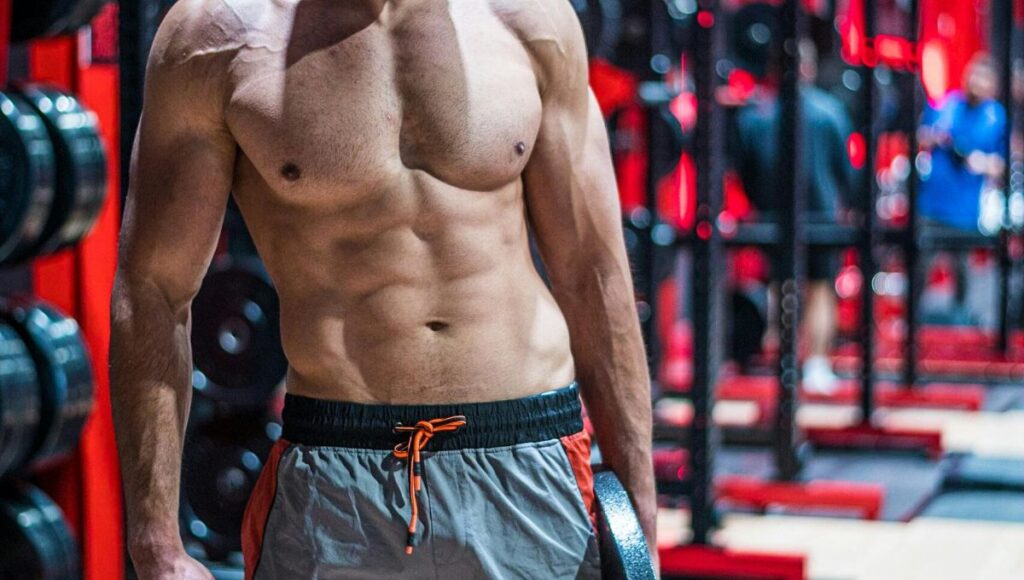
Adding new variations can often be a great way to shock your body into muscle growth, especially if you feel bored with your training plan or have hit a plateau.
How the Guillotine Press Differs From a Standard Bench Press
During a conventional barbell bench press, most lifters tuck their elbows roughly forty-five to sixty degrees from their torso and lower the bar to the lower portion of the sternum. That subtle elbow tuck aligns the humerus cleanly with the shoulder socket while allowing the pectoralis major, anterior deltoids, and triceps to share the pressing load safely and efficiently.
When you switch to a guillotine press, you take a wider grip, flare your elbows out toward ninety degrees relative to your torso, and lower the bar high toward the clavicular region near the base of your neck.
Flaring your upper arms outward like that places the pectoralis major fibers into a more direct line of pull while stretching the chest intensely at the bottom of each repetition.
Electromyography research comparing grip widths and pressing mechanics demonstrates that wider grips and specific pressing angles alter muscle recruitment across the clavicular and sternocostal heads of the pectoralis major while reducing triceps leverage. However, changing the angle of your upper arm also dramatically changes how forces act on the delicate structures inside your shoulder joint.
The Potential Upside for Stubborn Pectorals
Lifters who struggle to feel their chest working during standard bench presses often suffer from shoulder or triceps dominance, where stronger pressing muscles take over before the pecs reach meaningful fatigue. Because the guillotine press restricts elbow tuck and stretches the pectoral fibers across the ribcage at the bottom of every rep, it forces the chest to do a larger share of the work with noticeably lighter weights. Furthermore, recent sports science research examining range of motion shows that loading muscles at long, stretched muscle lengths promotes superior hypertrophy compared to emphasizing shortened contractions.
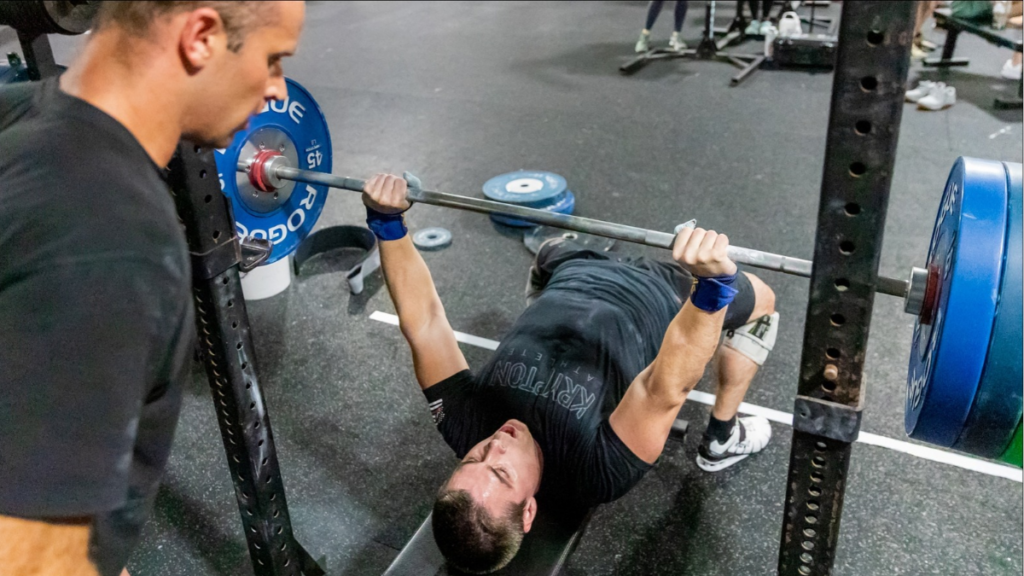
In theory, combining high pectoral stretch with lighter, controlled loads taken close to muscular failure checks several boxes for stimulating stubborn muscle fibers. Landmark studies comparing resistance training loads confirm that moderate and lighter weights produce muscle growth comparable to heavy weights when sets approach muscular failure. The catch is whether your shoulder anatomy can safely tolerate the mechanical demands required to achieve that stretch under a straight barbell.
The Biomechanical Risks You Cannot Ignore
Lowering a rigid steel bar high toward your neck with flared elbows forces your shoulders into pronounced horizontal abduction combined with internal rotation under load. Sports medicine and shoulder biomechanics research consistently identifies extreme horizontal abduction and internal rotation as positions that increase compressive and shear stress on the anterior shoulder capsule, labrum, and rotator cuff tendons. Unlike dumbbells or cables that allow your wrists and elbows to rotate naturally to match your unique skeletal structure, a straight barbell locks both hands into a fixed plane of motion.
On top of joint stress, lowering a loaded barbell directly above your neck or upper chest introduces obvious safety hazards if your grip slips or your muscles hit sudden fatigue without dedicated spotters and safety pins. When safer tools can deliver deep pectoral stretch and high mechanical tension without locking your shoulders into compromised angles, risking a multi-month shoulder injury rarely makes sense for everyday lifters.
Comparing the Guillotine Press With Safer Chest-Building Alternatives
| Exercise Option | Pectoral Stretch and Tension | Shoulder Joint Stress | Practical Verdict for Stubborn Chests |
| Barbell Guillotine Press | High stretch across upper and mid pecs with wide elbow flare | High risk due to fixed bar path, extreme abduction, and neck hazard | Generally not worth the orthopedic risk for most lifters |
| Incline Dumbbell Bench Press | High stretch with natural wrist and elbow rotation freedom | Low to moderate when elbows stay slightly tucked | Top free-weight choice for building upper and overall chest safely |
| Seated Chest Press Machine | High, steady tension along a supported, repeatable path | Low because back support and handles stabilize the shoulder | Ideal for pushing sets safely close to muscular failure |
| Cable Chest Flyes | Deep, customizable stretch across the full horizontal arc | Low to moderate when pulleys and stance are set sensibly | Excellent isolation finisher for stubborn pectoral fibers |
Is the Guillotine Press Worth Trying?
For the vast majority of lifters struggling to build their chest, the guillotine press is not worth the risk because its biomechanical downsides outweigh its hypertrophy advantages. While the lift genuinely stretches the pectorals and reduces triceps takeover, you can capture every bit of that muscle-building stimulus using incline dumbbell presses, wide-grip machine presses, or cable chest flyes without jamming your shoulders into vulnerable angles or hovering a barbell over your throat.
Meta-analytic evidence on resistance training frequency indicates that training your chest twice per week supports superior hypertrophy compared to once-weekly training, while controlled studies comparing free weights and machines show that both build substantial muscle when taken close to failure. If your chest has been lagging behind, focus on performing two structured chest sessions per week, controlling a slow three-second lowering phase into a comfortable deep stretch with dumbbells or cables, and progressively adding reps over time.
Key Takeaways
| Decision Factor | Evidence-Based Guidance | Why It Matters for Your Chest |
| Overall Verdict | Skip the barbell guillotine press in favor of safer stretched presses | High shoulder stress and neck risk outweigh any unique muscle benefit |
| Smarter Alternatives | Use incline dumbbell presses, machine presses, and cable flyes | Delivers deep pectoral stretch while letting shoulders move naturally |
| Load and Tempo | Use moderate weights with a controlled lowering phase near failure | Stimulates full pectoral hypertrophy without forcing risky joint angles |
| Weekly Programming | Train chest twice per week and track steady rep progression | Doubles weekly muscle growth signals while keeping joints healthy |
References
- Andersen, V., Fimland, M.S., Wiik, E., Skoglund, A. and Saeterbakken, A.H., 2014. Effects of grip width on muscle strength and activation in the bench press. Journal of Strength and Conditioning Research, 28(4), pp.1135-1142.
- Green, C.M. and Comfort, P., 2007. The affect of grip width on bench press performance and risk of injury. Strength and Conditioning Journal, 29(5), pp.10-14.
- Haugen, M.E., Vårvik, F.T., Larsen, S., Haugen, A.S., van den Tillaar, R. and Bjørnsen, T., 2023. Effect of free-weight vs. machine-based strength training on maximal strength, hypertrophy and jump performance: a systematic review and meta-analysis. Sports Medicine – Open, 9(1), p.103.
- Schoenfeld, B.J., Grgic, J., Ogborn, D. and Krieger, J.W., 2017. Strength and hypertrophy adaptations between low- vs. high-load resistance training: a systematic review and meta-analysis. Journal of Strength and Conditioning Research, 31(12), pp.3508-3523.
- Schoenfeld, B.J., Ogborn, D. and Krieger, J.W., 2016. Effects of resistance training frequency on measures of muscle hypertrophy: a systematic review and meta-analysis. Sports Medicine, 46(11), pp.1689-1697.
- Wolf, M., Androulakis-Korakakis, P., Fisher, J., Schoenfeld, B. and Steele, J., 2023. Partial vs full range of motion resistance training: a systematic review and meta-analysis. International Journal of Strength and Conditioning, 3(1), pp.1-15.
Robbie Wild Hudson
Editor-In-Chief at BOXROX. I come from a background of rugby and weightlifting. Growing up in the English Lake District, I spent a great deal of time swimming in its stunning lakes and rivers. In 2015 my brothers and I became the first people to swim the 145km length of the River Eden, from source to mouth, in 9 days. We also swam the Corryvreckan whirlpool, the third largest in the world, and Crossfit is a huge part of my training for these events.
More from Robbie Wild Hudson