

Strong forearms are one of the most overlooked aspects of fitness. Many beginners focus on building bigger biceps, broader shoulders, or a more impressive chest while completely neglecting the muscles below the elbow. The result is often a physique that looks incomplete and a body that performs below its potential.
Your forearms play a critical role in almost every upper body movement. Whether you are deadlifting, carrying groceries, climbing, rowing, performing pull ups, or simply opening a stubborn jar, your forearm muscles are working. They are responsible for gripping, stabilizing, flexing, extending, and rotating the wrist and hand.



Developing stronger and more muscular forearms is not just about aesthetics. Research consistently shows that grip strength is strongly associated with overall strength, athletic performance, functional capacity, and even long term health outcomes. A stronger grip often translates into improved performance in compound lifts, greater muscular endurance, and better quality of life.
The good news is that beginners can make impressive gains in forearm strength and size without spending hours in the gym. By focusing on a few key training principles, it is possible to build powerful forearms efficiently and effectively.
Why Forearm Training Matters
Before diving into the practical tips, it is important to understand why forearm development deserves attention. The forearm contains numerous muscles that can be broadly divided into two groups:
- Flexors, which help close the hand and flex the wrist.
- Extensors, which help open the hand and extend the wrist.
These muscles work together to produce grip strength, wrist stability, and fine motor control. One reason forearms are often difficult to develop is because many people assume compound lifts alone provide enough stimulus. While exercises such as rows, pull ups, and deadlifts certainly contribute to forearm development, evidence suggests that targeted training can significantly increase muscle growth and strength beyond what general training alone provides.
Another important consideration is that grip strength is frequently the limiting factor in many exercises. If your hands fail before your back, legs, or other major muscle groups, your overall training progress can suffer.
Research has also found strong links between grip strength and health markers. Grip strength is considered such a useful indicator that some researchers have described it as a biomarker of aging and overall physical function. With that foundation established, let us examine the three most effective strategies for beginners.
Tip 1: Stop Relying on Straps and Train Your Grip Directly
Many beginners unintentionally limit forearm development by using lifting straps too often. While straps have their place, especially for advanced athletes performing very heavy pulling movements, they can reduce the demand placed on the gripping muscles.
Why Grip Strength Drives Forearm Growth
Muscles grow when they are challenged with sufficient tension and workload. The muscles of the forearm respond particularly well to sustained gripping activities.
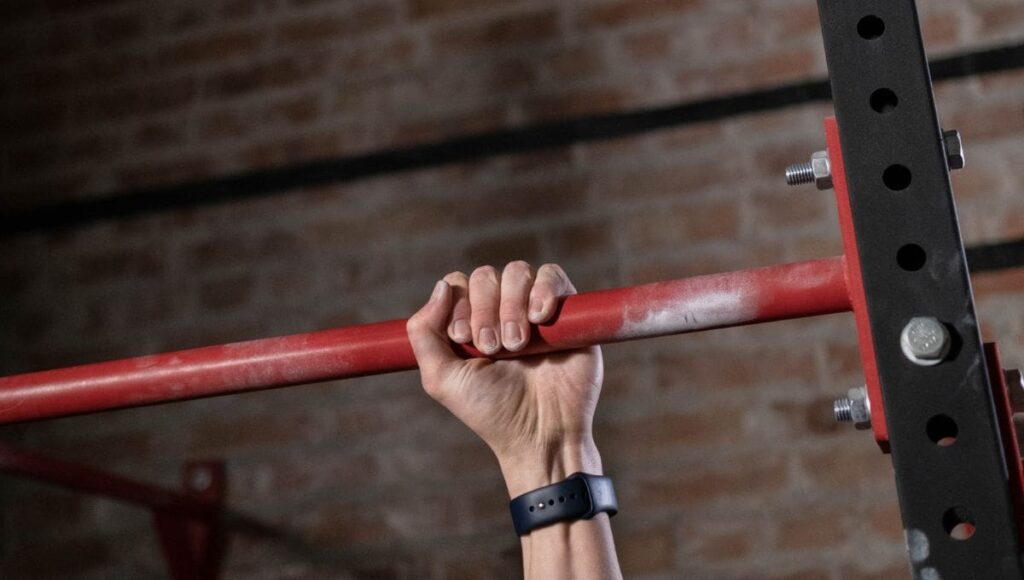
When you grip a barbell, dumbbell, kettlebell, or other object, the finger flexors must contract forcefully to prevent the object from slipping. This repeated loading creates a strong stimulus for adaptation.
Studies examining handgrip training have demonstrated significant improvements in grip strength and forearm muscular development through consistent practice. Grip intensive exercises also recruit a large percentage of the forearm musculature simultaneously, making them highly efficient.
The Best Grip Exercises for Beginners
Instead of immediately adding complicated isolation exercises, beginners should first master simple grip focused movements. Some of the most effective include:
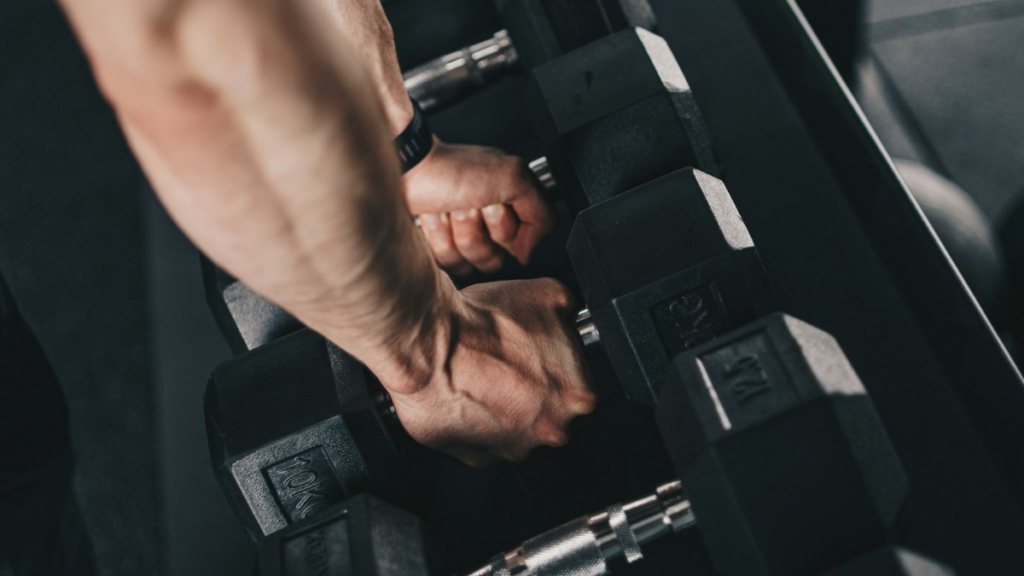
- Farmer carries
- Dead hangs
- Heavy barbell holds
- Towel hangs
- Suitcase carries
- Plate pinches
Farmer carries deserve special attention because they train grip strength, core stability, posture, and conditioning simultaneously. To perform a farmer carry:
- Pick up a pair of heavy dumbbells.
- Stand tall with shoulders back.
- Walk slowly while maintaining control.
- Continue until your grip begins to fail.
Dead hangs are equally effective. Hanging from a pull up bar places continuous tension on the forearm muscles while also improving shoulder mobility and endurance.
Progressive Overload Still Applies
Many people mistakenly believe forearm training should involve endless high repetitions. Like every other muscle group, the forearms respond to progressive overload. This means gradually increasing:
- Weight
- Duration
- Distance
- Training volume
For example:
Week 1: Farmer carry with 30 pound dumbbells for 30 seconds.
Week 4: Farmer carry with 40 pound dumbbells for 45 seconds.
Week 8: Farmer carry with 50 pound dumbbells for 60 seconds.
These small progressions create substantial long term improvements.
Tip 2: Train Both Wrist Flexors and Extensors
One of the biggest mistakes beginners make is focusing exclusively on gripping exercises. While gripping develops the flexor muscles effectively, it often leaves the extensor muscles undertrained. Balanced development requires attention to both sides of the forearm.
Understanding Forearm Balance
Most daily activities involve gripping and closing the hand. As a result, the flexor muscles often receive significantly more stimulation than the extensors. Over time, this imbalance can contribute to:
- Reduced wrist mobility
- Increased injury risk
- Elbow discomfort
- Slower overall forearm development
Research examining musculoskeletal balance consistently highlights the importance of training opposing muscle groups. The forearms are no exception.
The Best Wrist Flexor Exercises
The wrist flexors are located on the palm side of the forearm. Effective exercises include:
- Wrist curls
- Reverse curls
- Thick grip holds
- Hammer curls
- Farmer carries
Traditional wrist curls remain one of the simplest methods for directly targeting these muscles. Sit on a bench, rest your forearms on your thighs, and allow the wrists to move through a full range of motion. Use controlled repetitions rather than swinging the weight.

The Best Wrist Extensor Exercises
The extensors are located on the back side of the forearm. Effective exercises include:
- Reverse wrist curls
- Wrist extensions with resistance bands
- Reverse curls
- Finger extension work
- Rubber band hand opens
A particularly effective option involves placing a thick rubber band around the fingers and repeatedly opening the hand against resistance. This movement targets muscles that are often neglected in traditional gym programs.
Why Reverse Curls Are a Hidden Gem
If beginners could choose only one direct forearm exercise, reverse curls would be a strong candidate. Unlike standard curls, reverse curls use an overhand grip. This grip increases activation of:
- Brachioradialis
- Wrist extensors
- Grip muscles
The brachioradialis is one of the largest muscles contributing to forearm thickness. Research examining electromyography activity during different curling variations shows that grip position significantly influences muscle recruitment patterns. Reverse curls create a strong stimulus for forearm growth while simultaneously strengthening the elbow flexors.
Sample Beginner Forearm Finisher
At the end of an upper body workout:
- Reverse curls: 3 sets of 10 to 15 reps
- Wrist curls: 3 sets of 12 to 15 reps
- Reverse wrist curls: 3 sets of 12 to 15 reps
This short routine can be completed in less than ten minutes while providing a comprehensive forearm stimulus.
Beginner Summary
Balanced development matters. Key points:
- Train both flexors and extensors.
- Include reverse curls regularly.
- Use wrist curls for direct flexor work.
- Add finger extension exercises.
- Focus on full range of motion.
Tip 3: Increase Training Frequency Without Overdoing Volume
The forearms are unique compared to larger muscle groups. Because they are involved in countless daily activities, they often tolerate higher training frequencies than muscles such as the chest or quadriceps.
For beginners, this creates an opportunity. Rather than performing massive forearm workouts once per week, it is usually more effective to spread the workload across multiple sessions.
Why Frequency Matters
Muscle growth is driven by repeated exposure to training stimuli over time. Research on resistance training frequency suggests that distributing training volume across multiple sessions may improve hypertrophy and strength outcomes.
The forearms are especially suited to this approach because they recover relatively quickly. A beginner who performs a few sets of forearm work three or four times per week often achieves better results than someone who performs twenty sets on a single day.
The Skill Component of Grip Strength
Grip strength is not purely muscular. There is also a significant neural component. Frequent exposure improves:
- Motor unit recruitment
- Coordination
- Force production
- Endurance
This means regular practice can improve performance even before substantial muscle growth occurs. Beginners often notice grip strength increasing rapidly during the first several weeks of consistent training. These early gains are largely driven by neurological adaptations.
Practical Weekly Plan
A beginner could follow this simple schedule:
Monday
- Farmer carries
- Reverse curls
Wednesday
- Dead hangs
- Wrist curls
Friday
- Farmer carries
- Reverse wrist curls
Final Thoughts
Building stronger and more muscular forearms does not require complicated programs or endless isolation exercises. For beginners, the most effective strategy is surprisingly simple. First, prioritize direct grip training through loaded carries, hangs, and holds. Second, train both wrist flexors and extensors to create balanced development. Third, increase training frequency while keeping volume manageable and recovery adequate. These three principles are strongly supported by exercise science and practical experience. When applied consistently, they can transform weak forearms into one of the strongest and most impressive parts of your physique.
Remember that forearm development is not just about looking better. Strong forearms improve performance in almost every strength training exercise, enhance daily function, and contribute to long term physical capability. Stay consistent, progressively challenge your grip, and give the muscles time to adapt. The results will come.
References
- Bohannon, R.W. (2019) ‘Grip strength: An indispensable biomarker for older adults’, Clinical Interventions in Aging, 14, pp. 1681 to 1691.
- Cronin, J., Lawton, T., Harris, N., Kilding, A. and McMaster, D.T. (2017) ‘A brief review of handgrip strength and sport performance’, Journal of Strength and Conditioning Research, 31(11), pp. 3187 to 3217.
- Folland, J.P. and Williams, A.G. (2007) ‘The adaptations to strength training: Morphological and neurological contributions to increased strength’, Sports Medicine, 37(2), pp. 145 to 168.
- Grgic, J., Schoenfeld, B.J., Davies, T.B., Lazinica, B., Krieger, J.W. and Pedisic, Z. (2018) ‘Effect of resistance training frequency on gains in muscular strength: A systematic review and meta analysis’, Sports Medicine, 48(5), pp. 1207 to 1220.
- Keogh, J.W.L., Weber, C.L. and Dalton, C.T. (1999) ‘Evaluation of anthropometric, physiological, and skill related tests for talent identification in female field hockey’, Canadian Journal of Applied Physiology, 24(4), pp. 397 to 409.