































Why the Reverse-Grip Bench Press Deserves a Second Look for Chest Training

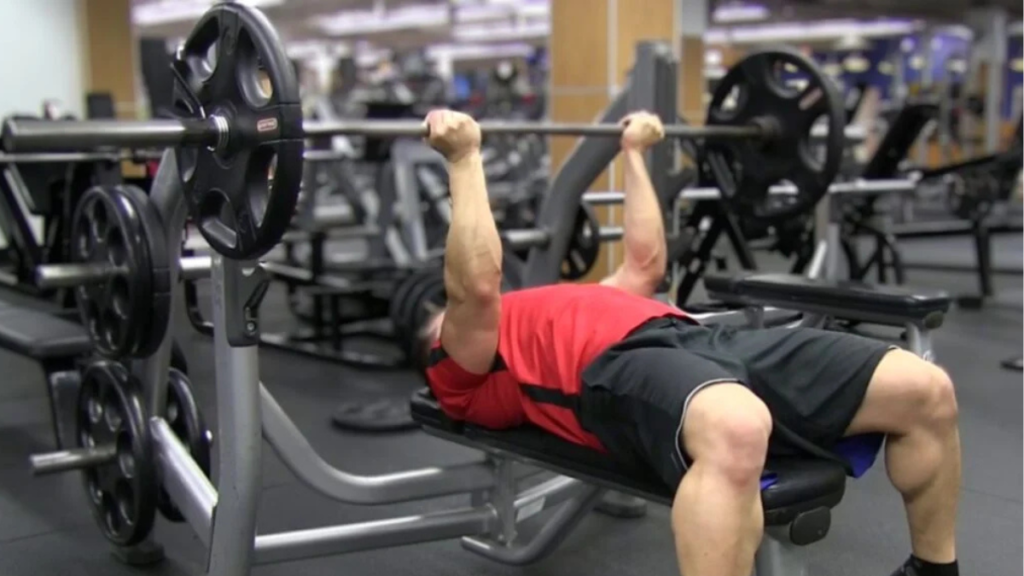
It’s an unusual way to bench press, but does it deserve a place in your training? Will it help you achieve your benching goals?
How Underhand Grip Mechanics Change Pectoral and Shoulder Involvement
Standard bench pressing locks your hands into a pronated, overhand position that naturally encourages wider elbow abduction as the bar moves down toward your chest. While a wide overhand grip recruits substantial pectoralis major activity, it can also place higher mechanical demand on the front of the shoulder joint when elbows flare wide at the bottom of the rep.
Switching to a supinated, reverse grip encourages your elbows to tuck closer to your torso and alters the line of pull across the clavicular and sternocostal fibers of the pectoralis major.
Reverse-Grip vs Standard Overhand Bench Press Comparison
| Feature | Reverse-Grip Bench Press | Standard Overhand Bench Press |
| Hand Orientation | Supinated underhand grip | Pronated overhand grip |
| Elbow Path | Naturally tucked closer to torso | More prone to wider abduction or flare |
| Chest Emphasis | Strong upper pectoral and pressing stimulus | Broad sternal and mid-pectoral stimulus |
| Primary Setup Caveat | Requires careful unracking, spotting, and wrist alignment | Familiar rack setup with standard bar path |
Practical Advantages for Chest Development and Joint Comfort
For lifters who feel their front deltoids taking over every time they set up on an incline bench, a flat or slightly angled reverse-grip press offers a refreshing alternative angle. Because your elbows naturally track closer to your ribs, the pressing path feels more compact and controlled, often allowing you to focus on squeezing the upper chest without excessive shoulder flare.

Triceps Synergy and Pressing Control
A reverse grip also recruits the triceps brachii actively through the pressing motion, helping you lock out sets cleanly while maintaining solid torso tension. Rather than turning into a sloppy bounce off the chest, a controlled reverse-grip press rewards smooth lowering, stacked wrists over the forearms, and deliberate bar control from start to finish.
Safety Rules Before You Load Heavy Weight
Because flipping your grip reverses how the bar sits in your hands and changes how you unrack and rerack the weight, careful setup is non-negotiable. Always wrap your thumbs securely around the bar rather than using an open thumbless grip, start with a moderate weight to learn the groove, and use a spotter or safety pins when pushing close to failure.
Keep your wrists stacked straight above your forearms rather than bending backward under heavy resistance, and stop any set immediately if you feel sharp wrist or shoulder discomfort.
How to Program the Reverse-Grip Bench Press Effectively
Treating the reverse-grip bench press as a purposeful secondary or supplemental movement rather than a reckless max-effort test makes it much easier to progress safely. Try performing three to four sets of eight to twelve clean repetitions after your main warm-ups or alongside your standard chest work, resting roughly ninety seconds to two minutes between sets. Pairing controlled reverse-grip presses with cable flyes, dumbbell presses, or rows gives you balanced upper-body development while keeping your training fresh across multi-week blocks.
Consistency over time, steady progression in clean repetitions or load, adequate daily protein, and quality recovery remain the true foundations of building a thicker chest. Give the reverse-grip bench press a fair, well-coached trial over the next several weeks and pay attention to how your upper chest and shoulders respond.
Key Takeaways for Reverse-Grip Chest Training
| Training Factor | Practical Rule | Why It Matters |
| Grip and Elbow Path | Use a closed underhand grip with tucked elbows | Supports upper chest tension and cleaner arm path |
| Loading and Reps | Train for 8 to 12 controlled reps before pushing max loads | Builds muscle stimulus while keeping technique sharp |
| Safety Habits | Keep wrists stacked and use safeties or a spotter | Reduces risk during unracking, pressing, and reracking |
| Program Fit | Pair with balanced chest, back, and recovery habits | Sustains long-term hypertrophy without overuse |
References
- Lehman, G.J. (2005) ‘The influence of grip width and hand orientation on muscle activity during the bench press’, Strength and Conditioning Journal, 27(5), pp. 29–34.
- Rodríguez-Ridao, D., Antequera-Vique, J.A., Martín-Fuentes, I. and Muyor, J.M. (2020) ‘Effect of five bench inclinations on the electromyographic activity of the pectoralis major, anterior deltoid, and triceps brachii during the bench press exercise’, International Journal of Environmental Research and Public Health, 17(19), p. 7339.
- Roy, X. and Sercia, P. (2020) ‘The effect of 12 variations of the bench press exercise on the EMG activity of three heads of the pectoralis major’, International Union of Strength and Conditioning Authors Journal, 1(1), pp. 1–11.
- Schoenfeld, B.J. (2010) ‘The mechanisms of muscle hypertrophy and their application to resistance training’, Journal of Strength and Conditioning Research, 24(10), pp. 2857–2872.
Robbie Wild Hudson
Editor-In-Chief at BOXROX. I come from a background of rugby and weightlifting. Growing up in the English Lake District, I spent a great deal of time swimming in its stunning lakes and rivers. In 2015 my brothers and I became the first people to swim the 145km length of the River Eden, from source to mouth, in 9 days. We also swam the Corryvreckan whirlpool, the third largest in the world, and Crossfit is a huge part of my training for these events.
More from Robbie Wild Hudson