






















Cable Chest Flyes vs Pec Deck: Which Builds a Better-Looking Chest?


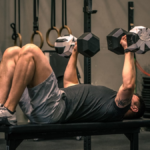
Aside from the big hitters such as the barbell and dumbbell bench presses (and all their variations), machines and cables can be fantastic ways to grow, develop and strengthen your chest.
Find out how to use each method, what exercises are good, and which one could be better for your goals.
The Anatomy of a Well-Proportioned Chest
Building an eye-catching chest requires stimulating both the large sternocostal head across the middle and lower chest and the clavicular head up near your collarbone.
Unlike flat or incline presses where your triceps and anterior deltoids shoulder a heavy portion of the load, fly variations keep your elbows at a relatively fixed angle to isolate horizontal shoulder adduction. This single-joint focus lets you pour mechanical tension straight into the pectoral fibers even after your triceps are too fatigued to press another heavy barbell or dumbbell.

Electromyography research comparing chest exercises demonstrates that machine fly movements elicit high pectoralis major activation comparable to traditional pressing exercises while reducing triceps involvement. However, how resistance is applied across the arc of motion determines whether your pecs work hardest in the deep stretch, the middle range, or the peak contraction. That subtle difference in resistance profile is where cables and the pec deck part ways.
How Cable Chest Flyes Challenge Your Pecs
Cable flyes provide smooth, continuous tension throughout the entire range of motion because the weight stack pulls along the line of the cable rather than relying strictly on vertical gravity. Even better, adjusting pulley height lets you subtly shift emphasis between upper, middle, and lower pectoral fibers while stepping slightly forward or backward changes where peak tension lands. Because your arms move freely in three dimensions, your shoulder stabilizers and core also stay engaged to control the path of each repetition.
Recent sports science highlights that training muscles at long, stretched muscle lengths promotes superior hypertrophy compared to emphasizing only shortened contractions. With cables, setting the pulleys slightly behind your torso allows you to achieve a deep, controlled stretch across the sternocostal and clavicular fibers before sweeping your hands together. The main trade-off is that standing cable flyes require balance and strict torso control, meaning fatigue in your core or shoulders can sometimes creep in before your pecs reach true muscular failure.
How the Pec Deck Maximizes Stability and Output
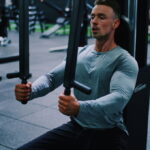
The seated pec deck machine locks your torso against a supportive backrest and guides your arms along a predetermined circular track. Because you do not have to balance your body or stabilize stray wrist and elbow angles, you can channel nearly all your mental focus and neuromuscular drive directly into contracting your chest.
Many modern pec deck machines also use a cam mechanism designed to keep resistance steady even as your hands come together in front of your sternum.
Controlled training studies comparing machine-based resistance and free-moving resistance show that high stability allows lifters to push sets close to muscular failure safely with minimal form breakdown.
For beginners or tired lifters finishing an intense chest workout, the pec deck eliminates awkward shoulder drift and protects the anterior shoulder capsule from overstretching under fatigue. The primary limitation is that a fixed lever path cannot always be customized to every individual arm length or ribcage angle quite as freely as adjustable cables.
Biomechanical and Practical Comparison of Cable Chest Flyes and the Pec Deck
| Training Factor | Cable Chest Flyes | Pec Deck Machine | Best Practical Application |
| Stability and Balance | Moderate, requiring active core and shoulder stabilization | High, with back support and a fixed movement path | Use the pec deck when fatigued; use cables when fresh and focused |
| Angle Versatility | Very high via adjustable pulley heights and body stance | Limited to horizontal seat height adjustments | Choose cables to target upper, mid, or lower pectoral fibers |
| Stretched-Position Tension | High when pulleys are set slightly behind the torso | Moderate to high depending on starting arm stop settings | Use cables for deep loaded stretches; set pec deck stops safely |
| Pushing Close to Failure | Good, though torso sway can limit final reps | Excellent, allowing safe effort right to muscular failure | Finish chest workouts on the pec deck to safely exhaust the pecs |
Which One Builds a Better-Looking Chest?
So which movement deserves the crown for sculpting an impressive chest? Both exercises build identical muscle tissue when taken close to muscular failure with progressive overload, yet each tool shines under different circumstances. Cable chest flyes win on versatility and deep, customizable stretch angles that help round out both the upper and lower chest fibers, whereas the pec deck wins on pure stability and safe, high-effort execution when fatigue is high.
The Best Arm Workout Men Over 40 Can Do
Meta-analytic research comparing training loads confirms that moderate loads lifted in the ten to fifteen repetition range produce robust hypertrophy when sets approach muscular failure. Similarly, evidence on weekly training frequency indicates that training your chest twice per week supports superior growth compared to blasting it once a week. Rotating cable flyes into your first weekly chest session for angle variety and finishing your second session on the pec deck gives you the best of both worlds without beating up your shoulder joints.
Key Takeaways
| Decision Category | Practical Recommendation | Scientific Rationale |
| Primary Verdict | Use both tools across your training week rather than picking one | Both produce high pectoral activation when pushed close to muscular failure |
| Best for Versatility | Choose cable flyes with adjustable pulley heights | Allows customized angles to emphasize upper, middle, or lower chest fibers |
| Best for Safety and Output | Choose the seated pec deck late in your workout | High external stability lets you train safely to failure without balance loss |
| Optimal Programming | Perform 3 sets of 10 to 15 controlled reps twice per week | Aligns with evidence on moderate-load hypertrophy and twice-weekly frequency |
References
- Haugen, M.E., Vårvik, F.T., Larsen, S., Haugen, A.S., van den Tillaar, R. and Bjørnsen, T., 2023. Effect of free-weight vs. machine-based strength training on maximal strength, hypertrophy and jump performance: a systematic review and meta-analysis. Sports Medicine – Open, 9(1), p.103.
- Schoenfeld, B.J., Grgic, J., Ogborn, D. and Krieger, J.W., 2017. Strength and hypertrophy adaptations between low- vs. high-load resistance training: a systematic review and meta-analysis. Journal of Strength and Conditioning Research, 31(12), pp.3508-3523.
- Schoenfeld, B.J., Ogborn, D. and Krieger, J.W., 2016. Effects of resistance training frequency on measures of muscle hypertrophy: a systematic review and meta-analysis. Sports Medicine, 46(11), pp.1689-1697.
- Welsch, E.A., Bird, M. and Mayhew, J.L., 2005. Electromyographic activity of the pectoralis major and anterior deltoid muscles during three upper-body lifts. Journal of Strength and Conditioning Research, 19(2), pp.449-452.
- Wolf, M., Androulakis-Korakakis, P., Fisher, J., Schoenfeld, B. and Steele, J., 2023. Partial vs full range of motion resistance training: a systematic review and meta-analysis. International Journal of Strength and Conditioning, 3(1), pp.1-15.
Robbie Wild Hudson
Editor-In-Chief at BOXROX. I come from a background of rugby and weightlifting. Growing up in the English Lake District, I spent a great deal of time swimming in its stunning lakes and rivers. In 2015 my brothers and I became the first people to swim the 145km length of the River Eden, from source to mouth, in 9 days. We also swam the Corryvreckan whirlpool, the third largest in the world, and Crossfit is a huge part of my training for these events.
More from Robbie Wild Hudson