


















Seated vs Lying Leg Curls: Which Builds Bigger and Stronger Hamstrings?


If you want bigger, stronger and tougher legs, which of these variations should you use?
Why Hip Angle Changes Everything for Hamstring Growth
Your hamstrings are not just one simple muscle running down the back of your thigh, because they consist of three distinct muscles called the semitendinosus, semimembranosus, and biceps femoris.
Three of the four hamstring heads, including the semitendinosus, semimembranosus, and the long head of the biceps femoris, are biarticular muscles that cross both your hip joint and your knee joint. Only the short head of the biceps femoris crosses solely the knee joint, meaning your hip position directly alters how stretched or slack the majority of your hamstring tissue sits before you even start bending your knees.
When you sit upright in a seated leg curl machine with your torso near ninety degrees relative to your thighs, your hips are flexed, which pulls the proximal attachments of those biarticular hamstrings taut over your pelvis. Conversely, when you lie flat on a prone leg curl bench, your hips stay extended in a straight line, leaving the upper portion of your hamstrings in a much shorter, less stretched starting position. Recent exercise science research on muscle hypertrophy consistently demonstrates that training muscles at longer, stretched muscle lengths promotes significantly greater muscle growth than training them in shortened positions.
What Science Says About Seated vs Lying Leg Curls
For years, lifters debated seated versus lying leg curls based purely on personal feel and gym lore until sports scientists put both machines head to head in controlled training trials. In a landmark twelve-week hypertrophy study where participants trained one leg on a seated leg curl machine and the opposite leg on a lying leg curl machine with matched volume and intensity, researchers measured muscle volume changes across all individual hamstring heads using magnetic resonance imaging.
The findings were striking because the seated leg curl produced substantially greater overall hamstring hypertrophy than the lying leg curl, specifically driving superior growth in the biarticular semitendinosus, semimembranosus, and biceps femoris long head. Meanwhile, the single-joint biceps femoris short head grew similarly in both variations because its length does not change with hip angle.
Systematic reviews examining range of motion and muscle length during resistance training reinforce this mechanism, confirming that mechanical tension applied while a muscle is stretched stimulates stronger hypertrophic signaling.
Where Lying Leg Curls Still Earn Their Keep
Even though seated leg curls win the head-to-head hypertrophy comparison, lying leg curls still offer genuine practical benefits that make them valuable in a smart leg program. Because your hips remain extended on a lying leg curl bench, the exercise mimics the hip position of sprinting, running, and athletic locomotion more closely than sitting upright. Some lifters also find that lying leg curls feel more comfortable if they have tight hamstrings or lower-back sensitivity when sitting upright with straight legs under heavy load.
3 Best Kettlebell Exercises for a Jacked and Great Looking Upper Body
Additionally, rotating between seated and lying leg curls across different training blocks or sessions prevents repetitive overuse stress around the back of the knee and hamstring tendons. Meta-analytic evidence on resistance training frequency shows that training a muscle group twice per week supports superior muscle growth compared to once-weekly training, giving you plenty of room to include both variations if you enjoy variety.
Comparing Seated Leg Curls and Lying Leg Curls for Hamstring Hypertrophy
| Training Factor | Seated Leg Curls | Lying Leg Curls | Best Practical Application |
| Hip Joint Position | Flexed around 90 degrees, placing biarticular hamstrings on stretch | Extended flat on the bench, keeping upper hamstrings shorter | Choose seated curls to maximize stretched-position tension |
| Overall Hypertrophy Stimulus | Superior growth across semitendinosus, semimembranosus, and long head | Solid growth, especially in the single-joint biceps femoris short head | Make seated leg curls your primary knee-flexion mass builder |
| Comfort and Setup | Locks thighs down firmly with minimal lower-back arching | Feels natural for lifters with tight hamstrings or hip stiffness | Use lying curls if seated setups feel overly tight at the knee |
| Athletic Carryover | Emphasizes knee flexion from a flexed hip posture | Mimics knee flexion mechanics during running and sprinting | Rotate lying curls into athletic blocks or second weekly leg days |
How to Build Complete Hamstrings Beyond Leg Curls
While seated leg curls are the clear winner between the two leg curl machines, relying solely on knee-flexion machines leaves an important piece of hamstring development on the table. Because the hamstrings both bend the knee and extend the hip, research examining regional hamstring activation shows that knee-dominant leg curls and hip-dominant hinges like Romanian deadlifts emphasize different regions of the hamstring muscles.
Combining a stretched knee-flexion movement like the seated leg curl with a hip-hinge exercise ensures complete growth from the glute tie-in all the way down behind the knee.
1. Prioritize Seated Leg Curls With Controlled Lowering
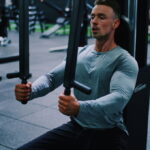
Set the backrest and thigh pad snugly on the seated leg curl machine so your knees align cleanly with the machine pivot point and your pelvis stays planted against the seat. Pull your heels smoothly toward the seat, pause briefly at full contraction, and take three full seconds to control the weight back to a full, comfortable knee extension on every repetition.
2. Pair Knee Flexion With a Hip Hinge Each Week
Alongside three working sets of seated leg curls in the eight to fifteen repetition range taken close to muscular failure, include a hip-hinge movement such as Romanian deadlifts or forty-five-degree back extensions during your weekly leg training. Research on resistance training loads confirms that moderate weights lifted close to muscular failure stimulate robust hypertrophy, allowing you to focus on clean form and deep stretch rather than rushing heavy weights.
3. Use Lying Leg Curls for Variety or Second Leg Sessions
If you train legs twice per week, you can perform seated leg curls on your first lower-body day and either repeat seated leg curls or swap in lying leg curls on your second day. Keeping your hips pressed gently into the pad on lying leg curls stops your lower back from lifting and keeps tension locked directly onto your hamstrings.
Key Takeaways
| Decision Area | Evidence-Based Guidance | Why It Matters for Bigger Hamstrings |
| Head-to-Head Winner | Seated leg curls beat lying leg curls for overall hamstring muscle growth | Flexed hips place the biarticular hamstrings under greater loaded stretch |
| Muscle Head Differences | Both grow the short head similarly, while seated grows the long heads more | Three of the four hamstring heads cross the hip and respond to hip flexion |
| Complete Development | Pair seated leg curls with a hip-hinge exercise like Romanian deadlifts | Knee flexion and hip extension target distinct regions of the hamstrings |
| Weekly Programming | Train hamstrings twice per week using controlled reps near failure | Supports stronger hypertrophy outcomes while protecting tendons and joints |
References
- Maeo, S., Huang, M., Wu, Y., Sakurai, H., Kusagawa, Y., Sugiyama, T., Kanehisa, H. and Isaka, T., 2021. Greater hamstrings muscle hypertrophy but similar damage protection after training at long versus short muscle lengths. Medicine and Science in Sports and Exercise, 53(4), pp.825-837.
- Schoenfeld, B.J., Contreras, B., Tiryaki-Sonmez, G., Wilson, J.M., Kolber, M.J. and Peterson, M.D., 2015. Regional differences in muscle activation during hamstrings exercise. Journal of Strength and Conditioning Research, 29(1), pp.159-164.
- Schoenfeld, B.J., Grgic, J., Ogborn, D. and Krieger, J.W., 2017. Strength and hypertrophy adaptations between low- vs. high-load resistance training: a systematic review and meta-analysis. Journal of Strength and Conditioning Research, 31(12), pp.3508-3523.
- Schoenfeld, B.J., Ogborn, D. and Krieger, J.W., 2016. Effects of resistance training frequency on measures of muscle hypertrophy: a systematic review and meta-analysis. Sports Medicine, 46(11), pp.1689-1697.
- Wolf, M., Androulakis-Korakakis, P., Fisher, J., Schoenfeld, B. and Steele, J., 2023. Partial vs full range of motion resistance training: a systematic review and meta-analysis. International Journal of Strength and Conditioning, 3(1), pp.1-15.
Robbie Wild Hudson
Editor-In-Chief at BOXROX. I come from a background of rugby and weightlifting. Growing up in the English Lake District, I spent a great deal of time swimming in its stunning lakes and rivers. In 2015 my brothers and I became the first people to swim the 145km length of the River Eden, from source to mouth, in 9 days. We also swam the Corryvreckan whirlpool, the third largest in the world, and Crossfit is a huge part of my training for these events.
More from Robbie Wild Hudson