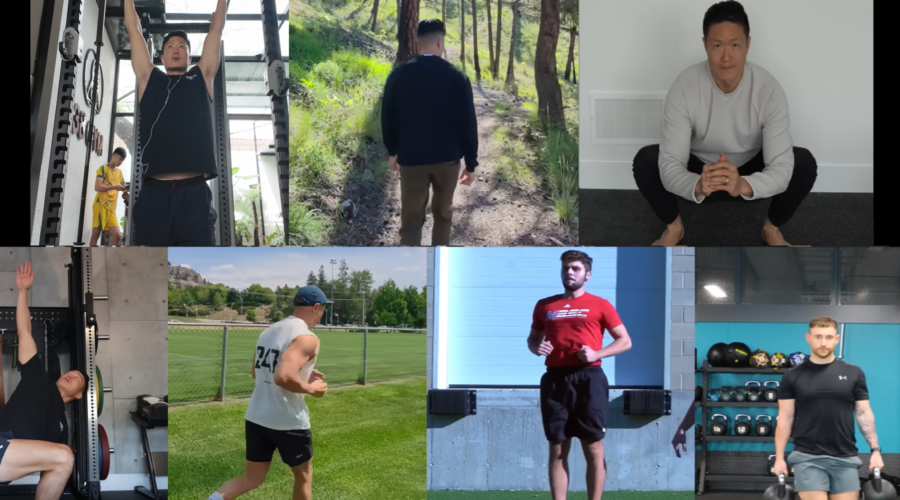


Many people accept stiffness, declining strength, and reduced mobility as unavoidable parts of aging. High-performance coach Dan Go disagrees. In a recent YouTube video, the coach shared the seven exercises he personally relies on at age 46 to maintain strength, athleticism, and independence while helping clients ranging from their 30s to their 70s achieve similar results.
Rather than chasing complicated workout routines, Go focuses on movement patterns backed by research that improve mobility, cardiovascular fitness, power, and resilience. Together, they form a practical framework for staying capable well into later life.


Bar Hangs Build Grip Strength and Shoulder Health
Go begins with one of the simplest exercises available: the bar hang.
He explains that hanging from a pull-up bar helps decompress the spine, improve shoulder function, and develop grip strength, which research has linked to longevity.
As Go puts it, “Grip strength isn’t just about opening jars. Researchers literally use it as a biomarker for longevity.”
He recommends beginners start with assisted hangs using a chair before progressing toward longer dead hangs and eventually more advanced variations like scapular pulls and one-arm hangs.

Japanese Interval Walking Improves Cardiovascular Fitness
For cardio, Go recommends Japanese Interval Walking, a protocol developed by Dr. Hiroshi Nose that alternates three minutes of brisk walking with three minutes of slower recovery walking.
According to Go, the approach offers an accessible way to improve aerobic fitness without requiring high-impact exercise.
He explains, “Your cardio is your longevity base and the IWT is the lowest friction way to rebuild it.”
The method can also be made more challenging over time by adding hills, a weighted vest, or a rucksack.
The Asian Squat Restores Everyday Mobility
The deep squat isn’t just another exercise in Go’s program. He considers it a fundamental human position that many adults gradually lose.
Maintaining the ability to comfortably rest in a squat helps preserve ankle mobility, hip function, spinal health, and independence.
Go emphasizes its importance by saying, “This squat is not optional. It is literal survival training, and it’s a signal for how old you are.”
Beginners can elevate their heels or hold onto support while gradually increasing time spent in the position.
The World’s Greatest Stretch Keeps Joints Moving
Mobility also plays a central role in Go’s approach.
His fourth recommendation is the World’s Greatest Stretch, a flowing movement that mobilizes the hips, thoracic spine, ankles, calves, and shoulders in a single sequence.
Rather than stretching isolated muscles, the exercise encourages multiple joints to move together, helping reduce stiffness and improve overall movement quality.
Zone 2 Cardio Builds the Engine for Longevity
Go also highlights the importance of Zone 2 cardio, performed at an intensity where conversation remains possible while breathing becomes slightly more challenging.
Whether through walking, cycling, rowing, or other low-impact activities, this style of training improves aerobic capacity while supporting recovery.
He notes, “Zone two is your cardiovascular base that everything else sits on. If you skip it, then the rest of your training has a ceiling.”
Plyometrics Preserve Athleticism
Explosive movements become increasingly valuable with age because power declines faster than strength.
Go recommends matching plyometric training to current ability, beginning with low-impact hops before progressing to jumps and more advanced variations.
As he explains, “Strength keeps you alive, but power is what keeps you young.”
Developing power helps improve reaction time, balance, and the ability to recover from trips or unexpected movements.
Loaded Carries Develop Real-World Strength
Go finishes with loaded carries, calling them the one exercise he would choose if limited to a single movement for life.
Farmer’s carries, suitcase carries, and overhead carries challenge grip strength, posture, core stability, breathing, and muscular endurance simultaneously while closely mimicking everyday tasks such as carrying groceries, luggage, or children.
The Takeaway
Dan Go’s recommendations share a common theme: prioritize movements that improve how your body functions, not just how it looks. By combining hanging, walking, squatting, mobility work, aerobic training, explosive exercises, and loaded carries, he believes people can maintain strength, mobility, and independence for decades. Instead of accepting physical decline as inevitable, his approach encourages building habits that allow the body to stay capable long after middle age.
About the Author
Jeremiah Oliva
Jeremiah Oliva is a writer passionate about fitness, sports, and active living. He has experience in songwriting and managing content and social media for online radio and magazine platforms.
He covers HYROX, CrossFit®, and competitive fitness, with a focus on performance, mindset, and athlete development.
Outside of writing, Jeremiah trains in boxing, cycles, explores the outdoors with his kids, and plays the guitar.