



























Incline Curls vs Cable Curls: Which Builds Bigger Biceps for Beginners?


Both the incline and cable curl train the biceps in different ways, but which one is better for you?
Time to find out how to take your arms to the next level.
How Resistance Curves and Muscle Length Shape Biceps Growth
Building noticeable thickness in the biceps brachii requires placing meaningful mechanical tension on the muscle fibers while keeping form controlled and joints happy.
The biceps has a short head and a long head, with the long head forming the outer contour of your arm and crossing both the shoulder and elbow joints. When your arm is positioned slightly behind your torso on an incline bench, the long head experiences greater elongation at the bottom of the repetition, whereas cable machines alter the direction of force across the entire arc of motion.
Recent hypertrophy research comparing training at long versus short muscle lengths shows that training elbow flexors at longer muscle lengths can produce greater muscle growth than training only at shorter muscle lengths.
At the same time, systematic reviews on variable or constant resistance suggest that overall muscle hypertrophy is largely comparable across resistance profiles when total effort and volume are matched, meaning the best choice often comes down to control, stretch, and consistency. For a beginner still learning to feel the target muscle without swinging the torso, that difference in setup and tension profile matters right away.
Incline Curls vs Cable Curls Comparison
| Feature | Incline Dumbbell Curls | Cable Curls |
| Stretch Position | Deep stretch on long head with arm behind torso | Moderate to strong stretch depending on pulley height |
| Resistance Curve | Easiest at bottom, hardest near mid-range, drops at top | Smooth, steady pull across most of the range of motion |
| Beginner Control | Can trigger shoulder sway or elbow drift if too heavy | Cable guides line of pull and encourages steady tempo |
| Best Beginner Role | Building long-head stretch and outer arm fullness | Learning smooth control and finishing sets safely |
Where Incline Curls Shine for Beginners
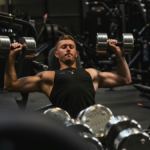
Leaning back on a bench set around forty-five to sixty degrees puts your upper arms slightly behind your body, which creates a distinct stretch through the front of the biceps before you even start curling. Beginners often love how intense that bottom stretch feels because it immediately signals that the muscle is working through a generous range of motion. Because the long head plays a big role in overall arm thickness, loading the biceps in a stretched position offers an appealing stimulus when paired with controlled repetitions.
Managing Shoulder Comfort and Momentum
Even though incline curls feel great on the biceps, leaning back on an angled bench can put extra stretch and stress on the front of the shoulder joint if you rush the bottom or use dumbbells that are too heavy. Beginners sometimes let their elbows drift forward or swing their upper back to get the weight moving, which turns a strict curl into a sloppy heave. Keeping your shoulder blades pinned back against the pad and lowering the dumbbells smoothly for two to three seconds keeps the tension right where it belongs.
Where Cable Curls Shine for Beginners
Walking up to a low pulley and grabbing a straight bar, EZ attachment, or D-handle gives beginners a very forgiving, consistent way to practice strict curl mechanics. Because the cable pulls along a fixed line rather than relying solely on vertical gravity, tension stays more even through parts of the lift where free weights sometimes feel light or awkward. That steady pull makes it easier for newer lifters to feel their biceps working from start to finish without losing rhythm.
Building Clean Technique and Safe Proximity to Failure
Learning how to push sets close to muscular failure without letting form fall apart is one of the most valuable skills a beginner can develop. Research on proximity to failure indicates that training close to failure supports muscle hypertrophy, especially when repetitions stay clean and controlled. Cable curls make it straightforward to stop right when your biceps slow down cleanly, and adjusting the pin on a weight stack takes seconds compared to re-racking heavy dumbbells on a tilted bench.
The Best Arm Workout for Men Over 30
Which One Should You Pick for Bigger Biceps?
If you have to choose one movement to anchor your beginner arm routine first, cable curls often give newer lifters a slight edge in learning clean control and consistent tension, while incline curls shine as a high-stretch complement once your form is steady. You do not actually have to treat them as bitter rivals because rotating both or pairing them across the week lets you benefit from a deep stretch and smooth, consistent resistance. Pick the variation that lets you keep your elbows steady, control the lowering phase, and progress your reps or weight week after week.
Consistent effort, adequate daily protein, and solid sleep will always do the heavy lifting for beginner muscle growth far more than chasing a magic exercise. Stick with clean repetitions over eight to fifteen reps, log your numbers each session, and give your arms the recovery time they need to grow.
Key Takeaways for Beginner Biceps
| Decision Area | Practical Guideline | Why It Helps Beginners |
| Muscle Length Stimulus | Include stretched positions like incline curls carefully | Longer muscle lengths can enhance hypertrophy potential |
| Beginner Control | Use cable curls to practice steady tempo and clean stops | Consistent cable pull helps keep form smooth |
| Joint and Form Care | Avoid swinging or letting elbows drift excessively | Protects shoulders and keeps tension on the biceps |
| Long-Term Progress | Track reps and weights while prioritizing protein and sleep | Drives steady arm growth without guesswork |
References
- Maeo, S., Wu, Y., Huang, M., Sakurai, H., Kusagawa, Y., Sugiyama, T., Kanehisa, H. and Isaka, T. (2023) ‘Greater elbow flexor muscle hypertrophy but similar strength gain after training at long vs. short muscle lengths’, Medicine & Science in Sports & Exercise, 55(4), pp. 746–756.
- Morton, R.W., Murphy, K.T., McKellar, S.R., Schoenfeld, B.J., Henselmans, M., Helms, E., Aragon, A.A., Devries, M.C., Banfield, L., Krieger, J.W. and Phillips, S.M. (2018) ‘A systematic review, meta-analysis and meta-regression of the effect of protein supplementation on resistance training-induced gains in muscle mass and strength in healthy adults’, British Journal of Sports Medicine, 52(6), pp. 376–384.
- Robinson, Z.P., Pelland, J.C., Remmert, J.F., Refalo, M.C., Jukic, I., Steele, J. and Zourdos, M.C. (2024) ‘Exploring the dose-response relationship between estimated resistance training proximity to failure, strength gain, and muscle hypertrophy: A series of meta-regressions’, Sports Medicine, 54(9), pp. 2209–2231.
- Schoenfeld, B.J., Grgic, J., Ogborn, D. and Krieger, J.W. (2017) ‘Strength and hypertrophy adaptations between low- vs. high-load resistance training: A systematic review and meta-analysis’, Journal of Strength and Conditioning Research, 31(12), pp. 3508–3523.
- Thompson, B.J., Stock, M.S., Shields, J.E., Luera, M.J., Munayer, I.K., Mota, J.A., Carrillo, E.C. and Olinghouse, K.D. (2015) ‘Barbell squat training does not enhance maximal squat or jump performance in recreationally active women’, Journal of Strength and Conditioning Research, 29(11), pp. 3082–3090.
Robbie Wild Hudson
Editor-In-Chief at BOXROX. I come from a background of rugby and weightlifting. Growing up in the English Lake District, I spent a great deal of time swimming in its stunning lakes and rivers. In 2015 my brothers and I became the first people to swim the 145km length of the River Eden, from source to mouth, in 9 days. We also swam the Corryvreckan whirlpool, the third largest in the world, and Crossfit is a huge part of my training for these events.
More from Robbie Wild Hudson