
































3 Perfect Banded Chest Exercises for Beginners to Get Stronger Pecs

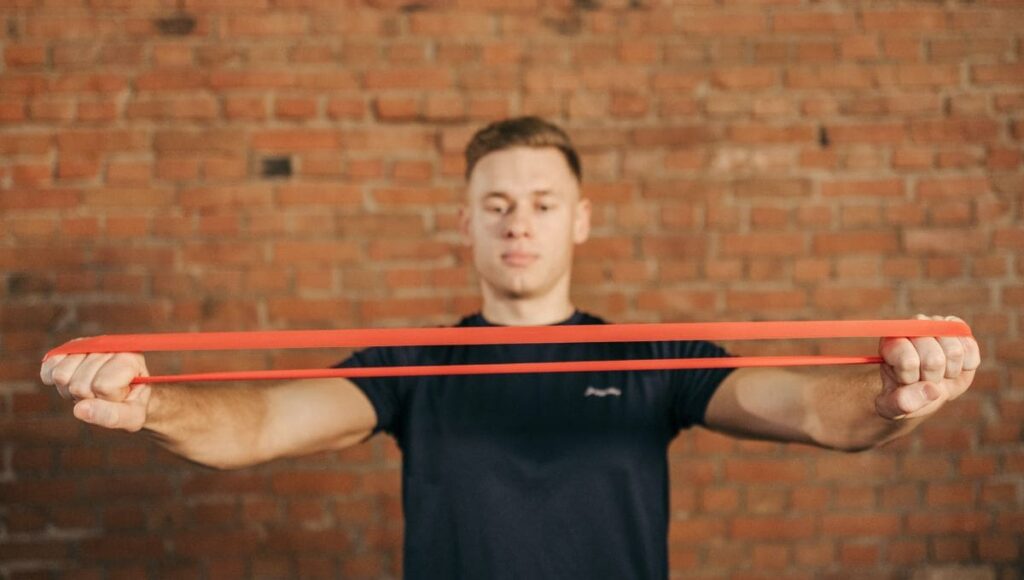
Use these exercises if you want to strengthen your upper body. Each one is designed to challenge your body and improve your physique in different ways.
Why Elastic Resistance Works Well for Beginner Pecs
Your pectoralis major is a broad, fan-shaped muscle across the front of your chest that pulls the upper arm inward across the body and forward during pushing motions. When beginners start out, they often struggle to feel their chest muscles engaging because their anterior deltoids or triceps take over early in a press or push-up.
Elastic bands create progressive tension that increases as the band stretches, meaning resistance is lighter at the stretched start and peaks as you press or bring your hands toward the midline.
Systematic reviews and meta-analyses comparing elastic resistance training with conventional resistance training show that elastic bands can produce comparable strength gains in healthy adults when programmed properly. Because tension builds gradually as the band stretches, beginners can focus on smooth posture, scapular control, and clean pressing paths without getting crushed under heavy weights at the bottom of a rep.
Setting Up Smartly Before You Pull a Band
Even though resistance bands feel light and friendly compared to barbells, beginners still need clear setup habits so their chest muscles do the heavy lifting. Anchoring a band securely at chest height or around a sturdy upright post ensures consistent line of pull, and stepping forward or backward lets you fine-tune tension without hunting for new weights. Always inspect your bands for nicks or wear before training, and keep your torso stacked tall with your shoulder blades slightly retracted so your shoulders stay in a supportive position.
Research on training frequency indicates that training a muscle group twice per week supports superior muscle growth compared to training it only once per week. Performing a focused banded chest routine two times per week with at least forty-eight hours of recovery between sessions gives beginners regular practice to refine technique and stimulate adaptation.
Beginner Banded Chest Routine for Strength and Control
| Exercise | Primary Target | Sets | Reps | Rest | Key Execution Cue |
| Standing Band Chest Press | Pectoralis Major, Anterior Deltoids, and Triceps | 3 | 12 to 15 | 90 sec | Step forward into a staggered stance, keep ribs tucked, and press smoothly to chest height |
| Band-Resisted Push-Up | Pectoralis Major, Triceps, and Anterior Deltoids | 3 | 8 to 15 | 90 sec | Loop the band across your upper back under your palms and lower your chest under control |
| Standing Band Chest Fly | Pectoralis Major (Sternal and Clavicular Fibers) | 3 | 12 to 15 | 60 sec | Maintain a soft bend in your elbows and bring hands together in a wide arc without shrugging |
The 3 Perfect Banded Chest Exercises for Beginners
Performing these three movements twice per week builds pressing coordination, horizontal adduction strength, and peak contraction control across your pecs. Focus on a smooth, unhurried lowering phase on every repetition and pause briefly when your hands reach the finish position to feel your chest muscles working hard.
1. Standing Band Chest Press
The standing band chest press teaches you how to transfer force from a stable athletic stance through your core and chest without needing a bench. Facing away from an anchor point at chest height, hold the band handles or loops with elbows slightly tucked and press forward until your arms extend without locking out harshly.
Electromyographic and biomechanical research on pressing mechanics highlights how controlled horizontal pressing recruits the pectoralis major alongside assisting shoulder and elbow extensors, helping beginners build foundational pushing strength.
2. Band-Resisted Push-Up
Standard push-ups are already a staple bodyweight chest builder, and adding a light band across your upper back increases resistance as you push yourself away from the floor.
Research comparing push-ups and bench pressing at comparable effort levels shows that push-ups can stimulate meaningful upper-body strength and muscle activity when performed with proper mechanics. If full floor push-ups with a band feel too challenging at first, perform them with your hands elevated on a sturdy bench or table while keeping a straight line from head to heels.
3. Standing Band Chest Fly
While presses recruit help from your triceps and front shoulders, a standing band chest fly emphasizes horizontal adduction across the chest with minimal elbow bending.
Anchor the band around chest height, step forward until you feel gentle tension with your arms extended out to your sides, and sweep your hands together in front of your sternum. Electromyographic research on chest exercises underscores the value of adducting movements for targeting the pectoralis major directly, and elastic tension lets you hold a crisp squeeze at the finish of each rep.
How to Progress Without Stalling
Beginners often stall with bands because they keep using the exact same tension and rep count week after week without giving their muscles a new reason to adapt. A simple double-progression approach works well: pick a band resistance that lets you complete twelve clean repetitions with one or two good reps left in reserve. Across upcoming workouts, add one or two repetitions per set until you reach fifteen solid reps on every set, then step up to a slightly thicker band or walk a few inches further from your anchor point.
Pairing gradual tension increases with two sessions per week, steady sleep, and enough daily protein helps beginners build lasting chest strength safely. Stay patient with small milestones, keep your shoulders relaxed away from your ears, and let clean repetitions drive your progress over time.
Key Takeaways
| Training Factor | Recommended Strategy | Why It Helps Beginners |
| Exercise Selection | Combine standing band presses, band-resisted push-ups, and band chest flys | Trains horizontal pressing, push-up mechanics, and chest adduction for balanced pec strength |
| Resistance Mechanics | Use variable band tension taken near muscular failure with clean form | Supports strength gains comparable to traditional resistance when programmed with solid effort |
| Weekly Frequency | Perform the routine twice per week with rest days between sessions | Aligns with evidence favoring twice-weekly training over once-weekly training for growth |
| Progression Method | Build reps up to the top of the range before moving to heavier band tension | Keeps technique crisp and reduces joint irritation as chest strength increases |
References
- Andersen, V., Fimland, M.S., Wiik, E., Skoglund, A. and Saeterbakken, A.H., 2014. Effects of grip width on muscle strength and activation in the bench press. Journal of Strength and Conditioning Research, 28(4), pp.1135-1142.
- Calatayud, J., Borreani, S., Colado, J.C., Martin, F., Tella, V. and Andersen, L.L., 2015. Bench press and push-up at comparable levels of muscle activity results in similar strength gains. Journal of Strength and Conditioning Research, 29(1), pp.246-253.
- Lopes, J.S.S., Machado, A.F., Micheletti, J.K., de Almeida, A.C., Cavina, A.P. and Pastre, C.M., 2019. Effects of training with elastic resistance versus conventional resistance on muscular strength: a systematic review and meta-analysis. SAGE Open Medicine, 7, pp.1-9.
- Schoenfeld, B.J., Grgic, J., Ogborn, D. and Krieger, J.W., 2017. Strength and hypertrophy adaptations between low- vs. high-load resistance training: a systematic review and meta-analysis. Journal of Strength and Conditioning Research, 31(12), pp.3508-3523.
- Schoenfeld, B.J., Ogborn, D. and Krieger, J.W., 2016. Effects of resistance training frequency on measures of muscle hypertrophy: a systematic review and meta-analysis. Sports Medicine, 46(11), pp.1689-1697.
Robbie Wild Hudson
Editor-In-Chief at BOXROX. I come from a background of rugby and weightlifting. Growing up in the English Lake District, I spent a great deal of time swimming in its stunning lakes and rivers. In 2015 my brothers and I became the first people to swim the 145km length of the River Eden, from source to mouth, in 9 days. We also swam the Corryvreckan whirlpool, the third largest in the world, and Crossfit is a huge part of my training for these events.
More from Robbie Wild Hudson