




















EZ Bar Curls vs Dumbbell Curls: Which Builds Bigger Biceps?

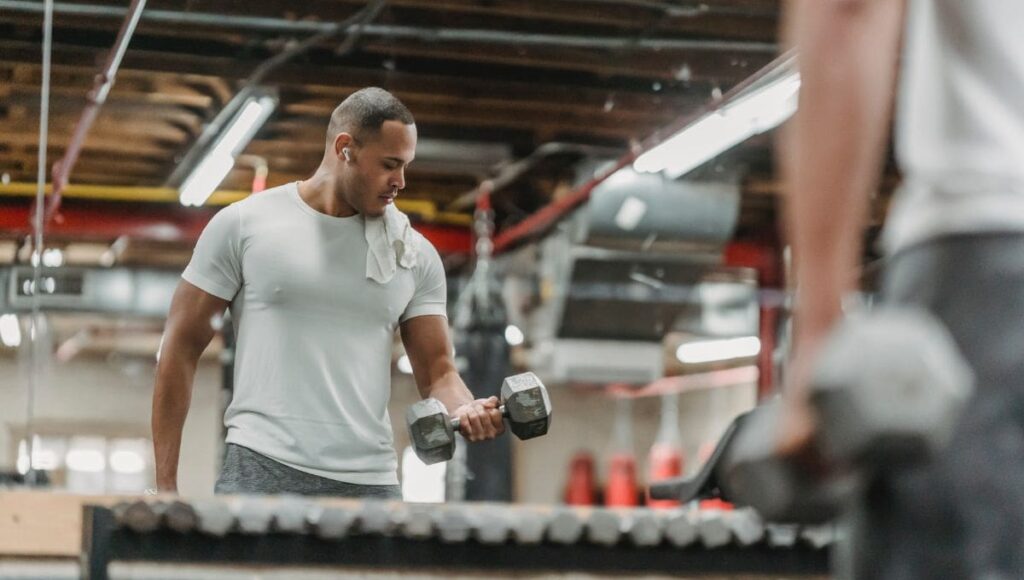
There are a huge number of ways to train your arms. As we are all physiologically different, there may be different curls variations that suit you more than others.
Here we will explore the subtleties of EZ bar and dumbbell curls, and you will find out which one is better for you and your goals.
Why Forearm Position Changes Bicep Mechanics
Your upper arm contains more than just the front peak of the biceps brachii, because the long head and short head work alongside the brachialis tucked underneath and the brachioradialis crossing into your forearm.
How your wrist and forearm are oriented during a curl changes the pull angle of those muscles and alters how much tension each elbow flexor experiences through the range of motion. A straight bar locks your forearms into full supination, an EZ bar places your wrists at a semi-supinated angle, and dumbbells allow you to rotate freely from neutral to supinated as you curl.

Electromyography research comparing dumbbell and barbell curls demonstrates that grip and forearm orientation influence muscle activity across the biceps brachii and brachioradialis during elbow flexion.
Recent range-of-motion research shows that emphasizing the initial, lengthened portion of a curl can promote greater muscle adaptations than focusing only on the top contraction. Paying attention to how your elbows and forearms move through that lengthened bottom position matters just as much as which piece of equipment you hold.
How EZ Bar Curls Stack Up for Arm Growth
The angled grip of an EZ curl bar takes sharp rotational torque off your wrists and forearms compared to a straight bar, making it comfortable for many lifters who feel forearm splint pain or wrist strain during heavy curls. Because both hands stay connected on one bar, you can often use steady, symmetrical loading and focus on smooth, controlled repetitions through your sets. That comfortable grip angle lets you push challenging sets close to muscular failure without your wrists tapping out before your biceps do.
Research on resistance training loads shows that moderate and lighter weights can produce muscle growth comparable to heavier weights when sets are taken close to muscular failure.
When you pair a comfortable angled grip on the EZ bar with a controlled lowering phase and clean elbow position, you can accumulate high-quality mechanical tension safely. Just watch out for letting your elbows drift way forward or using hip momentum to heave heavy weights past your sticking point.
How Dumbbell Curls Stack Up for Arm Growth
Dumbbell curls give each arm complete independence, which helps reveal and address strength or size differences between your left and right arms while letting you adjust your wrist angle naturally. Starting with palms facing slightly inward or neutral and rotating into supination as you curl engages forearm supination alongside elbow flexion, while sitting on an incline bench lets you stretch the long head of the biceps behind your torso.
Dumbbells also make it easy to perform variations like hammer curls or incline curls that target different angles of your elbow flexors.
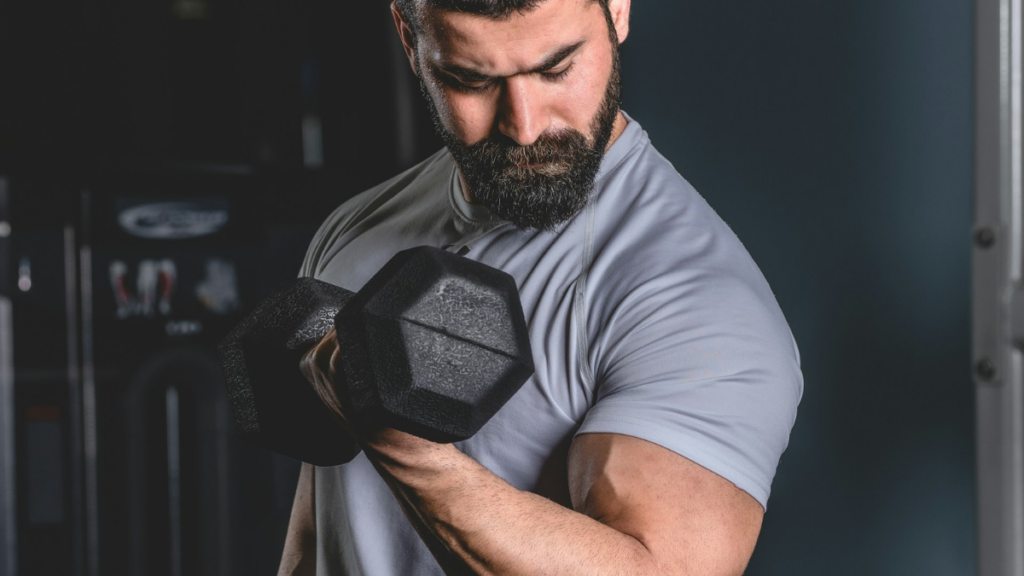
Biomechanical and electromyographic findings on curl variations highlight how forearm rotation and arm angle affect recruitment across the elbow flexors, while meta-analytic evidence on training frequency indicates that training a muscle group twice per week supports superior hypertrophy compared to once-weekly training. The main catch with standing dumbbell curls is that lifters sometimes swing one arm at a time or cut the bottom stretch short when fatigue builds. Keeping your torso steady and controlling the lowering phase solves that problem immediately.
Comparing EZ Bar Curls and Dumbbell Curls for Bicep Development
| Training Factor | EZ Bar Curls | Dumbbell Curls | Best Practical Application |
| Wrist and Forearm Comfort | Angled grip reduces wrist strain compared to straight bars | Adjustable rotation suits varying wrist and elbow comfort | Use EZ bar curls for comfortable angled pressing-style curling; use dumbbells for custom angles |
| Unilateral Balance | Bilateral bar keeps both hands linked together | Independent hands highlight and address side-to-side differences | Use dumbbells when you want independent arm work or incline stretch angles |
| Range of Motion and Angles | Fixed bar path with semi-supinated grip | Flexible path allowing supination, hammer grips, or incline positioning | Pair dumbbells for stretched or rotated angles with EZ bar curls for steady symmetrical sets |
| Fatigue and Cheating Risk | Easy to heave with hips or swing elbows forward if too heavy | Easy to sway torso or twist unevenly on late reps | Keep elbows tucked and lower weights slowly over two to three seconds on every rep |
Which One Builds Bigger Biceps?
So which option builds bigger biceps? Neither tool has an exclusive lock on bicep growth, because both can build impressive arms when you take sets close to muscular failure, control the lowering phase, and progressively increase your reps or load over time. An EZ bar is often fantastic for straightforward, wrist-friendly symmetrical sets, while dumbbells shine when you want independent arm work, supination, or a deep stretch on an incline bench.
Meta-analytic evidence comparing training loads confirms that hypertrophy responds strongly to effort near failure across a practical range of loads rather than requiring extreme heavy weights alone. Using both exercises across the week, such as performing EZ bar curls in one session and dumbbell curls in another, gives your biceps varied angles and steady growth signals without beating up your joints.
Key Takeaways
| Decision Area | Evidence-Based Guidance | Why It Matters for Bigger Biceps |
| Overall Winner | Neither wins alone; both build muscle when taken close to failure | Bicep growth depends on mechanical tension, effort near failure, and progression |
| EZ Bar Advantage | Comfortable angled grip with symmetrical two-handed control | Reduces wrist discomfort while letting you focus on clean, repeatable sets |
| Dumbbell Advantage | Independent movement with flexible wrist and bench angles | Allows custom rotation, unilateral balance, and deep stretched positions |
| Weekly Programming | Train arms twice per week using controlled reps and gradual progression | Supports stronger hypertrophy outcomes than once-weekly training with less joint strain |


References
- Marchetti, P.H., Junior, J.R.S., Leon, R.C., et al., 2018. Differences in electromyographic activity of biceps brachii and brachioradialis during dumbbell and barbell curls. Journal of Human Kinetics, 65(1), pp.1-10.
- Pedrosa, G.F., Simões, M.G., Figueiredo, M.O.C., Lacerda, L.T., Schoenfeld, B.J., Lima, F.V., Chagas, M.H. and Diniz, R.C.R., 2023. Training in the initial range of motion promotes greater muscle adaptations than at final in the arm curl. Sports, 11(2), p.39.
- Schoenfeld, B.J., Grgic, J., Ogborn, D. and Krieger, J.W., 2017. Strength and hypertrophy adaptations between low- vs. high-load resistance training: a systematic review and meta-analysis. Journal of Strength and Conditioning Research, 31(12), pp.3508-3523.
- Schoenfeld, B.J., Ogborn, D. and Krieger, J.W., 2016. Effects of resistance training frequency on measures of muscle hypertrophy: a systematic review and meta-analysis. Sports Medicine, 46(11), pp.1689-1697.
Robbie Wild Hudson
Editor-In-Chief at BOXROX. I come from a background of rugby and weightlifting. Growing up in the English Lake District, I spent a great deal of time swimming in its stunning lakes and rivers. In 2015 my brothers and I became the first people to swim the 145km length of the River Eden, from source to mouth, in 9 days. We also swam the Corryvreckan whirlpool, the third largest in the world, and Crossfit is a huge part of my training for these events.
More from Robbie Wild Hudson