



























Floor Press vs Bench Press: Which Should Beginners Learn First?

Building a strong chest is a great way to bulk up your upper body and improve your general strength, but where should you start?
Let’s dive in.
How the Floor Press and Bench Press Differ Mechanically
During a standard flat bench press, your upper back rests on a narrow padded bench while your feet plant firmly on the floor, allowing your elbows to travel below the level of the bench at the bottom of every repetition.
That extra downward travel places the pectoralis major and anterior deltoids into a deep stretch while requiring you to stabilize the load through a full horizontal pressing arc. Because your torso sits elevated above the ground, you also learn how to create mild upper-back tension and steady leg drive to keep your shoulders anchored safely.
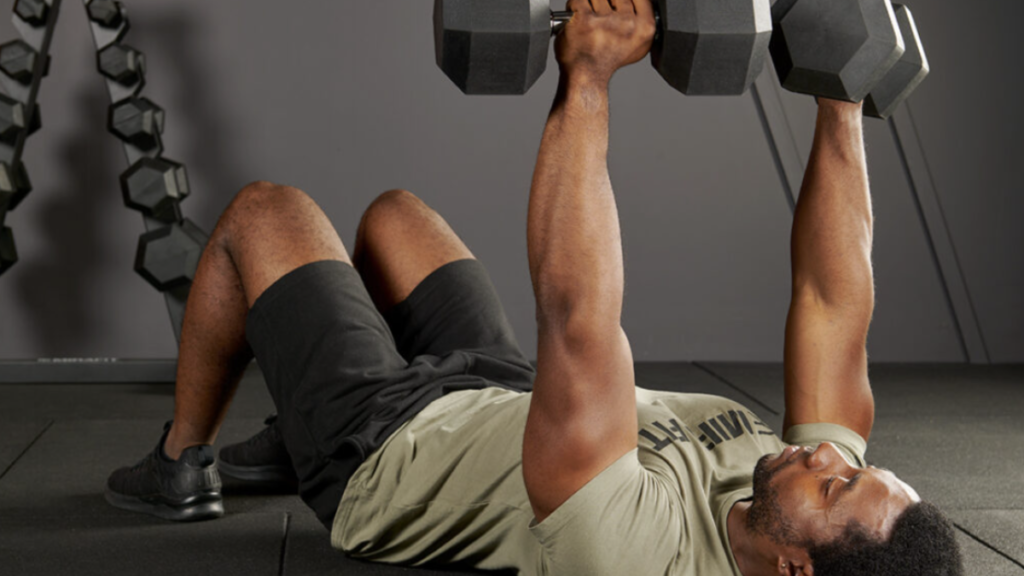
When you perform a floor press, your entire back, hips, and legs rest flat on the ground, and the floor acts as an automatic depth stop the moment the backs of your upper arms touch down.
Because your elbows cannot drop past the plane of your torso, the bottom range of motion is shortened, shifting greater emphasis onto mid-range pressing strength and triceps lockout power. Biomechanical and electromyographic research examining partial versus full pressing arcs and bench press variations shows that restricting bottom elbow depth reduces peak shoulder extension while altering force demands across the pectoralis major, anterior deltoid, and triceps brachii.
What Science Says About Muscle Growth, Strength, and Shoulder Safety
When beginners compare the floor press against the bench press, two major factors stand out in sports science literature: shoulder joint stress and hypertrophy across different muscle lengths. Sports medicine and shoulder biomechanics research indicates that deep horizontal abduction and extension at the bottom of a bench press increases stress on the anterior shoulder capsule if a lifter flares their elbows excessively or loses scapular control.
Because the floor physically prevents your elbows from dropping behind your torso, the floor press offers a built-in safety guardrail while beginners learn clean elbow tuck and pressing posture.
At the same time, exercise science research comparing full and partial range-of-motion resistance training consistently demonstrates that training muscles through a full, lengthened range of motion produces superior overall hypertrophy compared to relying solely on shortened ranges.
Since the bench press allows the pectoralis major to stretch deeply under load at the bottom of each repetition, it delivers a stronger overall chest-building stimulus once your technique is solid. Furthermore, studies comparing free-weight resistance exercises show that both dumbbell and barbell pressing build substantial upper-body strength and muscle mass when sets are taken close to muscular failure.
Comparing the Floor Press and Bench Press for Beginners
| Training Factor | Floor Press | Flat Bench Press | Best Practical Fit for Beginners |
| Range of Motion | Shortened at the bottom because the floor stops elbow travel | Full horizontal pressing arc with deep bottom pectoral stretch | Start on the floor if unsure of depth; use bench press for full growth |
| Shoulder Joint Protection | Built-in depth stop reduces excessive anterior shoulder extension | Requires controlled elbow tuck and scapular retraction at the bottom | Floor press protects cranky or unstable shoulders early on |
| Muscle Emphasis | Strong focus on triceps lockout and mid-range chest pressing | Balanced, high stimulus across pectoralis major, front delts, and triceps | Bench press builds fuller overall chest mass over time |
| Learning Curve and Setup | Simple back-flat setup with easy dumbbell self-spotting | Requires learning bench setup, foot placement, and rack or dumbbell control | Floor press teaches clean pressing path quickly before bench progression |
Which One Should Beginners Learn First?
For most absolute beginners, learning the dumbbell floor press first for two to four weeks before progressing onto the flat bench press is a smart, confidence-building strategy, although healthy beginners with good shoulder control can also learn the dumbbell bench press right away with light weights. Starting on the floor teaches you how to keep your wrists stacked over your elbows, tuck your upper arms roughly forty-five degrees from your torso, and press smoothly without worrying about dropping weights too deep or losing balance on a narrow bench.
Once you can perform three clean sets of ten to twelve repetitions on the dumbbell floor press with steady control, transitioning to the flat dumbbell or barbell bench press unlocks the full stretched range of motion needed for maximum chest hypertrophy. Meta-analytic evidence on resistance training frequency confirms that training upper-body muscles twice per week supports stronger hypertrophy outcomes than once-weekly training, giving you plenty of practice to master clean pressing mechanics.
1. Start With Dumbbell Floor Presses to Groove Clean Mechanics
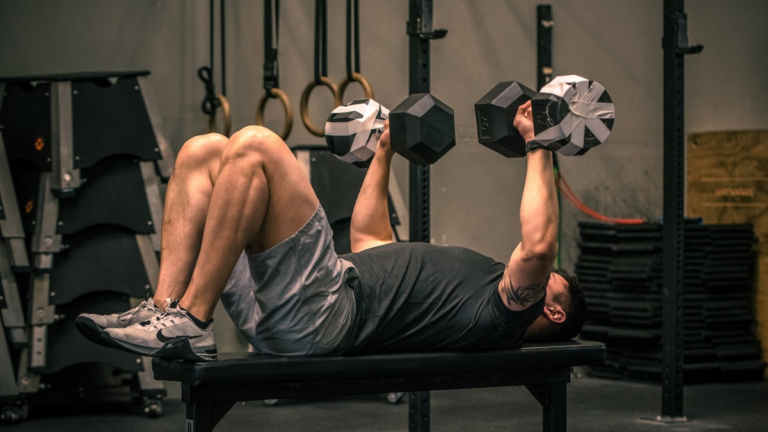
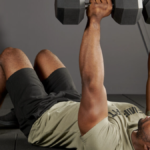
Lie flat on the floor with your knees bent and feet planted comfortably, holding a pair of light to moderate dumbbells above your chest with palms angled slightly inward. Lower the weights smoothly over two to three seconds until the backs of your upper arms rest gently on the floor, pause for one full second without bouncing, and press back up cleanly.
2. Transition to the Flat Bench Press for Full Chest Stretch
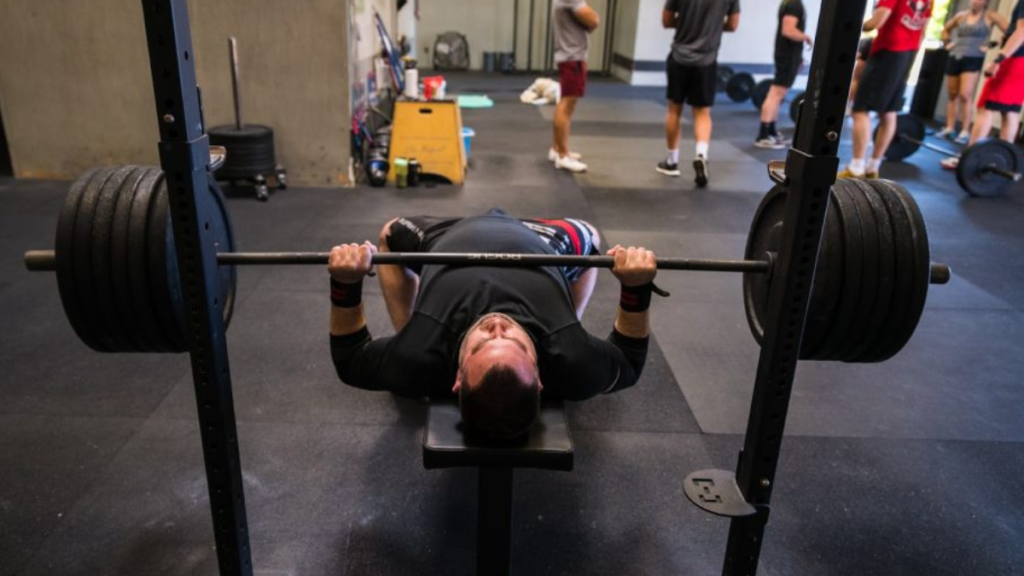
After building comfort and control on the floor, move to a flat bench using manageable dumbbells or an empty barbell inside a rack with safety pins set properly. Retract your shoulder blades gently against the bench, keep your elbows tucked moderately rather than flaring wide, and lower the weight under control until you feel a comfortable stretch across your chest.
3 Best Kettlebell Exercises for a Jacked and Great Looking Upper Body
3. Progress Gradually and Stop Near Muscular Failure
Research on resistance training loads shows that moderate weights in the eight to fifteen repetition range taken close to muscular failure stimulate robust muscle growth and strength. Focus on adding one clean repetition per set across your workouts before increasing dumbbell or barbell weight so your joints and tendons adapt smoothly.
Key Takeaways
| Decision Area | Evidence-Based Guidance | Why It Matters for Beginners |
| Best Starting Progression | Learn the dumbbell floor press first, then progress to the flat bench press | Builds safe elbow path and shoulder control before adding deep stretch |
| Hypertrophy Advantage | The flat bench press wins long term due to its full stretched range of motion | Lengthened mechanical tension drives superior overall chest growth |
| Shoulder Safety Feature | The floor acts as a physical depth stop that limits excessive shoulder extension | Protects beginners while they learn proper scapular and elbow alignment |
| Weekly Programming | Train horizontal presses twice per week with 8 to 15 controlled reps near failure | Accelerates motor learning and hypertrophy without beating up your joints |
References
- Green, C.M. and Comfort, P., 2007. The affect of grip width on bench press performance and risk of injury. Strength and Conditioning Journal, 29(5), pp.10-14.
- Lauver, J.D., Cayot, T.E. and Scheuermann, B.W., 2016. Influence of bench angle on upper extremity muscular activation during bench press exercise. European Journal of Sport Science, 16(3), pp.309-316.
- Schoenfeld, B.J., Grgic, J., Ogborn, D. and Krieger, J.W., 2017. Strength and hypertrophy adaptations between low- vs. high-load resistance training: a systematic review and meta-analysis. Journal of Strength and Conditioning Research, 31(12), pp.3508-3523.
- Schoenfeld, B.J., Ogborn, D. and Krieger, J.W., 2016. Effects of resistance training frequency on measures of muscle hypertrophy: a systematic review and meta-analysis. Sports Medicine, 46(11), pp.1689-1697.
- Wolf, M., Androulakis-Korakakis, P., Fisher, J., Schoenfeld, B. and Steele, J., 2023. Partial vs full range of motion resistance training: a systematic review and meta-analysis. International Journal of Strength and Conditioning, 3(1), pp.1-15.
Robbie Wild Hudson
Editor-In-Chief at BOXROX. I come from a background of rugby and weightlifting. Growing up in the English Lake District, I spent a great deal of time swimming in its stunning lakes and rivers. In 2015 my brothers and I became the first people to swim the 145km length of the River Eden, from source to mouth, in 9 days. We also swam the Corryvreckan whirlpool, the third largest in the world, and Crossfit is a huge part of my training for these events.
More from Robbie Wild Hudson