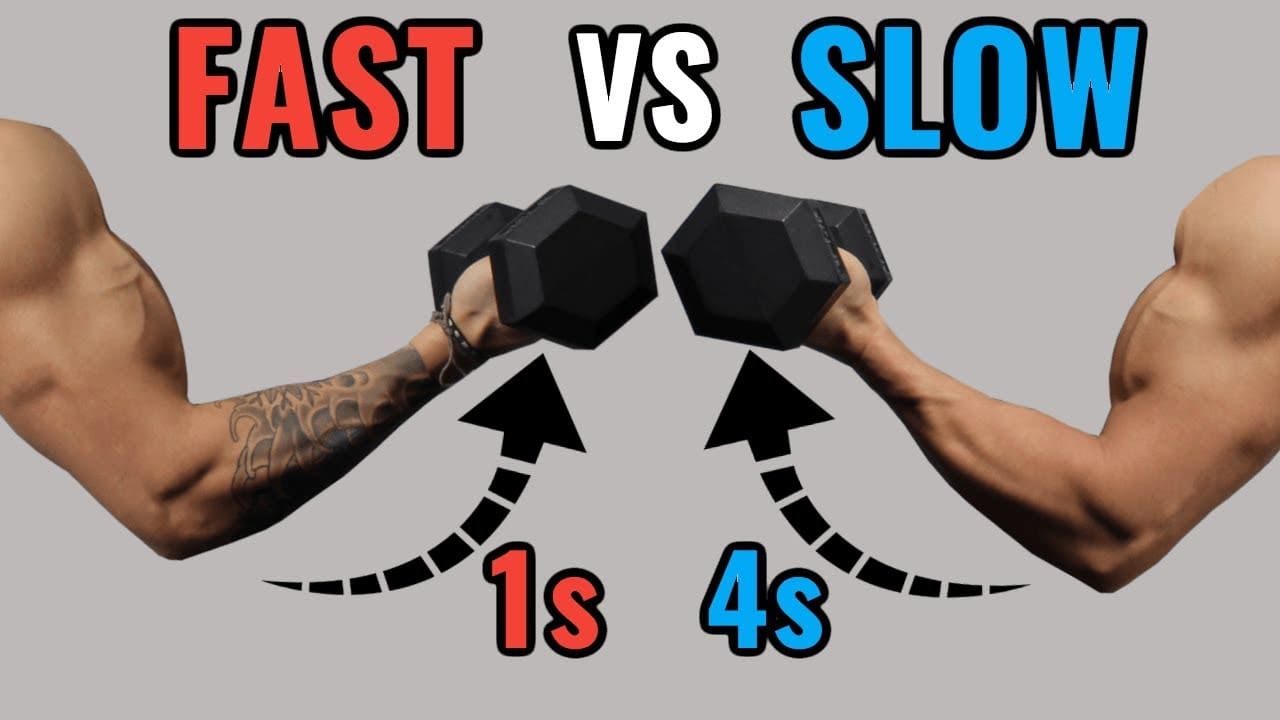


The speed of your reps can completely change how an exercise feels. Lower a dumbbell slowly and every inch seems difficult. Move it up fast and the lift can feel powerful, athletic, and satisfying. That difference has led to plenty of confident claims that one tempo is the secret to faster muscle growth.
The truth is more useful than either extreme. Slow reps and fast reps can both build muscle very effectively, provided the sets are challenging, the exercise is performed with control, and your training progresses over time. The best choice depends on the exercise, the load, your technique, and what you need from that particular set.


For most people chasing size, the winning approach is not painfully slow lifting or careless speed. It is controlled lowering combined with an intentional, forceful lifting phase.
What Rep Speed Actually Means
A repetition has several parts. The eccentric phase is when the working muscle lengthens under load, such as lowering the bar in a bench press or descending into a squat. The concentric phase is when the muscle shortens to move the load, such as pressing the bar away from your chest or standing up from the bottom of a squat.
There can also be pauses. A pause at the stretched position of a lift can make an exercise harder by removing momentum and requiring the target muscles to produce force from a disadvantaged position. A pause at the top can be useful for control, although it sometimes provides a chance to rest.
Slow repetitions usually involve deliberately extending the eccentric phase, the concentric phase, or both. Fast repetitions aim to move the weight with greater speed, especially during the concentric phase. Importantly, fast does not mean uncontrolled. In productive resistance training, the lifter tries to move the weight quickly while maintaining a stable position and full range of motion.
The actual speed of a rep is always influenced by the load. A heavy barbell will move slowly even if you are pushing as hard as possible. That effort still matters. Trying to accelerate a load recruits high threshold motor units, which include the larger fibers with strong growth potential.
5 Secrets to Help You Stick to Your Diet and Lose Body Fat
The Case for Slow Reps
Slow reps are popular for good reasons. They make it easier to control technique, reduce unwanted momentum, and feel the target muscle working. They can also make relatively light weights challenging.
More Time Under Tension
When you slow down a repetition, the muscle spends more time producing force. This is known as time under tension. It sounds like an automatic muscle building advantage, but time under tension is not a magic variable on its own.
Muscle growth is driven primarily by mechanical tension, enough hard work, and repeated exposure to training that challenges the muscle. A slow rep can increase the difficulty of a set, but it can also force you to use less weight and complete fewer repetitions. The final result depends on whether the muscle receives a sufficiently demanding stimulus.
Research comparing rep durations has found that muscle growth can be similar across a wide range of repetition speeds. Repetitions lasting roughly half a second to eight seconds can support hypertrophy when training is hard enough. Extremely slow lifting, however, appears less effective because the load becomes so light that producing high mechanical tension is difficult.
This means a controlled two or three second lowering phase can be useful, but turning every repetition into a long, slow struggle is unlikely to build more muscle simply because the set lasts longer.
Better Technique and More Useful Feedback
Slowing the eccentric phase gives you time to organize your position. You can keep your shoulder blades stable during pressing, maintain bracing during a squat, and avoid swinging through curls or lateral raises. For beginners, this can be especially valuable because skill improves with repeated, high quality practice.
Slower reps also make it easier to identify which muscles are doing the work. If a lifter cannot feel their back during a row, slowing the lowering phase and briefly controlling the stretched position may help reduce momentum and improve execution. This is not a substitute for progressive overload, but it can help ensure the intended muscle receives the training stimulus.
Useful When Loads Are Limited
Slow reps can be a practical tool when you train at home, only have light dumbbells, or need to reduce joint stress temporarily. A lighter load can still promote muscle growth when the set is taken close to failure. Adding a slower eccentric or a brief pause can make that light weight more challenging without needing extra plates.
This does not mean light weights always feel comfortable. Sets performed close to failure with high repetitions can create substantial burning and fatigue. They can build muscle, but they may be mentally demanding and less time efficient than using moderate loads.
The Case for Fast Reps
Fast reps have an unfair reputation in muscle building discussions because people often confuse speed with sloppy lifting. These are not the same thing. A controlled attempt to move a load quickly has distinct benefits.

Intent to Move Fast Improves Force Production
During the concentric phase, trying to move the weight explosively encourages high force output. Even when the bar itself moves slowly because it is heavy, the intention to accelerate can increase motor unit recruitment.
This is particularly relevant for compound exercises such as squats, presses, rows, pull ups, and deadlifts. These lifts often become more technically demanding when a lifter deliberately slows the concentric phase. A purposeful ascent allows the body to use its natural coordination while keeping effort high.
For muscle growth, the key point is simple. The weight does not need to fly upward. You need to apply force and keep the repetition technically sound.
Faster Reps May Preserve Productive Volume
Very slow lifting can create fatigue before you have completed enough challenging repetitions. For example, a ten second lowering phase in a squat can turn a moderate set into a breathing and discomfort test long before the legs have received the best possible growth stimulus.
Using a normal controlled tempo often allows you to handle more load, complete more high quality repetitions, and accumulate more productive training volume. Training volume is not the only driver of hypertrophy, but it is strongly associated with long term growth when sets are hard and recovery is adequate.
A faster concentric phase can also make sessions more efficient. This matters if you are trying to train several muscle groups per week without spending every evening in the gym.
Speed Is Valuable for Athletic Training
Explosive intent is especially helpful for athletes who want muscle alongside strength, jumping ability, sprinting ability, or general power. Training to move resistance quickly can improve the ability to generate force rapidly.
The direct goal of power training is not always maximum muscle growth. Still, including forceful concentric work can complement a hypertrophy program. It helps you maintain athletic movement qualities while building size.
What the Research Says About Muscle Growth
The strongest evidence does not support an absolute winner. Research suggests that a broad middle ground of rep speeds can produce similar hypertrophy when sets are performed close to muscular failure and training volume is reasonably matched.
A major review and meta analysis found comparable muscle growth from repetition durations between roughly 0.5 and 8 seconds. The authors concluded that very slow repetitions lasting more than 10 seconds were likely inferior for hypertrophy. The practical message is that normal, controlled lifting works extremely well, while exaggerated slow motion reps are not necessary.
Studies comparing lighter and heavier resistance training show that both can build muscle when sets are taken close to failure. That finding helps explain why different tempos can work. A slower tempo may make a lighter load difficult enough to stimulate growth, while a faster tempo may allow a heavier load to be trained effectively.
The important caveat is effort. Stopping a light set far from failure is unlikely to recruit enough muscle fibers for maximum growth. With heavier weights, the high effort arrives sooner, but the same principle applies. You need challenging sets, consistent progression, and enough recovery.
Why the Eccentric Phase Deserves Extra Attention
The lowering phase is where slow reps are most useful. Muscles can produce high force while lengthening, and eccentric training is a powerful stimulus for strength and hypertrophy. However, it does not require painfully slow descents.
For most exercises, lowering under control for around two to three seconds is enough to eliminate reckless momentum and maintain tension. You should be able to feel that you are actively resisting the load rather than simply dropping it.
A controlled eccentric also prepares you to produce force in the concentric phase. In a squat, lowering with balance and tension gives you a stronger, safer position from which to stand. In a bench press, controlling the bar to the chest keeps the shoulders organized and makes the press more repeatable.
The exception is when a specific technique calls for a different pace. Olympic lifting variations, jumping movements, and some strength sport training use faster eccentrics or deliberately controlled pauses for performance reasons. Your program should match the exercise and your goal.
The Best Tempo for Most Muscle Building Sets
For hypertrophy, a reliable default is a controlled eccentric, a brief transition, and an intentional concentric phase. In practical terms, lower the weight for about two to three seconds, avoid an unnecessary pause unless it serves a purpose, then lift with force while keeping perfect form.

This does not require counting every second in your head. If counting makes you tense or distracts from the exercise, use simple cues. Lower under control. Reach a stable bottom position. Drive the weight up hard. Repeat with the same technique.
On isolation exercises, slower reps can be particularly helpful. Curls, triceps extensions, lateral raises, leg extensions, leg curls, and cable flyes are easy to turn into momentum based movements. A slower eccentric and a controlled concentric can keep tension on the target muscle and protect the joints.
On big compound lifts, do not deliberately crawl through the concentric phase. Squats, presses, rows, and pull ups usually benefit from a powerful but controlled lifting phase. The load may move slowly, especially near failure, but your intent should remain strong.
When Slow Reps Make Sense
Slow reps are a useful tool, not a full time rule. Use them when you need better technique, have limited equipment, want to increase the difficulty of an isolation exercise, or need to reduce load while keeping a set challenging.
They can also help if you habitually rush the eccentric phase. Many lifters lower the bar or dumbbell with little control, then wonder why they struggle to feel the intended muscle. A measured eccentric often fixes that immediately.
Do not use slow reps to make every set maximally uncomfortable. If the tempo causes your form to deteriorate, turns your breathing into the limiting factor, or prevents progression for weeks, it is no longer helping.
When Fast Reps Make Sense
Use fast concentric intent on most compound exercises, especially when your goal includes strength, athleticism, or efficient training. The movement should look smooth and controlled, not frantic.
Fast reps also make sense when you are using a load that is already heavy. A heavy five repetition set of squats will naturally move slowly near the end. Trying to force a deliberately slow concentric adds little. Instead, brace well, descend with control, and drive upward aggressively.
Avoid trying to move fast when your technique is not stable. If a barbell is drifting, your knees are collapsing, or your shoulders are losing position, slow down enough to regain control. Speed should be earned through good mechanics.
How to Apply This in Your Training
For most muscle building programs, use a controlled two to three second eccentric on the majority of exercises. Lift each rep with purpose, but never sacrifice range of motion or alignment to make it faster.
Keep your repetitions consistent. If your first six reps are smooth and your final two become slower because you are approaching failure, that is normal. It tells you the set is demanding. End the set when you can no longer complete another good repetition or when your technique would noticeably break down.
Progression still decides whether you grow. Add repetitions, load, sets, or better execution gradually over time. Changing tempo can make an exercise harder, but it should not become a way to avoid measurable progress.
The Verdict
Slow reps and fast reps can both build serious muscle. The best evidence shows that muscle growth is similar across a broad range of normal repetition durations when training is sufficiently challenging.
Very slow repetitions are not superior simply because they create more time under tension. They can be useful in specific situations, but they often limit the load and productive volume you can perform. Fast, uncontrolled reps are equally unhelpful because momentum can shift tension away from the target muscle and increase technical errors.
For most lifters, the best strategy is simple. Control the lowering phase, use a full range of motion, and try to lift the weight with force. That combination gives you the tension, effort, and repeatable technique needed to build muscle over the long term.
Key Takeaways
| Rep Speed | Best Use | What It Means for Muscle Growth |
|---|---|---|
| Controlled slow eccentric | Most hypertrophy exercises, technique work, isolation lifts | Helps maintain tension and improve execution without requiring exaggeratedly slow reps |
| Fast concentric intent | Compound lifts, heavier training, athletic goals | Encourages high force output and can support productive training volume |
| Extremely slow repetitions | Occasional light load or rehabilitation style training | Usually not superior for growth and may reduce the load you can use |
| Uncontrolled fast repetitions | None | Momentum and poor positioning can reduce effective tension and compromise technique |
| Consistent, challenging sets | Every hypertrophy program | Effort, progression, and sufficient volume matter more than chasing one exact tempo |
References
- Davies, T., Kuang, K., Orr, R., Halaki, M. and Hackett, D. (2017) ‘Effect of movement velocity during resistance training on dynamic muscular strength: A systematic review and meta analysis’, Sports Medicine, 47(8), pp. 1603–1617.
- Gonzalez Badillo, J.J., Rodríguez Rosell, D., Sánchez Medina, L., Ribas Serna, J. and Pareja Blanco, F. (2014) ‘Maximal intended velocity is always important for improving strength’, International Journal of Sports Medicine, 35(5), pp. 354–360.
- Lasevicius, T., Schoenfeld, B.J., Silva Batista, C., Barros, T.S., Aihara, A.Y., Brendon, H. and Tricoli, V. (2018) ‘Muscle failure promotes greater muscle hypertrophy in low load but not in high load resistance training’, Journal of Strength and Conditioning Research, 36(2), pp. 346–351.
- Pareja Blanco, F., Rodríguez Rosell, D., Sánchez Medina, L., Sanchis Moysi, J., Dorado, C., Mora Custodio, R., Yáñez García, J.M., Morales Alamo, D., Pérez Suárez, I. and González Badillo, J.J. (2017) ‘Effects of velocity loss during resistance training on athletic performance, strength gains and muscle adaptations’, Scandinavian Journal of Medicine and Science in Sports, 27(7), pp. 724–735.
- Schoenfeld, B.J., Grgic, J., Ogborn, D. and Krieger, J.W. (2017) ‘Strength and hypertrophy adaptations between low versus high load resistance training: A systematic review and meta analysis’, Journal of Strength and Conditioning Research, 31(12), pp. 3508–3523.
- Schoenfeld, B.J., Ogborn, D.I. and Krieger, J.W. (2015) ‘Effect of repetition duration during resistance training on muscle hypertrophy: A systematic review and meta analysis’, Sports Medicine, 45(4), pp. 577–585.
- Schoenfeld, B.J., Ogborn, D. and Krieger, J.W. (2019) ‘Effects of resistance training frequency on measures of muscle hypertrophy: A systematic review and meta analysis’, Sports Medicine, 49(4), pp. 631–645.
- Wernbom, M., Augustsson, J. and Thomeé, R. (2007) ‘The influence of frequency, intensity, volume and mode of strength training on whole muscle cross sectional area in humans’, Sports Medicine, 37(3), pp. 225–264.