

Big arms make a noticeable difference to how your upper body looks in a T shirt, shirt, or tank top. Your biceps sit at the front of the upper arm, so developing them can make your arms look fuller from multiple angles. For beginners, the good news is that you do not need an advanced bodybuilding routine or dozens of different exercises to start seeing progress.
You do need a smart approach. Biceps grow when you train them consistently, use good technique, challenge the muscle with enough resistance, and gradually improve what you can do over time. The three exercises below cover the most useful foundations: a standard curl pattern, a position that challenges the biceps at a long muscle length, and a grip that trains the surrounding arm muscles for a thicker overall look.



No single exercise builds super jacked arms overnight. Muscle growth takes repeated training sessions, adequate food, recovery, and patience. However, these movements give beginners an efficient and evidence based place to start.
What Makes the Biceps Grow?
The biceps brachii has two heads, known as the long head and short head. It crosses both the shoulder and elbow joints, which means it helps bend the elbow and contributes to turning the palm upward. It also assists with shoulder movement.
To make the biceps grow, your training needs to provide sufficient mechanical tension. This is the force experienced by muscle fibers when they work against resistance. Research consistently shows that resistance training builds muscle when sets are performed with enough effort and sufficient weekly volume. You do not need to lift extremely heavy weights to gain size, but the final repetitions of a set should feel demanding while your technique stays controlled.
The Only 3 Exercises Beginners Need For Wider Shoulders
For beginners, the goal is not to make every workout exhausting. It is to learn a small number of movements well and make gradual progress. Adding a repetition, improving control, or using a slightly heavier dumbbell over time gives your body a reason to adapt.
Training a muscle through a full comfortable range of motion is also useful. A controlled curl from a fully extended elbow position to a hard squeeze near the top allows the biceps to work across the whole movement. Resistance training that challenges muscles at longer lengths may be especially helpful for hypertrophy, which is one reason exercise setup matters.
1. Standing Dumbbell Curl
The standing dumbbell curl is one of the best first bicep exercises because it is simple, accessible, and easy to progress. It teaches the central action of the biceps: bending the elbow while rotating the palm upward.
Unlike a barbell curl, dumbbells let each arm work independently. This can make it easier to identify strength differences between sides and prevents the stronger arm from doing too much of the work. Dumbbells also allow a natural wrist position, which many beginners find more comfortable.
How to Do It
Stand tall with a dumbbell in each hand and your arms by your sides. Start with your palms facing forward. Keep your chest up, ribs down, and shoulders relaxed rather than pulled toward your ears.
Curl both dumbbells upward by bending your elbows. Keep your upper arms close to your torso and focus on bringing your hands toward the front of your shoulders. Pause briefly at the top, squeeze your biceps, then lower the dumbbells slowly until your elbows are straight again.
The lowering phase matters. Do not simply let the weights drop. Controlling the descent increases the amount of quality work your biceps perform and helps you maintain better positioning.
Common Beginner Mistakes
The most common mistake is using body momentum to lift a weight that is too heavy. If your lower back swings, your elbows travel far forward, or your shoulders take over, the biceps receive less direct tension.
Choose a load that allows you to keep your torso still. You should feel the biceps working hard, but the movement should look smooth. Start with two or three sets of eight to 12 repetitions, leaving roughly one or two good repetitions in reserve at the end of each set.
2. Incline Dumbbell Curl
The incline dumbbell curl is an excellent choice for beginners who want to add a more challenging bicep exercise without making the routine complicated. Sitting on an incline bench places the arms slightly behind the torso, which lengthens the biceps at the bottom of the movement.
This setup makes it harder to cheat because your back is supported and your body has less opportunity to swing. It also encourages a deep stretch at the bottom, provided you use a weight you can control.
Long muscle length training has received growing attention in hypertrophy research. While exercise selection is only one part of growth, movements that load a muscle in a stretched position can be a useful addition to a well designed program. The incline curl gives beginners a simple way to include that stimulus.
How to Do It
Set an adjustable bench to a moderate incline. Sit back with a dumbbell in each hand, allowing your arms to hang down naturally beside your body. Begin with your palms facing forward or slightly inward if that feels better on your wrists.
Curl the dumbbells upward without allowing your elbows to drift forward. Think about keeping the upper arms behind your torso as you bend the elbows. Squeeze your biceps near the top, then lower the dumbbells under control until your arms are straight.
Use a lighter weight than you use for standing curls. The stretched position makes the movement much more demanding, and trying to force heavy dumbbells through the exercise usually leads to poor technique.
Why It Works So Well for Beginners
Beginners often assume that a difficult exercise must involve a large amount of weight. That is not true. The incline dumbbell curl can create a strong training stimulus with relatively light dumbbells because the biceps are challenged in a mechanically disadvantaged position.
The exercise also teaches you to feel the target muscle working. Because the bench limits swinging, it becomes easier to learn the difference between curling with your biceps and simply throwing the weight upward with your shoulders and lower back.
Perform two or three sets of eight to 15 controlled repetitions. Stop the set when you cannot maintain the same smooth range of motion.
3. Hammer Curl
Hammer curls deserve a place in a beginner arm program because they build more than just the biceps. The neutral grip, with palms facing each other, trains the brachialis and brachioradialis alongside the biceps brachii.
The brachialis sits underneath the biceps and can contribute to upper arm thickness as it grows. The brachioradialis runs along the upper forearm and helps create a stronger, more muscular transition from the elbow to the forearm. If your goal is arms that look bigger overall, this added work is valuable.
Hammer curls can also feel friendlier on the wrists and elbows for some lifters. The neutral hand position is natural and often allows beginners to train hard without discomfort. Pain is not a required part of effective training, so choose variations that you can perform consistently and comfortably.
How to Do It
Stand tall holding dumbbells at your sides with your palms facing inward. Keep your elbows close to your torso. Curl the dumbbells toward your shoulders while maintaining the neutral grip throughout the repetition.
Avoid turning the movement into a shoulder raise. Your elbows can move slightly, but they should not drive far forward as the dumbbells rise. Lower the weights slowly and fully extend your elbows before starting the next repetition.
You can perform hammer curls with both arms together or one arm at a time. Alternating arms may help you focus on technique, while curling both arms together can make the set more time efficient.
Where Hammer Curls Fit
Hammer curls work especially well after a standard curl or incline curl. They give you a different arm angle and grip without requiring another complicated movement pattern.
For beginners, two or three sets of 10 to 15 repetitions are usually enough. Use a weight that makes the final few repetitions difficult but still allows you to avoid swinging.
How to Build Your Beginner Bicep Routine
You do not need to perform all three exercises every day. Biceps need training stimulus, but they also need time to recover. Since they already work during pulling exercises such as rows, pulldowns, and pull ups, direct bicep work should fit around the rest of your program.
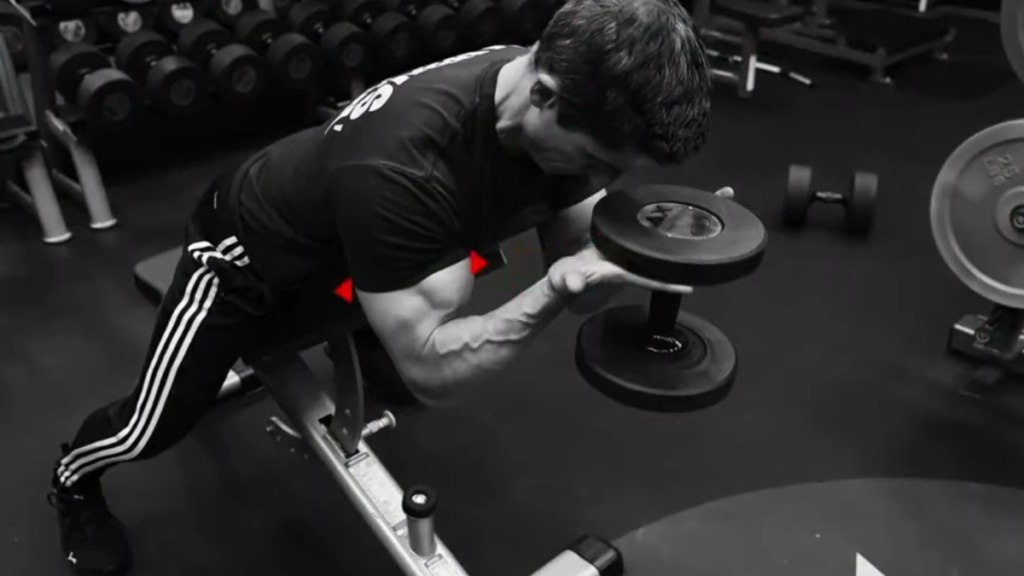
Train your biceps directly two times per week. In each session, choose two of the three exercises and perform two or three hard sets of each. This gives you eight to 12 direct weekly sets, which is a productive starting point for many beginners. If you are also doing substantial back training, begin closer to the lower end and assess how your elbows and recovery feel.
A simple first session could include standing dumbbell curls followed by hammer curls. Your second session could use incline dumbbell curls followed by hammer curls. Keep at least one full day between sessions when possible.
Your priority should be progressive overload. When you can complete the top end of your repetition range with clean form on every set, increase the weight slightly at the next workout. If heavier dumbbells cause poor technique, stay at the same weight and improve your repetitions first.
The Habits That Make Your Arms Grow Faster
The fastest route to bigger arms is not constantly changing exercises. It is repeating good basics long enough to become stronger at them. Log your weights and repetitions so you can see whether you are improving from week to week.
Eat enough protein and total calories to support muscle growth. Resistance training provides the signal, but your body needs adequate nutrition to build new tissue. Protein intake distributed across the day can support training adaptations, particularly when paired with regular resistance exercise.
Sleep and recovery also matter. Training breaks muscle tissue down temporarily, while recovery supports the rebuilding process. If your elbows ache, your performance is declining, or you are still very sore when the next session arrives, reduce your volume slightly and focus on better technique.
Most importantly, do not judge your progress after one workout. Take photos, track your measurements, and compare your strength over several weeks. Bigger arms are built through consistent sessions that become gradually more challenging.
References
- Grgic, J., Schoenfeld, B.J., Orazem, J., Sabol, F., Smajić, M., Bishop, D.J. and Pedisic, Z. (2022) ‘Effects of resistance training performed to repetition failure or non failure on muscular strength and hypertrophy: A systematic review and meta analysis’, Journal of Sport and Health Science, 11(2), pp. 202 to 211.
- Maeo, S., Balshaw, T.G., Ando, R., Kanehisa, H. and Kawakami, Y. (2021) ‘Triceps brachii hypertrophy is substantially greater after elbow extension training performed at long versus short muscle lengths’, Journal of Applied Physiology, 131(3), pp. 987 to 997.
- Morton, R.W., Murphy, K.T., McKellar, S.R., Schoch, R.D., Henselmans, M., Helms, E., Aragon, A.A., Devries, M.C., Banfield, L., Krieger, J.W. and Phillips, S.M. (2018) ‘A systematic review, meta analysis and meta regression of the effect of protein supplementation on resistance training induced gains in muscle mass and strength in healthy adults’, British Journal of Sports Medicine, 52(6), pp. 376 to 384.
- Schoenfeld, B.J., Ogborn, D. and Krieger, J.W. (2017) ‘Dose response relationship between weekly resistance training volume and increases in muscle mass: A systematic review and meta analysis’, Journal of Sports Sciences, 35(11), pp. 1073 to 1082.
- Schoenfeld, B.J. and Grgic, J. (2020) ‘Effects of range of motion on muscle development during resistance training interventions: A systematic review’, Skeletal Muscle, 10, 32.
- Schoenfeld, B.J., Grgic, J., Ogborn, D. and Krieger, J.W. (2017) ‘Strength and hypertrophy adaptations between low versus high load resistance training: A systematic review and meta analysis’, Journal of Strength and Conditioning Research, 31(12), pp. 3508 to 3523.
Key Takeaways
| Focus | What beginners should do | Why it matters |
|---|---|---|
| Standing dumbbell curl | Use controlled sets of eight to 12 repetitions without swinging | Builds the core elbow flexion pattern and allows each arm to work independently |
| Incline dumbbell curl | Use lighter dumbbells and emphasize the stretched bottom position | Challenges the biceps at a longer muscle length while limiting cheating |
| Hammer curl | Keep palms facing each other for 10 to 15 repetitions | Trains the biceps, brachialis, and brachioradialis for thicker looking arms |
| Weekly training | Train biceps directly twice per week for eight to 12 total sets | Provides enough practice and volume without making recovery difficult |
| Progression | Add repetitions first, then increase weight when form stays clean | Gradual overload is the main driver of long term muscle growth |