





























3 Best Muscle Building Exercises for Beginners to Get a More Jacked Chest

Building a bigger chest does not require complicated workouts or a long list of exercises. For beginners, a few movements that train the pectoral muscles well, performed consistently and made gradually harder, can provide a strong foundation. The best choices are exercises you can control, repeat with good form, and adapt as your strength improves.
The chest is mainly formed by the pectoralis major, a large muscle with fibers running in different directions. Pressing movements train it alongside the triceps and front shoulders. A flat press gives you a useful all around chest exercise, while an incline press changes the angle and places more emphasis on the upper region of the pectoralis major. Push ups offer a practical starting point because the difficulty can be adjusted without specialized equipment.

It is helpful to remember that muscle activity measured during a single exercise is not the same as proof that the exercise builds more muscle over time. Studies of muscle growth look at training programs over weeks or months. The exercises below are useful because they are practical, easy to progress, and supported by research on pressing movements and resistance training.
What Beginners Need for Chest Growth
Muscle growth comes from training that challenges the muscle and progresses over time. A beginner does not need to lift the heaviest weight possible or train every set until the next repetition is impossible. Instead, choose a variation that allows controlled repetitions, use a load that feels challenging near the end of a set, and gradually increase the work as you adapt.
A reasonable place to start is two chest sessions per week, with at least a day between them. In each session, perform two or three sets of each exercise for about 8 to 15 repetitions. This gives you six to nine working sets per session if you do all three exercises, so beginners may prefer to start with two exercises per session or fewer sets and add work as recovery allows. Research suggests that greater weekly training volume can produce greater muscle growth, but more is not automatically better if it makes it difficult to recover or maintain good technique.

For most sets, finish when you think you could still complete about one to three good repetitions. This is called leaving repetitions in reserve. Training all the way to failure is not required for muscle growth, and stopping a little earlier can help you keep your form steady, especially when learning a new movement. As the exercise becomes familiar, the final repetitions should still feel demanding.
1. Push Up
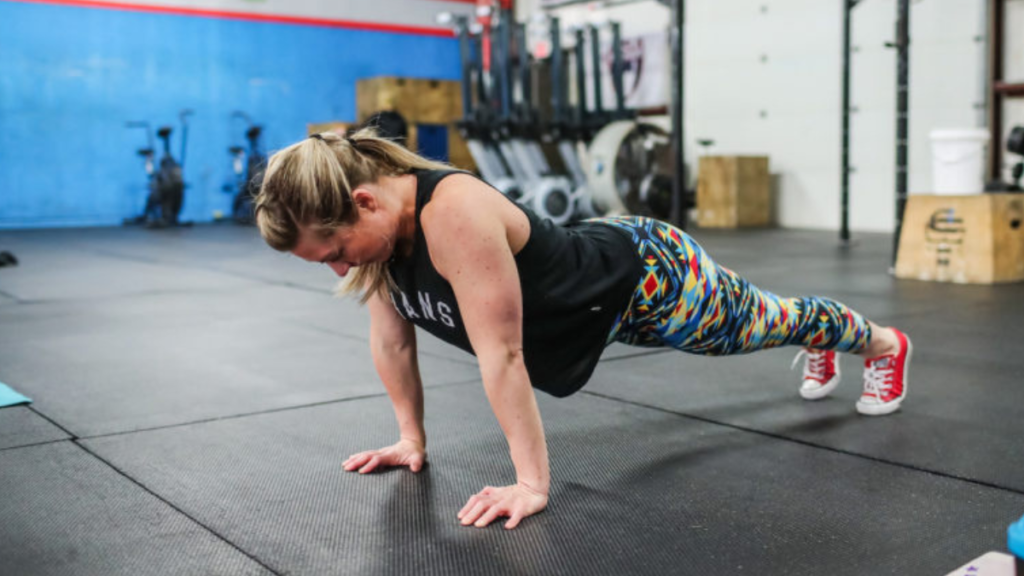
The push up is one of the best first chest exercises because it trains the chest, triceps, and front shoulders using body weight. It also requires little equipment, and you can adjust the difficulty to match your current strength. A study comparing push ups and bench presses found similar strength improvements when the exercises were performed at comparable levels of effort. Another study in untrained men reported similar chest muscle growth and strength gains from low load push ups and bench presses performed with similar effort.
These findings do not mean every push up program is identical to every bench press program, but they do show that a push up can be a serious resistance exercise.
How to Do It
Start in a high plank with your hands slightly wider than shoulder width and your body in a straight line from head to heels. Brace your midsection, lower your chest toward the floor by bending your elbows, then press the floor away until your arms are straight. Keep your hips from sagging or rising as you move. Use a range of motion you can control without discomfort.
If a floor push up is too difficult, place your hands on a stable bench or counter. The higher the surface, the easier the movement tends to be. Lower the hand support gradually as you build strength. If regular push ups become easy, you can make them harder by slowing the lowering phase, using a resistance band, or elevating your feet. Change one variable at a time so you can tell whether the new version is manageable.
Do two or three sets, stopping when you have about one to three good repetitions left. If you cannot complete at least eight smooth repetitions, use a higher hand position. If you can do more than 15 repetitions comfortably, try a harder variation. Keep the movement controlled rather than rushing through repetitions to reach a number.
2. Flat Dumbbell Bench Press
The flat dumbbell bench press is a useful next step because it lets you train each arm with its own weight and adjust the load in small increments. It trains the pectoralis major along with the triceps and front shoulders. Dumbbells also allow each hand to move independently, which many beginners find comfortable. Research comparing chest press variations supports the flat press as a strong general option for training the middle and lower regions of the pectoralis major.
How to Do It
Lie on a flat bench with a dumbbell in each hand and your feet on the floor. Begin with the weights over your chest, palms facing forward or slightly inward. Lower the dumbbells under control until they reach a comfortable position near the sides of your chest. Press them back up without letting them collide forcefully at the top. Keep your shoulders steady against the bench and avoid letting your wrists bend backward.
Choose weights that let you complete 8 to 15 controlled repetitions. If the dumbbells feel unstable or your shoulders roll forward, reduce the weight and practice the movement. You do not need to lower the weights as far as possible if doing so causes discomfort or makes you lose control. A comfortable, repeatable range of motion is more useful than forcing a deep stretch.
If you do not have dumbbells or a bench, you can keep progressing with push ups. If you are new to free weights, a spotter can help you position and put away the dumbbells safely. Rest between sets long enough to regain control and repeat the same technique, often around two minutes for a challenging set.
3. Incline Dumbbell Bench Press
The incline dumbbell bench press is a good way to vary your chest training and give more attention to the upper portion of the pectoralis major. In an electromyography study, a 30 degree bench angle produced the highest measured activity in the upper portion of the pectoralis major among the angles tested. Steeper angles increased front shoulder activity and reduced pectoral performance in that study.
Because EMG measures short term electrical activity rather than long term growth, it is best to treat these results as guidance for exercise selection rather than proof that one angle produces the most muscle growth.
How to Do It
Set an adjustable bench to a low incline, roughly 15 to 30 degrees. Sit with a dumbbell in each hand, then lie back so the weights are positioned over your upper chest. Lower them slowly toward the outside of your upper chest, then press them upward. Keep your elbows slightly below shoulder height as you lower the weights, and avoid flaring them directly out to the sides.
Begin with less weight than you use for the flat press. The incline position may feel harder because it changes the movement angle and increases the contribution of the front shoulders. If you feel the movement mostly in your shoulders, lower the bench angle, reduce the weight, and check that the dumbbells travel over your upper chest rather than toward your face.
Use two or three sets of 8 to 15 repetitions. You do not need to include the incline press in every workout from the beginning. If three chest exercises in one session leaves you too tired to keep good form, alternate the incline press and flat press between workouts.
How to Put the Exercises Together
A beginner could perform the push up and flat dumbbell bench press in one workout, then use the push up and incline dumbbell press in the next chest workout. Start with two sets per exercise if you are new to resistance training. Once you can complete your sets with steady technique and recover comfortably, add a third set or increase the difficulty. This gradual approach gives you a simple way to build training volume without changing everything at once.
Keep a record of the exercise variation, weight, and repetitions you complete. When you can perform the top of your target range for every set with good form, make the next session slightly harder. For dumbbell presses, use the next available weight increase. For push ups, lower the hand support or select a more difficult variation. The American College of Sports Medicine recommends increasing resistance when a person can exceed the target repetitions with the current load, which reflects the broader principle of progressive overload.

Progress does not need to happen every workout. Some sessions will feel stronger than others, and a small increase in repetitions or improved control is still progress. Give the routine time, keep the movements consistent, and add difficulty in manageable steps. A month of careful training gives you better information than frequently switching exercises before you can measure improvement.
Common Beginner Mistakes
One common mistake is choosing a variation that is too difficult and shortening the movement to finish the set. If you cannot control the lowering phase or keep your body aligned during a push up, use an easier version. If dumbbells wobble or your shoulders shift around on the bench, reduce the weight. Good technique helps you repeat the movement consistently and makes it easier to track progress.
The 3 Best Exercises that Make Your Biceps Look Wider
Another mistake is changing the routine too often. There is no need to replace an exercise simply because you have seen a new variation online. Keep an exercise long enough to learn it and measure whether you are improving. You can change it when equipment, comfort, or progress gives you a clear reason to do so.
Beginners also sometimes assume that every set must end with a forced repetition. Research reviews have found that reaching momentary failure is not necessary for strength and muscle growth. A challenging set performed with a few good repetitions left can still be productive. Stop if you experience sharp pain, and adjust the range of motion or exercise if a movement repeatedly feels uncomfortable.
The Bottom Line
Push ups, flat dumbbell bench presses, and incline dumbbell bench presses offer beginners three practical ways to train the chest. Push ups are easy to scale, flat presses provide a reliable all around pressing movement, and a low incline changes the pressing angle to involve more of the upper chest region. Begin with manageable loads, practice controlled repetitions, and gradually add repetitions, sets, or resistance as your strength improves.
Table of Key Takeaways
| Exercise or principle | Beginner takeaway |
|---|---|
| Push up | Start with hands elevated if floor push ups are too difficult, then lower the support as strength improves. |
| Flat dumbbell bench press | Use a comfortable range and a load you can lower and press with control. |
| Incline dumbbell bench press | Start with a low bench angle and lighter weights than your flat press. |
| Weekly training | Train the chest about twice per week and begin with a manageable number of sets. |
| Effort | Finish most sets with about one to three good repetitions left. |
| Progression | Add repetitions or a small amount of resistance when your current sets feel controlled. |
References
- American College of Sports Medicine (2009) ‘Progression models in resistance training for healthy adults’, Medicine & Science in Sports & Exercise, 41(3), pp. 687–708.
- Calatayud, J., Borreani, S., Colado, J.C., Martin, F., Tella, V. and Andersen, L.L. (2015) ‘Bench press and push-up at comparable levels of muscle activity results in similar strength gains’, Journal of Strength and Conditioning Research, 29(1), pp. 246–253.
- Kikuchi, N. and Nakazato, K. (2017) ‘Low-load bench press and push-up induce similar muscle hypertrophy and strength gain’, Journal of Exercise Science & Fitness, 15(1), pp. 37–42.
- Grgic, J., Schoenfeld, B.J., Orazem, J. and Sabol, F. (2022) ‘Effects of resistance training performed to repetition failure or non-failure on muscular strength and hypertrophy: A systematic review and meta-analysis’, Journal of Sport and Health Science, 11(2), pp. 202–211.
- Rodríguez-Ridao, D., Antequera-Vique, J.A., Martín-Fuentes, I. and Muyor, J.M. (2020) ‘Effect of five bench inclinations on the electromyographic activity of the pectoralis major, anterior deltoid, and triceps brachii during the bench press exercise’, International Journal of Environmental Research and Public Health, 17(19), 7339.
- Schoenfeld, B.J., Grgic, J., Ogborn, D. and Krieger, J.W. (2017) ‘Strength and hypertrophy adaptations between low- vs. high-load resistance training: A systematic review and meta-analysis’, Journal of Strength and Conditioning Research, 31(12), pp. 3508–3523.
- Schoenfeld, B.J., Ogborn, D. and Krieger, J.W. (2017) ‘Dose-response relationship between weekly resistance training volume and increases in muscle mass: A systematic review and meta-analysis’, Journal of Sports Sciences, 35(11), pp. 1073–1082.
Robbie Wild Hudson
Editor-In-Chief at BOXROX. I come from a background of rugby and weightlifting. Growing up in the English Lake District, I spent a great deal of time swimming in its stunning lakes and rivers. In 2015 my brothers and I became the first people to swim the 145km length of the River Eden, from source to mouth, in 9 days. We also swam the Corryvreckan whirlpool, the third largest in the world, and Crossfit is a huge part of my training for these events.
More from Robbie Wild Hudson