

If you want to improve your performance in CrossFit, your lower body strength, power, and endurance need to be elite. Nearly every workout depends on your legs. From squats and Olympic lifts to running, rowing, and jumping, your legs are the engine that drives performance.
This article breaks down the 3 best leg exercises for CrossFit athletes based on scientific evidence and practical application. You will learn why these movements are so effective, how they transfer to real CrossFit performance, and how to use them properly.


Why Leg Training Matters for CrossFit Athletes
CrossFit is unique because it combines strength, power, endurance, and skill. Your legs are involved in almost every domain.
Stronger legs improve:
- Olympic lifting performance
- Sprinting and running economy
- Jumping ability
- Work capacity in high repetition workouts
- Injury resilience
Lower body strength is strongly correlated with athletic performance across multiple domains. Research shows that maximal strength improves force production, rate of force development, and efficiency in endurance tasks.
Additionally, compound leg exercises stimulate large muscle groups, leading to greater hormonal responses and overall adaptation. This includes increases in testosterone and growth hormone, which support muscle growth and recovery.
For CrossFit athletes, the key is choosing exercises that deliver maximum transfer to sport performance. That is why the following three movements stand out.
1. Leg Exercises for CrossFit Athletes – Back Squat

Why the Back Squat Is Essential
The back squat is one of the most effective leg exercises for CrossFit athletes. It builds maximal strength, improves coordination, and enhances performance in almost every lower body movement.
Research consistently shows that the squat improves strength, vertical jump, sprint speed, and power output. It recruits the quadriceps, glutes, hamstrings, and core in a coordinated pattern that closely mimics many CrossFit movements.
The back squat is also foundational for Olympic lifts. A stronger squat directly improves your clean and snatch recovery.
Muscle Activation and Strength Development
The back squat produces high levels of muscle activation in:
- Quadriceps
- Gluteus maximus
- Adductors
- Hamstrings
- Core stabilizers
Studies using electromyography show that deeper squats result in greater glute activation and overall muscle recruitment. This is important because glute strength is a major contributor to explosive power.
Transfer to CrossFit Performance
The back squat carries over to:
- Thrusters
- Wall balls
- Cleans
- Snatches
- Box jumps
- Sprinting
Improved squat strength increases force production, which helps you move heavier loads and cycle repetitions faster.
There is also evidence that strength training improves running economy. This means you use less energy at a given pace, which is critical in longer workouts.
Leg Exercises for CrossFit Athletes – How to Perform the Back Squat
- Place the bar on your upper back
- Stand with feet shoulder width apart
- Brace your core
- Sit down and back while keeping your chest upright
- Descend until your hips are below your knees
- Drive through your heels to stand up
Focus on control and depth. Full range of motion leads to better strength gains and muscle development.
Programming Tips
- Train 2 to 3 times per week
- Use a mix of heavy sets and moderate volume
- Include pauses or tempo squats for control
- Progressively increase load over time
2. Leg Exercises for CrossFit Athletes – Deadlift

Why the Deadlift Is Critical
The deadlift is one of the most powerful leg exercises for CrossFit athletes because it trains the posterior chain. This includes the glutes, hamstrings, and lower back.
Posterior chain strength is essential for power, speed, and injury prevention.
The deadlift allows you to lift heavy loads, which builds maximal strength and improves neuromuscular efficiency. Research shows that heavy resistance training increases motor unit recruitment and force production.
Posterior Chain Dominance
The deadlift primarily targets:
- Glutes
- Hamstrings
- Erector spinae
- Core
- Lats for stabilization
Strong glutes are especially important for explosive movements like jumping and sprinting. Studies show that hip extension power is a key factor in athletic performance.
Transfer to CrossFit Movements
The deadlift improves performance in:
- Cleans and snatches
- Kettlebell swings
- Box jumps
- Sprints
- Rowing
It also improves grip strength, which is essential for high repetition workouts and gymnastics movements.
Injury Prevention Benefits
A strong posterior chain reduces injury risk by improving movement mechanics and spinal stability.
Research indicates that resistance training strengthens connective tissue and improves joint stability. This helps protect against common injuries in high intensity training.
How to Perform the Deadlift
- Stand with the bar over mid foot
- Grip the bar just outside your knees
- Keep your chest up and spine neutral
- Push through your legs and extend your hips
- Keep the bar close to your body
- Stand fully upright at the top
Avoid rounding your back. Maintain tension throughout the lift.
Programming Tips
- Train 1 to 2 times per week
- Focus on heavy sets for strength
- Include variations like Romanian deadlifts for hypertrophy
- Avoid excessive volume to manage fatigue
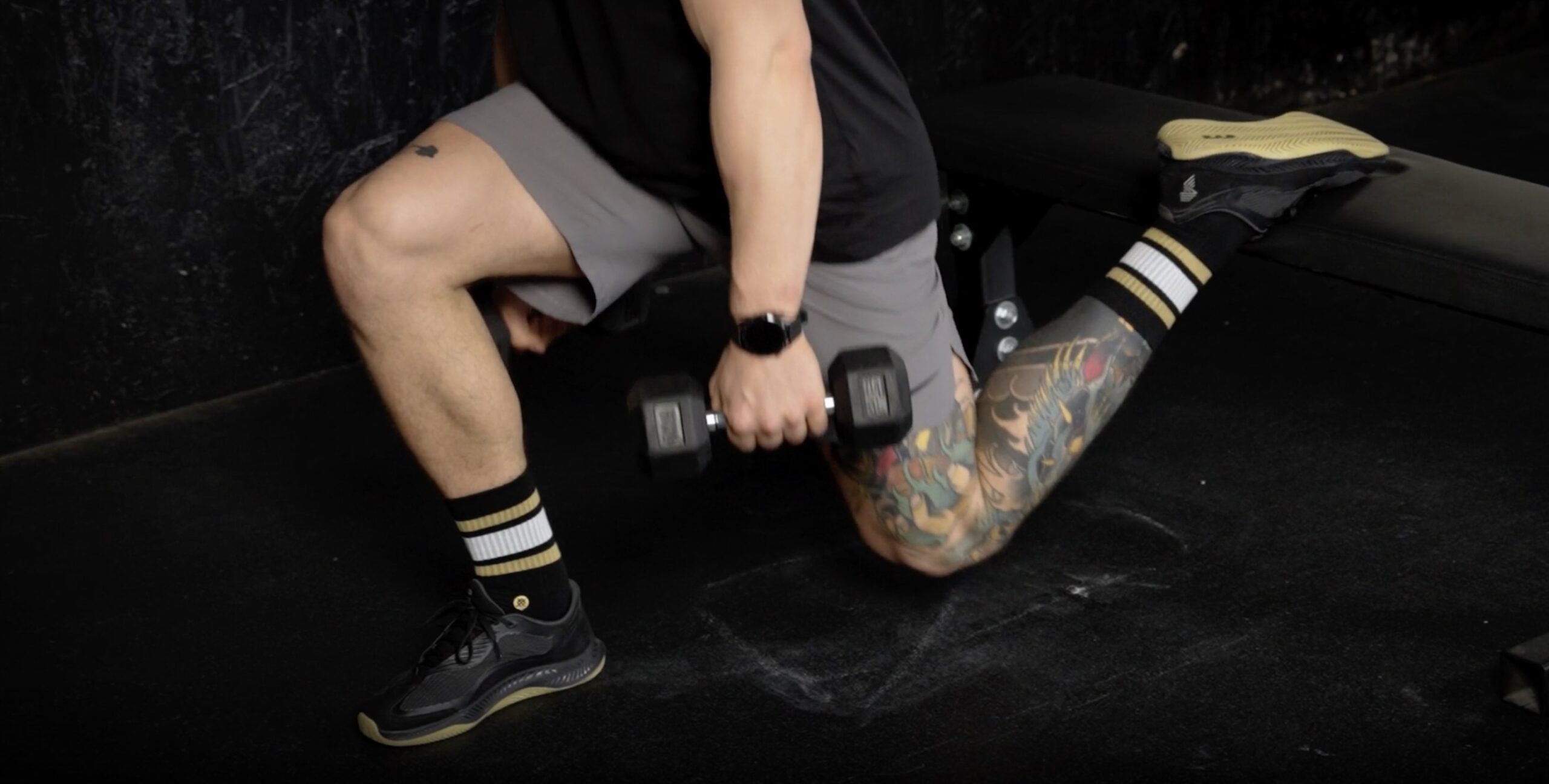
3. Leg Exercises for CrossFit Athletes – Bulgarian Split Squat
Why Unilateral Training Matters
The Bulgarian split squat is often overlooked, but it is one of the best leg exercises for CrossFit athletes.
Unilateral training addresses imbalances, improves stability, and enhances coordination. Research shows that single leg exercises improve balance and reduce injury risk.

Muscle Activation and Balance
The Bulgarian split squat targets:
- Quadriceps
- Glutes
- Hamstrings
- Core stabilizers
It also challenges balance and coordination, which are essential in dynamic CrossFit movements.
Studies show that unilateral exercises can produce similar strength gains to bilateral movements while also improving symmetry between limbs.
Transfer to Athletic Performance
This exercise improves:
- Running efficiency
- Jumping mechanics
- Change of direction ability
- Stability under fatigue
Single leg strength is critical because many movements in CrossFit involve asymmetrical loading or shifting weight between legs.
How to Perform the Bulgarian Split Squat
- Place one foot behind you on a bench
- Keep your front foot flat on the ground
- Lower your hips until your front thigh is parallel
- Keep your torso upright
- Drive through your front heel to stand up
Maintain balance and control throughout the movement.
Programming Tips
- Perform 2 to 3 sets per leg
- Use moderate to heavy weights
- Focus on control and range of motion
- Include in accessory sessions or warm ups
How These Exercises Work Together
The combination of these three movements creates a complete lower body training system.
- Back squat builds maximal strength and power
- Deadlift develops posterior chain strength
- Bulgarian split squat improves balance and stability
Together, they target all major muscle groups and movement patterns needed in CrossFit.
Research supports combining bilateral and unilateral training for optimal performance and injury prevention.
Strength, Power, and Endurance Integration
CrossFit requires multiple physical qualities at once. These exercises help develop:
Strength
Heavy squats and deadlifts increase maximal force production.
Power
Improved strength enhances rate of force development, which is critical for explosive movements.
Endurance
Resistance training improves muscular endurance and efficiency. This helps you sustain high intensity efforts for longer periods.
Common Mistakes to Avoid
Even the best leg exercises for CrossFit athletes can become ineffective if performed incorrectly.
Avoid these common errors:
- Partial range of motion in squats
- Rounding the back in deadlifts
- Using weights that compromise form
- Ignoring unilateral training
- Training legs without adequate recovery
Proper technique and smart programming are essential for long term progress.
Weekly Sample Structure
Here is a simple way to include these exercises in your training:
Day 1:
- Back squat heavy sets
- Bulgarian split squats
Day 2:
- Deadlift heavy sets
- Posterior chain accessory work
Day 3:
- Moderate squats or front squats
- Unilateral work and mobility
This structure balances intensity and recovery.
Recovery and Adaptation
Leg training is demanding. Recovery is critical for performance and injury prevention.
Key recovery strategies:
- Sleep at least 7 to 9 hours per night
- Consume adequate protein
- Manage training volume
- Use active recovery methods
Research shows that sleep and nutrition play a major role in muscle repair and performance adaptation.
Final Thoughts
The best leg exercises for CrossFit athletes are those that deliver strength, power, and resilience.
The back squat, deadlift, and Bulgarian split squat stand out because they:
- Target all major lower body muscles
- Transfer directly to CrossFit movements
- Improve performance across multiple domains
- Reduce injury risk
Focus on proper technique, progressive overload, and consistency. Over time, these exercises will build the foundation you need to perform at a higher level.
References
- Schoenfeld, B.J. (2010). The mechanisms of muscle hypertrophy and their application to resistance training. Journal of Strength and Conditioning Research, 24(10), pp.2857-2872.
- Suchomel, T.J., Nimphius, S. and Stone, M.H. (2016). The importance of muscular strength in athletic performance. Sports Medicine, 46(10), pp.1419-1449.
- McBride, J.M., Blow, D., Kirby, T.J., Haines, T.L., Dayne, A.M. and Triplett, N.T. (2009). Relationship between maximal squat strength and five, ten, and forty yard sprint times. Journal of Strength and Conditioning Research, 23(6), pp.1633-1636.
- Hartmann, H., Wirth, K. and Klusemann, M. (2013). Analysis of the load on the knee joint and vertebral column with changes in squatting depth and weight load. Sports Medicine, 43(10), pp.993-1008.
- Escamilla, R.F. (2001). Knee biomechanics of the dynamic squat exercise. Medicine and Science in Sports and Exercise, 33(1), pp.127-141.