

For many gym goers, the 100kg bench press is the first true strength milestone. It is heavy enough to command respect, difficult enough to require serious training, and achievable enough that most healthy lifters can reach it with the right approach. Walk into almost any commercial gym and you will see people chasing the coveted two plate bench press.
The problem is that many lifters attempt 100kg long before they are physically prepared for it. They load the bar, get stapled halfway through the lift, and wonder why progress has stalled. Strength does not appear out of nowhere. A successful 100kg bench press is usually the result of several smaller milestones being achieved first. These milestones reflect not only muscular strength but also technical skill, movement efficiency, and structural preparedness.



Recent strength coaching analyses have highlighted several performance markers that strongly predict readiness for a 100kg bench press. Instead of focusing only on your current one rep max, it makes far more sense to evaluate whether you have built the foundation required to press triple digits safely and consistently.
If you cannot do the following three things, you are probably not ready for a 100kg bench press yet. The good news is that each one can be trained.
Milestone 1: You Can Bench 80kg for 8 to 10 Clean Reps
One of the strongest indicators that a 100kg bench press is within reach is the ability to handle 80kg for multiple quality repetitions. Many lifters focus entirely on maximal strength, but submaximal performance often provides a more accurate picture of overall readiness.
Why This Benchmark Matters
Research on resistance training demonstrates a strong relationship between repetition performance and one repetition maximum strength. Various prediction equations have been developed using submaximal loads to estimate maximal lifting ability. If you can bench 80kg for 8 to 10 strict repetitions with good technique, most prediction models place your estimated one rep max very close to 100kg.
This matters because maximal attempts are influenced by many factors:
• Fatigue
• Motivation
• Sleep quality
• Technical execution
• Psychological readiness
Multiple repetitions at 80kg indicate that the strength is truly built rather than simply displayed on a good day.
What Clean Reps Actually Mean
Many people overestimate their strength because they count repetitions that should not count.
A clean repetition means:
• Full range of motion
• Controlled lowering phase
• Brief chest contact
• No bouncing
• No excessive hip rise
• No spotter assistance
If your eighth rep looks like a wrestling match, you have not actually achieved the benchmark.
The goal is repeatable strength.
The Science Behind Volume and Strength
Research consistently shows that training volume plays a major role in long term strength development. Lifters who can handle moderate loads for multiple repetitions have typically accumulated sufficient training volume to support future maximal strength gains.
This is one reason experienced coaches often look beyond one rep max numbers when assessing readiness. Being able to dominate 80kg for multiple reps demonstrates that the muscular foundation is already present.
Milestone 2: You Can Bench 90kg for at Least 3 Reps
The second benchmark bridges the gap between muscular endurance and maximal strength. Being able to press 90kg for three solid repetitions is often one of the clearest signs that a 100kg bench press attempt is realistic.
Why 90kg for 3 Reps Is So Important
Strength athletes and coaches frequently use repetition maximum testing because it provides valuable information while reducing injury risk compared with all out one rep maximum attempts.
If you can perform three clean repetitions with 90kg, most predictive models estimate a one rep max between 98kg and 102kg. In practical terms, this means you are already operating within striking distance of the milestone. The difference between a successful and unsuccessful 100kg attempt may simply come down to factors such as:
• Proper warm up
• Recovery status
• Confidence
• Technical precision
Neural Adaptations Become More Important
As loads get heavier, muscle size becomes only part of the equation. Neural factors begin playing a larger role, including:
• Motor unit recruitment
• Firing frequency
• Intermuscular coordination
• Movement efficiency
Heavy triples expose weaknesses in these systems much more effectively than lighter sets. A lifter who can move 90kg for multiple repetitions has usually developed enough neurological efficiency to handle heavier weights safely.
Technical Consistency Under Load
Technique often falls apart as weights approach maximum levels. Watch inexperienced lifters attempt heavy bench presses and you will commonly see:
• Elbows flaring excessively
• Loss of upper back tightness
• Inconsistent bar path
• Reduced leg drive
• Shoulder instability
Successfully completing three repetitions at 90kg demonstrates the ability to maintain technique when the bar becomes challenging. That skill transfers directly to a 100kg attempt.
Milestone 3: You Can Control 95kg for a Single Perfect Rep
This may sound obvious. If you want to bench 100kg, surely you should be able to bench 95kg. But the key word here is control.
Strength Is Specific
One of the most important principles in exercise science is specificity. The closer your training resembles the target task, the greater the transfer. A controlled single at 95kg prepares your body and nervous system for the demands of a maximal attempt without exposing you to unnecessary fatigue. Many successful strength programs use heavy singles in the 90 to 97 percent range for exactly this reason.

Confidence Matters More Than Most People Realize
Research in sports psychology repeatedly shows that confidence influences performance outcomes. A lifter who has already handled 95kg smoothly approaches 100kg differently than someone whose heaviest successful lift is 85kg. The first athlete sees a small jump. The second athlete sees a massive leap.
The Hidden Requirement: A Strong Upper Back
Although the bench press is often viewed as a chest exercise, the upper back plays a crucial supporting role. Many failed bench press attempts can be traced to inadequate upper back strength and stability.
Why the Upper Back Matters
The upper back creates the platform from which you press. Without a stable base:
• Force production decreases
• Bar path becomes inconsistent
• Shoulder stress increases
• Power transfer becomes less efficient
Research examining bench press biomechanics has repeatedly highlighted the importance of scapular stability during pressing movements. A stronger upper back improves that stability.
Exercises That Support a Bigger Bench
If your goal is 100kg, these movements deserve regular attention:
• Barbell rows
• Chest supported rows
• Pull ups
• Lat pulldowns
• Face pulls
• Rear delt raises
The strongest bench pressers are rarely weak pullers. Balanced development creates a more stable and powerful pressing foundation.
Bodyweight Still Matters
While technique and programming are critical, bodyweight remains one of the strongest predictors of bench press performance.
Muscle Mass Influences Strength
Larger muscles generally possess greater force producing capacity. This does not mean you need to gain excessive body fat. However, extremely light lifters often struggle to reach 100kg because they simply lack sufficient muscle mass. For many recreational lifters, gaining a few kilograms of lean body mass can accelerate bench press progress dramatically.
Common Reasons Lifters Miss 100kg
Even athletes who are physically strong enough sometimes fail because of avoidable mistakes.
Poor Setup
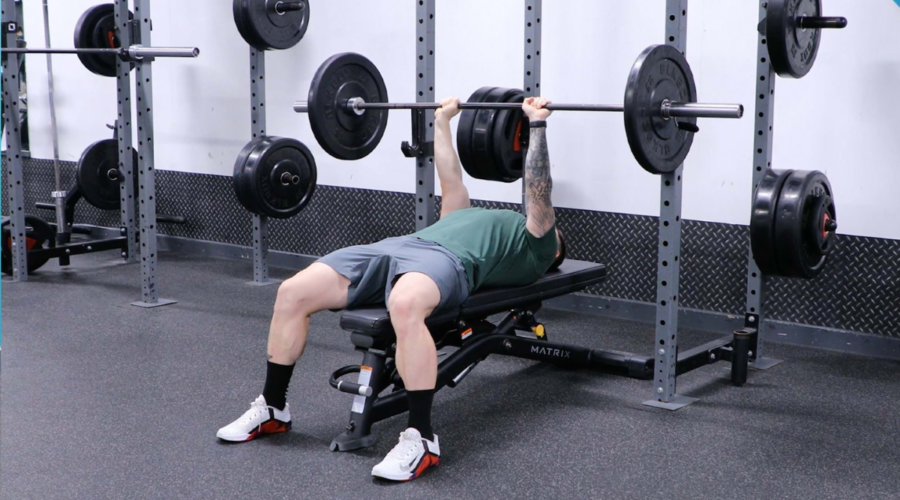
The bench press begins before the bar leaves the rack.
A strong setup includes:
• Retracted shoulder blades
• Firm foot position
• Full body tension
• Stable grip
Without these elements, strength leaks occur throughout the lift.
Inconsistent Bar Path
Research on successful bench press technique shows that elite lifters typically use a slightly curved bar path. The bar travels down toward the lower chest and back toward the shoulders during the press. A straight up and down path often reduces efficiency.
Insufficient Recovery
Strength gains occur during recovery, not training. Sleep restriction has been shown to impair performance, recovery, and muscular adaptation. Lifters who consistently sleep poorly often find their bench press progress stalls regardless of programming quality.
How to Know If You Are Ready Today
Before attempting 100kg, ask yourself these questions:
• Can I bench 80kg for 8 to 10 clean repetitions?
• Can I bench 90kg for at least 3 solid repetitions?
• Can I perform a controlled 95kg single with excellent technique?
If the answer is yes to all three, your chances of successfully pressing 100kg are very high. If not, your energy is better spent strengthening the foundation first.
Final Thoughts
The 100kg bench press is not a random number. It is the result of accumulated strength, technical practice, and intelligent progression.
Most lifters who achieve this milestone have already demonstrated the ability to handle slightly lighter weights with authority. Before chasing a heroic one rep max, make sure you can do the three things that predict success:
• Bench 80kg for 8 to 10 clean reps
• Bench 90kg for 3 strong reps
• Control 95kg for a technically perfect single
These benchmarks provide a far more reliable picture of readiness than wishful thinking. Hit all three consistently and the jump to 100kg becomes much less intimidating. Instead of hoping you are strong enough, you will know.
References
• American Council on Exercise (2012) ‘ACE-sponsored research: Study determines best chest exercises’, American Council on Exercise Fitness Research Journal.
• Andersen, V., Fimland, M.S., Brennset, O., Haslestad, L., Lundteigen, M.S., Skalleberg, K., Saeterbakken, A.H. and Raastad, T. (2014) ‘Muscle activation and strength in bench press exercises with different stability requirements’, Journal of Strength and Conditioning Research, 28(12), pp. 3294–3300.
• Grgic, J., Lazinica, B., Schoenfeld, B.J. and Pedisic, Z. (2020) ‘Test-retest reliability of the one-repetition maximum strength assessment’, Sports Medicine Open, 6(1), pp. 1–16.
• Helms, E.R., Storey, A., Cross, M.R., Brown, S.R., Lenetsky, S., Ramsay, H., Dillen, C. and Zourdos, M.C. (2017) ‘RPE and velocity relationships for the back squat, bench press, and deadlift in powerlifters’, Journal of Strength and Conditioning Research, 31(2), pp. 292–297.
• Krzysztofik, M., Wilk, M., Wojdala, G. and Golas, A. (2019) ‘Maximizing muscle hypertrophy: A systematic review of advanced resistance training techniques and methods’, International Journal of Environmental Research and Public Health, 16(24), pp. 4897–4913.
• Lasevicius, T., Schoenfeld, B.J., Silva Batista, M., Barros, T.D.S., Aihara, A.Y., Brendon, H., Longo, A.R. and Tricoli, V. (2018) ‘Muscle failure promotes greater muscle hypertrophy in low load but not high load resistance training’, Journal of Strength and Conditioning Research, 36(12), pp. 3469–3476.
• Matuszak, M.E., Fry, A.C., Weiss, L.W., Ireland, T.R. and McKnight, M.M. (2003) ‘Effect of rest interval length on repeated one repetition maximum bench press performance’, Journal of Human Movement Studies, 45(3), pp. 189–201.
• Saeterbakken, A.H., van den Tillaar, R. and Fimland, M.S. (2011) ‘A comparison of muscle activity and performance in bench press on stable and unstable surfaces’, Journal of Strength and Conditioning Research, 25(1), pp. 182–188.