

For a beginner trying to build a bigger chest, both the dumbbell bench press and the push up can work extremely well. Neither exercise is automatically superior simply because one uses weights and the other uses body weight. Muscle growth comes from repeatedly challenging the chest with enough effort, enough useful training volume, and a progression plan that keeps the exercise difficult as you get stronger.
That said, the two movements do not offer exactly the same practical advantages. The dumbbell bench press makes it straightforward to add load in small steps and train the chest through a deep, controlled range of motion. Push ups require no equipment, teach whole body control, and can build the chest impressively when the resistance is challenging enough. For most beginners, the dumbbell press has the edge for long term chest growth because progressive overload is simpler. Push ups remain a first class chest exercise, especially early on or when they are progressed intelligently.


What Makes Chest Muscles Grow?
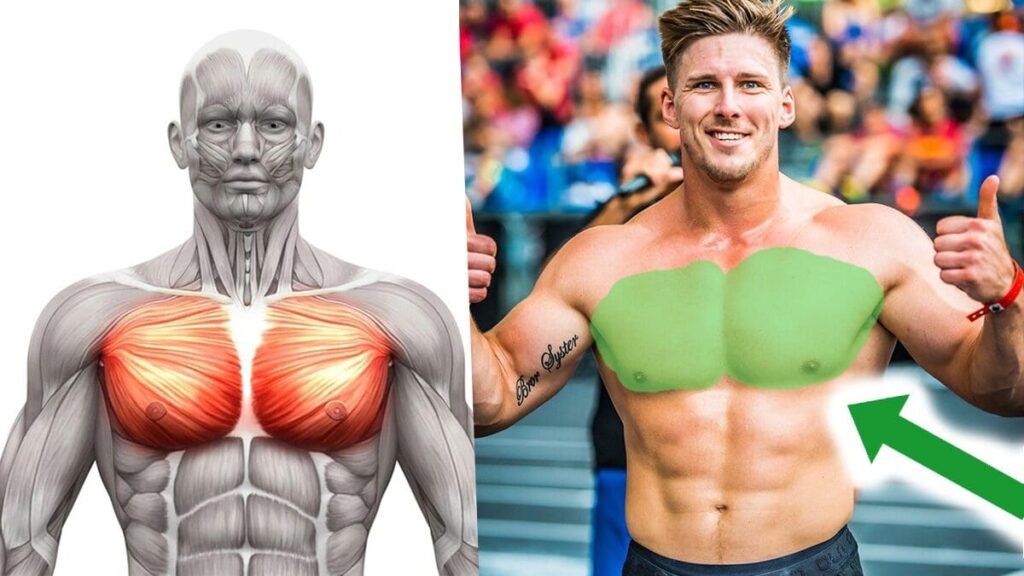
The pectoralis major is the large, fan shaped muscle that creates most of the chest’s visible size. Its main jobs include bringing the upper arm toward the body and across the body. Both dumbbell presses and push ups train those actions while the front deltoids and triceps assist.
Research shows that muscle growth can occur across a wide range of resistance training loads when sets are performed with sufficient effort. This matters because a hard set of push ups and a hard set of dumbbell presses can both stimulate hypertrophy, even though the external loading is very different. Heavier loading is generally more useful for developing maximum strength, but it is not the only route to building muscle.

For beginners, the key is to choose a version that allows consistent, technically sound repetitions and to end most working sets close to the point where another clean repetition would be very difficult. You do not need to force every set to absolute failure. Evidence suggests that training close to failure can produce similar hypertrophy to failure training, while going all the way to failure may be particularly useful when the load is light.
Training volume also matters. More hard sets can support more muscle growth up to a point, but a beginner does not need an advanced bodybuilder’s workload. Starting with a manageable amount, recovering well, and adding work only when progress stalls is far more productive than piling on exhausting sets from day one.
Dumbbell Bench Press: Why It Is So Effective for Chest Growth
It Makes Progressive Overload Simple
The biggest practical advantage of dumbbells is that they are easy to quantify. If you can perform three sets of eight repetitions with 30 pound dumbbells using good form, you can aim for nine repetitions next session, then ten, and eventually move up to the next pair. This clear progression is valuable for beginners because it turns training into a repeatable process instead of a guess.
Body weight stays relatively constant during a standard push up. As you improve, the same set can gradually become less challenging for the chest. You can alter the exercise, add a weighted vest, use a band, or elevate the feet, but those changes are slightly less precise than adding a small amount of weight to each dumbbell.
Dumbbells Allow a Natural Arm Path
Unlike a barbell, dumbbells allow each arm to move independently. Most people can press them with a slightly angled grip and a path that feels comfortable for their shoulders. This does not mean dumbbells are inherently safer for every person, but the freedom to adjust wrist angle and elbow position can make it easier for beginners to find a stable, pain free technique.
The dumbbell press also demands control from each side of the body. If one arm is weaker or less coordinated, it cannot rely as much on the stronger side to complete the repetition. That makes the movement a useful way to expose and gradually reduce side to side differences.
It Can Train a Deep Range of Motion
With a flat bench and appropriate control, dumbbells can often be lowered until the upper arms move slightly below the torso. That may provide a greater stretch of the chest than a floor based push up for some lifters. Reviews of resistance training research generally support using a full, controlled range of motion for hypertrophy rather than routinely shortening repetitions. The goal is not to chase extreme depth or force the shoulders into an uncomfortable position. It is to use the deepest range you can own without pain, loss of control, or the shoulders rolling forward.
Technique for Beginners
Set the bench flat and place your feet firmly on the floor. Start with the dumbbells above the chest, then lower them under control with the elbows angled roughly halfway between the torso and a straight out position. Keep the shoulder blades gently pulled back and down against the bench. Press upward and slightly inward without banging the dumbbells together. Keep the ribs controlled instead of turning the movement into an exaggerated lower back arch.
Choose a load that lets you perform about six to fifteen controlled repetitions. If you cannot lower the dumbbells steadily or keep your shoulders stable, the weight is too heavy for productive chest training. If you can perform far more than fifteen to twenty easy repetitions, it is probably time to use heavier dumbbells or add repetitions and sets in a structured way.
Push Ups: More Than a Beginner Exercise
Push Ups Can Build the Chest
Push ups are not a lesser version of pressing. When the resistance is matched, laboratory studies have found broadly comparable muscle activation in the chest and other prime movers during push ups and bench press variations. More importantly, short training studies comparing progressive push up training with bench press training have reported similar improvements in chest muscle thickness and upper body strength when the exercises were appropriately loaded.
These findings do not mean every casual set of push ups builds as much muscle as every dumbbell press. They show that the chest responds to tension and effort, not to a piece of equipment. A person who stops a set of regular push ups far from fatigue may not give the chest enough stimulus. A person doing a harder variation close to technical failure is in a very different position.
Push Ups Build Useful Whole Body Tension
A good push up asks the chest to press while the trunk, glutes, and legs keep the body rigid. This can make it an excellent teaching tool for beginners. You learn to connect the shoulders and arms to a stable torso, which is useful in many gym movements and sports.
The movement is also easy to practice frequently because it needs minimal setup. That convenience matters. An exercise you can perform consistently in a small space is often more valuable than a theoretically ideal exercise you regularly skip.
How to Make Push Ups Harder
Once standard push ups become easy, continuing to add very high repetitions is not always the most efficient way to build the chest. Instead, increase the mechanical demand. Elevating the feet shifts more body weight toward the arms and makes the exercise harder. Wearing a weighted vest or placing a securely positioned resistance band across the upper back can also add resistance. Push up handles can allow a deeper range of motion for people whose shoulders tolerate it well.
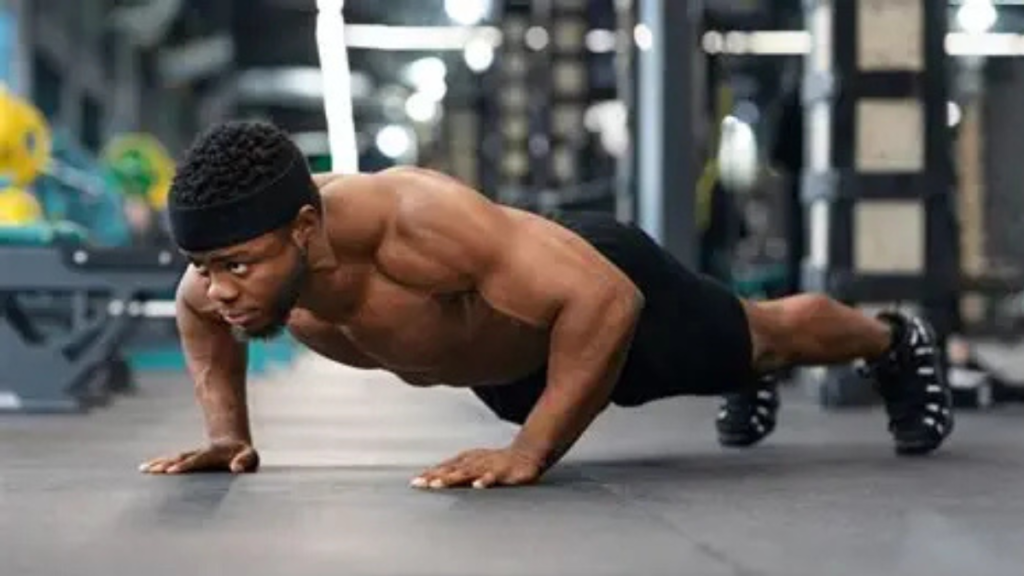
Another useful option is to slow the lowering phase and pause briefly near the bottom while keeping the body straight. These methods can make a set more demanding, although resistance should still progress over time. Avoid turning every repetition into an extremely slow struggle if it causes form to collapse. A smooth, controlled lowering phase and a strong press are usually enough.
Technique for Beginners
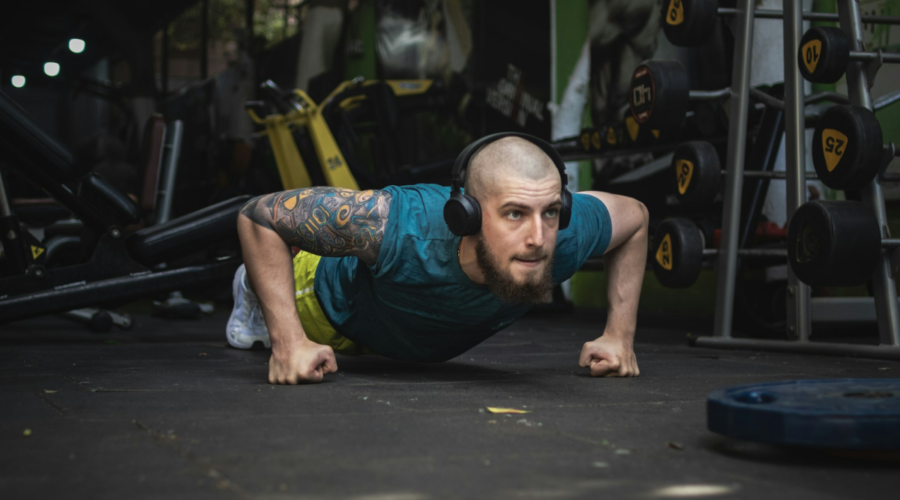
Place your hands slightly wider than shoulder width, with the body forming one long line from head to heel. Brace your abs and squeeze the glutes lightly before descending. Lower the chest toward the floor by allowing the elbows to travel at a moderate angle from the torso, then press the floor away until the elbows are straight.
If a full push up is currently too difficult, begin with hands elevated on a sturdy bench, bar, or countertop. Raising the hands reduces the proportion of body weight you must press while preserving the movement pattern. As you gain strength, lower the hand height gradually. Knee push ups can also be useful, but elevated push ups often preserve a more similar body line and may make progression easier to judge.
Which Builds More Chest Muscle for Beginners?
The Evidence Based Answer
When effort, useful range of motion, and training volume are comparable, both exercises can build chest muscle. There is no good evidence that a dumbbell automatically produces more hypertrophy than a properly progressed push up simply because it is a weight training movement. The chest can grow from both.
However, the dumbbell bench press is usually the better primary choice for a beginner whose main goal is maximizing chest size over many months. It offers more reliable and measurable overload. You can start with a manageable load, gradually add repetitions, then increase dumbbell weight with little need to redesign the exercise. It also makes it easier to keep working sets in a productive repetition range as you become stronger.
Push ups may be equally effective in the early stage, particularly for a beginner who cannot yet press heavy dumbbells or does not have access to equipment. The limitation appears later when standard push ups no longer get close to muscular fatigue before other factors become limiting. At that point, progression is essential. A weighted, band resisted, or feet elevated push up remains a serious chest builder.
The Best Choice Depends on Your Starting Point
Choose dumbbell bench presses first if you have access to a bench and suitable dumbbells, you want a simple long term progression system, and your shoulders feel comfortable pressing. Choose push ups first if you train at home, are learning basic pressing control, or need an exercise you can perform anywhere.
For the best outcome, use both. Start a chest session with dumbbell presses when you are fresh, then use push ups as a controlled higher repetition accessory exercise. Alternatively, use push ups on days when you do not have equipment and dumbbell presses on gym days. Variation can help you accumulate quality chest work without relying on one movement pattern alone.
A Simple Beginner Plan
Train the chest twice per week with at least one day between sessions. On the first session, complete three sets of dumbbell bench presses for six to twelve repetitions. Leave roughly one to three repetitions in reserve on the first sets and stop when your final repetition would clearly lose form. Rest long enough to perform the next set with similar control, usually around two minutes or more.
3 Best Cable Back Exercises for a More Attractive V Shaped Torso
On the second session, complete three sets of a push up variation for eight to twenty repetitions. Select a variation that makes the final few repetitions challenging while your body remains rigid and the chest moves toward the floor. If regular push ups are too hard, elevate the hands. If they are too easy, elevate the feet, use a band, or add external load.
When you reach the top of the repetition range on all sets with clean form, make the exercise slightly harder. For dumbbells, increase the load by the smallest available amount and work back up through the range. For push ups, use a more difficult variation or a small amount of added resistance. This double progression approach is easy to track and gives your chest a clear reason to adapt.
Do not judge progress only by soreness. Muscle soreness is not a reliable scorecard for hypertrophy. Track your repetitions, load, push up variation, body weight, and occasional chest measurements or photos under similar conditions. Strength improvement, stable technique, and gradual changes over several months are much more useful indicators.
Common Mistakes That Reduce Chest Growth
The first mistake is choosing a load or variation that is far too easy. Sets should become difficult, especially toward the end, but the repetition quality must remain high. The second is rushing the lowering phase. Lowering under control helps you keep tension where you want it and prevents the movement from becoming a sloppy bounce.
The third is allowing the shoulders to dominate every repetition. In both movements, keep the shoulder blades controlled and avoid shrugging toward the ears. The fourth is changing exercises every workout. A beginner needs enough consistency to practice technique and see whether performance is improving.
Finally, do not let chest training replace recovery basics. Resistance training produces the stimulus, but adequate food, protein, sleep, and recovery help the body respond to it. A systematic review and meta analysis has found that protein supplementation can produce small additional gains in resistance training related muscle mass and strength, particularly when total protein intake is otherwise not sufficient. Food should be the foundation, with supplements treated as a convenient option rather than a requirement.
Final Verdict
The dumbbell bench press is the better standalone option for most beginners who want to build as much chest muscle as possible because it makes progressive overload straightforward and can be loaded precisely for years. Push ups are still a highly effective chest exercise. When they are challenging, controlled, and progressed instead of treated as a warm up, they can build real muscle.
Use dumbbells as your main strength and hypertrophy tool if you have them. Use push ups to build pressing skill, add quality volume, and train anywhere. The winning choice is not the exercise with the more impressive label. It is the one you can perform consistently, progress patiently, and take close enough to your limits with excellent form.
References
- Calatayud, J., Borreani, S., Colado, J.C., Martin, F., Rogers, M.E., Behm, D.G. and Andersen, L.L. (2015) ‘Bench press and push up at comparable levels of muscle activity results in similar strength gains’, Journal of Strength and Conditioning Research, 29(1), pp. 246 to 253.
- Grgic, J., Schoenfeld, B.J., Orazem, J. and Sabol, F. (2022) ‘Effects of resistance training performed to repetition failure or non failure on muscular strength and hypertrophy: A systematic review and meta analysis’, Journal of Sport and Health Science, 11(2), pp. 202 to 211.
- Kassiano, W., Costa, B., Nunes, J.P., Ribeiro, A.S., Schoenfeld, B.J. and Cyrino, E.S. (2023) ‘Which ROMs lead to Rome? A systematic review of the effects of range of motion on muscle hypertrophy’, Journal of Strength and Conditioning Research, 37(5), pp. 1135 to 1144.
- Kikuchi, N. and Nakazato, K. (2017) ‘Low load bench press and push up induce similar muscle hypertrophy and strength gain’, Journal of Exercise Science and Fitness, 15(1), pp. 37 to 42.
- Lasevicius, T., Ugrinowitsch, C., Schoenfeld, B.J., Roschel, H., Tavares, L.D., de Souza, E.O., Tricoli, V. and Libardi, C.A. (2022) ‘Muscle failure promotes greater muscle hypertrophy in low load but not in high load resistance training’, Journal of Strength and Conditioning Research, 36(2), pp. 346 to 351.
- Morton, R.W., Murphy, K.T., McKellar, S.R., Schoenfeld, B.J., Henselmans, M., Helms, E., Aragon, A.A., Devries, M.C., Banfield, L., Krieger, J.W. and Phillips, S.M. (2018) ‘A systematic review, meta analysis and meta regression of the effect of protein supplementation on resistance training induced gains in muscle mass and strength in healthy adults’, British Journal of Sports Medicine, 52(6), pp. 376 to 384.
- Schoenfeld, B.J., Grgic, J., Ogborn, D. and Krieger, J.W. (2017) ‘Strength and hypertrophy adaptations between low versus high load resistance training: A systematic review and meta analysis’, Journal of Strength and Conditioning Research, 31(12), pp. 3508 to 3523.
Key Takeaways
| Question | Practical answer |
|---|---|
| Which is better for long term chest growth? | Dumbbell bench presses usually have the edge because adding load and tracking progress is simpler. |
| Can push ups build chest muscle? | Yes. Hard, progressively loaded push ups can build chest muscle when performed with good form and close to muscular fatigue. |
| Should beginners train both? | Yes. Dumbbell presses can provide the main progressive lift, while push ups add convenient and effective chest volume. |
| How often should beginners train chest? | Two sessions per week is a practical starting point, with recovery and steady progression guiding further adjustments. |