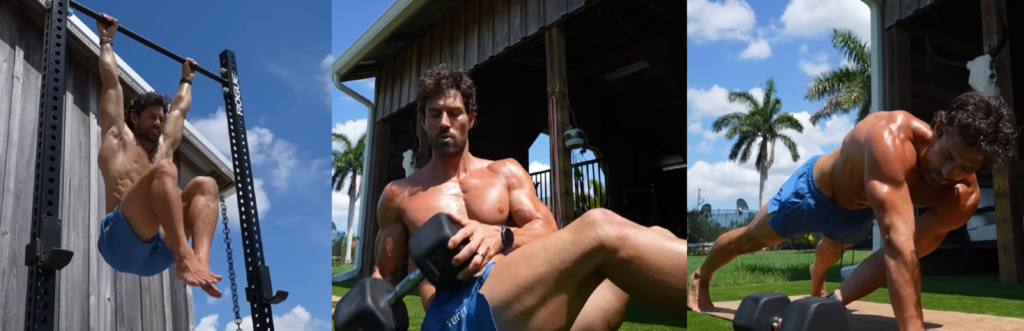
Twisting exercises train your trunk to rotate while your abdominal muscles help control the movement. That makes them a useful addition to a beginner’s core routine, alongside exercises that resist movement, such as planks and dead bugs. You do not need to twist quickly or use heavy weights to get started. A comfortable range of motion and steady control matter more than speed.
The three exercises below offer different ways to practice rotation: seated without equipment, lying on the floor, and standing with a resistance band. Research on rotational training suggests it can affect the oblique muscles and trunk mobility, but studies do not establish these three exercises as a definitive ranking. Think of them as accessible starting points that you can adjust to your ability.


What twisting core exercises train
Your core is more than your six-pack muscles. It includes the muscles around your abdomen, back, and pelvis that help support and move your trunk. The internal and external obliques are among the abdominal muscles involved in rotation. Their activity changes with the direction and range of a twist, and research has also recorded activity in other trunk muscles during rotation.
A small study of healthy men found that trunk rotation was associated with changes in activity across several abdominal and back muscles. A separate randomized trial found increased oblique muscle thickness after four weeks of rotational movement training. These findings support including rotation in a varied routine, but they do not show that twisting exercises alone prevent injury or guarantee a stronger core for every person.

Beginners should practice rotation slowly and comfortably. Your hips and feet can move a little if that feels natural, especially during standing exercises. Avoid forcing your spine to rotate farther than it can comfortably move. If an exercise causes pain, stop and choose a smaller range or an easier variation. People with an existing back injury or persistent symptoms should ask a qualified health professional for guidance before beginning a new exercise routine.
1. Seated torso twist
The seated torso twist is the simplest place to learn the movement because you can control the range without balancing or handling equipment. It gives you time to notice whether your shoulders and chest are turning together, rather than swinging your arms to create the appearance of a twist.
How to do it
Sit on the floor with your knees bent and your feet flat. Sit tall, cross your arms over your chest, and keep your shoulders relaxed. Turn your chest a small distance to one side, pause briefly, and return to the center. Repeat on the other side. Keep your head aligned with your chest, and breathe normally instead of holding your breath.
Start with six to eight controlled repetitions on each side. If sitting on the floor is uncomfortable, sit upright on a sturdy chair and use the same small, controlled movement. The chair variation is also useful if you find that your lower back rounds or your posture collapses on the floor.
Make it easier or harder
Keep your feet planted and shorten the range if you feel unsteady. The goal is to rotate smoothly, not to reach a particular angle. As the movement becomes comfortable, you can pause for a second at each end of the twist. You can also add a very light object held close to your chest, but only if you can maintain control without leaning backward or jerking from side to side.
This is a practice exercise rather than a test of flexibility. A small, pain-free turn performed with control is a good starting point. Research measuring trunk rotation has found that muscle activity varies across spinal segments and throughout the movement, which supports using a deliberate range instead of forcing an end position.
2. Bent-knee windshield wipers
Bent-knee windshield wipers let you practice trunk rotation while lying on your back. Because your knees stay bent, this is a manageable way for many beginners to explore a side-to-side movement without supporting their body weight in a seated or standing position.
How to do it
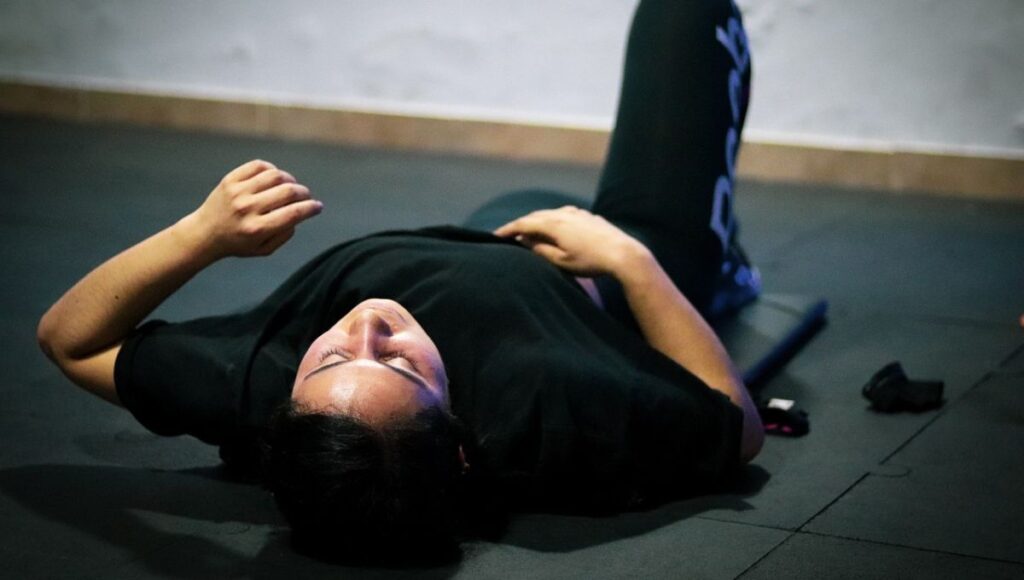
Lie on your back with your arms resting out to the sides and your palms facing down. Bend your knees and bring your feet off the floor so your hips and knees are comfortably bent. Keep your shoulders relaxed against the floor. Slowly lower both knees a short distance toward one side, then bring them back to the middle and lower them toward the other side.
Move only as far as you can while keeping the motion smooth and comfortable. Your knees do not need to touch the floor. Begin with five or six repetitions per side, and pause between repetitions if you need to reset your position. Breathe out gently as your knees move to the side, then inhale as you return to the center.
Adjust the range to your comfort
If lifting your feet feels too challenging, keep them on the floor and slide one knee outward at a time. If the full two-knee movement feels comfortable, gradually allow your knees to travel a little farther while keeping your shoulders relaxed. Avoid using momentum to swing your legs from side to side.
This exercise is not a direct test of oblique strength, and the research cited here does not establish this exact movement as superior to other core exercises. Its value for a beginner is that it introduces controlled rotation with a simple setup and an easy way to reduce the range. Choose the version that lets you move without discomfort or strain.
3. Standing resistance band rotation
Standing band rotation adds light resistance, so your trunk has to control the pull of the band as you turn. It also lets you practice rotating while standing, which may feel more familiar than doing every core exercise on the floor. Use a light band at first, since a band that pulls too strongly can make it difficult to move smoothly.
How to do it
Secure a resistance band to a stable anchor around chest height. Stand sideways to the anchor with your feet about shoulder width apart. Hold the band with both hands in front of your chest and step away until there is light tension. Keep your knees soft and your torso upright. Turn your chest away from the anchor in a controlled motion, then return slowly to your starting position.
Complete eight to ten repetitions, then turn around and repeat facing the other direction. Keep your hands close to your chest at first. As you become more confident, you can extend your arms slightly, which increases the distance between the band and your body and may make the exercise feel harder. Do not increase the band’s resistance and the range of motion at the same time.
Keep the movement controlled
Let your feet and hips turn naturally if needed rather than pinning them in place and forcing your lower back to rotate. Do not let the band pull you back quickly between repetitions. The return is part of the exercise, so guide it smoothly. If you find yourself leaning, twisting your knees, or holding your breath, reduce the band tension or step closer to the anchor.
Rotational exercise research suggests that the obliques respond during trunk rotation, but it does not show that a heavier band produces better results for beginners. Start with resistance you can control throughout every repetition. Increase it gradually only when you can maintain your posture and return the band without rushing.
How to add these exercises to a beginner routine
You can practice one or two of these movements two or three times per week as part of a balanced strength routine. Start with one or two sets per exercise and leave enough rest to perform each set with good control. There is no need to train your core to exhaustion. If your technique gets worse or the movement becomes uncomfortable, end the set.
3 Best Exercises for Building the Upper Body Beginners Often Ignore
A simple session could include seated torso twists, bent-knee windshield wipers, and standing band rotations. Use the repetitions described in each exercise, or do fewer if that helps you stay in control. You can also choose just one movement and practice it consistently before adding another. Beginners benefit from a manageable starting point they can repeat, rather than making every exercise difficult on the first day.
Progress by making one small change at a time. You might add a repetition, move through a slightly larger comfortable range, or use a little more band tension. The American College of Sports Medicine’s guidance on resistance training emphasizes matching progression to a person’s goals and training status. For these exercises, gradual changes are a practical way to build confidence and keep the movement controlled.
Twisting exercises are only one part of core training. A complete routine can also include exercises that resist rotation, such as a bird dog or a Pallof press, as well as general strength exercises. The aim is not to twist as far as possible. It is to practice rotation in a way you can control and build from over time.
Key takeaways
| Exercise | Beginner starting point | Main coaching cue |
|---|---|---|
| Seated torso twist | Six to eight repetitions per side | Turn your chest slowly and keep your feet planted |
| Bent-knee windshield wipers | Five or six repetitions per side | Use a comfortable range and avoid swinging your legs |
| Standing resistance band rotation | Eight to ten repetitions per side | Choose light resistance and guide the return |
References
- Catania, B., Ross, T., Sandella, B., Bley, B. and DiTrani Lobacz, A. (2020) ‘Clinical assessment and thickness changes of the oblique and multifidus muscles using a novel screening tool and exercise program: A randomized controlled trial’, Journal of Sport Rehabilitation, 30(3), pp. 384–394.
- Kraemer, W.J., Adams, K., Cafarelli, E., Dudley, G.A., Dooly, C., Feigenbaum, M.S., Fleck, S.J., Franklin, B., Fry, A.C., Hoffman, J.R., Newton, R.U., Potteiger, J., Stone, M.H., Ratamess, N.A. and Triplett-McBride, T. (2002) ‘American College of Sports Medicine position stand. Progression models in resistance training for healthy adults’, Medicine & Science in Sports & Exercise, 34(2), pp. 364–380.
- Niewiadomy, P., Szuścik-Niewiadomy, K., Kuszewski, M., Kurpas, A. and Kochan, M. (2021) ‘The influence of rotational movement exercise on the abdominal muscle thickness and trunk mobility: Randomized control trial’, Journal of Bodywork and Movement Therapies, 27, pp. 464–471.
- Sugaya, T., Sakamoto, M., Nakazawa, R. and Wada, N. (2016) ‘Relationship between spinal range of motion and trunk muscle activity during trunk rotation’, Journal of Physical Therapy Science, 28(2), pp. 589–595.