

A beginner looking to build a stronger core may head straight for crunches and situps. Those exercises can train the abdominal muscles, but they are only part of the picture. Your core also works to keep your trunk steady as your arms and legs move, and to resist tipping or twisting when a load pulls you off balance. Exercises that practice those jobs can add useful variety to a training plan.
The three movements below are the dead bug, bird dog, and side plank. They are often overlooked because they look less dramatic than hanging leg raises or heavy cable crunches. Each gives you a different challenge: controlling your trunk while your limbs move, stabilizing your torso in a quadruped position, or resisting a sideways bend.



There is an important distinction between training the core and building visible abdominal muscle. These exercises can help you learn control and improve trunk endurance, but muscle activity measured during a movement does not prove that the exercise will increase muscle size over time. For more abdominal muscle mass, you also need a way to make training progressively challenging. And abdominal training alone should not be expected to remove fat from your midsection.
A controlled trial found that six weeks of abdominal exercise improved endurance but did not significantly change body fat or abdominal measurements.
What Beginners Should Know About Core and Six Pack Training
The word core is often used as if it means only the muscles at the front of the stomach. It usually refers to a broader group of trunk muscles, including the abdominal muscles and muscles that help support and control the spine. The rectus abdominis is the paired muscle at the front of the abdomen that forms the familiar six pack shape when its segments are visible. The obliques run along the sides of the torso, while deeper muscles also contribute to trunk control.
Core exercises can challenge these muscles in different ways. Some involve bending the trunk, while others ask you to keep your spine and torso steady as your limbs move. The dead bug, bird dog, and side plank belong mainly to this second group. They teach you to control movement and maintain a stable position while the exercise creates a challenge.
That does not make them guaranteed muscle building exercises. Research on core movements often measures muscle activity during a single exercise session. Those results can help explain which muscles are working, but they cannot show on their own how much muscle growth someone will get after weeks of training. In one study, the muscle activity recorded during a dead bug and quadruped exercise was relatively low in healthy participants, leading the researchers to question whether those versions would be enough to strengthen healthy adults. That is a useful reason to progress the exercises as they become easier, rather than repeating an easy version indefinitely.
For muscle growth, training needs to provide a meaningful challenge over time. A systematic review and meta analysis found similar hypertrophy across a range of resistance loads when training volume was matched, while heavier loads produced greater gains in one repetition maximum strength. Another review found that training to the point where another repetition is impossible does not appear to be essential for strength or muscle growth. In practical terms, beginners can focus on controlled repetitions, gradually harder variations, and sound technique instead of rushing to failure.
1. Dead Bug
The dead bug is performed lying on your back, which gives beginners a stable position from which to learn trunk control. Its main challenge is to move an arm and leg while keeping the torso steady. Research measuring muscle activity during the movement found that the rectus abdominis and abdominal obliques were active, and that activity increased as the exercise became more difficult.
How to Do the Dead Bug
Lie on your back with your arms reaching toward the ceiling and your hips and knees bent. Keep your knees above your hips. Gently brace your abdomen as if preparing for a light nudge, and keep your lower back in a comfortable position against the floor. The goal is to prevent your trunk from arching as your limbs move.
Slowly lower one arm overhead while you extend the opposite leg away from your body. Stop before your back lifts or your position becomes difficult to control. Return to the starting position, then repeat with the other arm and leg. Use a range of motion that lets you stay steady rather than reaching so far that you lose control.
A good starting point is two or three sets of six to ten repetitions per side. Take your time with each repetition and breathe normally. If you find it hard to keep your back steady, begin by moving only one leg at a time. You can also shorten the movement by tapping one heel toward the floor instead of extending the leg far away.
How to Progress It
Once you can complete your repetitions without your back arching or your limbs moving too quickly, extend the leg farther or slow down the lowering phase. You can also hold a light band in your hands and pull it gently while you move your legs. The added resistance should make it harder to control your trunk without forcing you to change your position.
The dead bug is useful for learning how to resist unwanted movement while your arms and legs move. It should not be treated as a direct replacement for every exercise that loads the abdominal muscles through a larger movement. If your main goal is abdominal muscle growth, include a progressive resistance exercise in your wider training plan as your control improves.
2. Bird Dog
The bird dog begins on your hands and knees and asks you to move opposite limbs while keeping your trunk steady. It is a straightforward way to practice controlling rotation, since lifting an arm or leg can tempt the torso to shift. Studies of stabilization exercises have found that quadruped movements recruit trunk muscles, including the obliques, although the muscle activity can vary with the movement and the person performing it.
How to Do the Bird Dog
Start on your hands and knees with your hands under your shoulders and your knees under your hips. Keep your back in a comfortable, neutral position and look toward the floor. Brace lightly, then extend one arm forward and the opposite leg backward. Reach long rather than lifting the limbs as high as possible.
Pause briefly when your arm and leg are extended, then return to the starting position under control. Repeat with the other arm and leg. Your hips should remain level, and your torso should not twist as you reach. If you cannot keep your balance, move one limb at a time until the pattern feels manageable.
Try two or three sets of six to ten repetitions per side. Make each repetition deliberate, and stop the set when you can no longer keep your torso still. The aim is not to get through the set quickly. A steady movement helps you notice whether your trunk is shifting and gives you a chance to correct it.
How to Progress It
First, improve your control by pausing for a second or two at full reach. Next, you can increase the pause or use a slower return to the starting position. A light resistance band or small ankle weight may offer another step, but only if you can keep your hips level and your back steady throughout the set.
The bird dog is often overlooked because it does not create a strong burning sensation in the abdominal muscles. That feeling is not a reliable way to judge whether an exercise is useful. The bird dog’s value is its coordination and trunk control challenge. Because the load is limited, however, it may not provide enough resistance by itself to maximize abdominal muscle growth. Treat it as one piece of a balanced core routine.
3. Side Plank
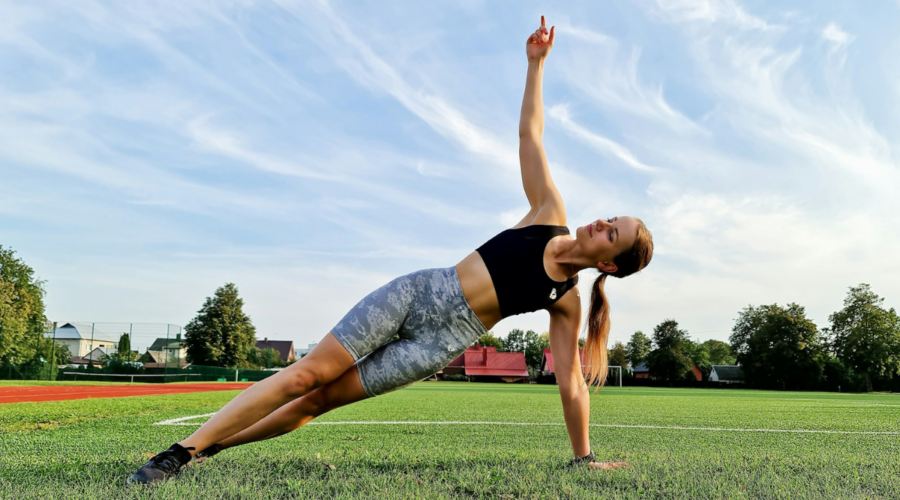
The side plank challenges the muscles along the side of the torso to resist a sideways bend. It is easy to scale because you can support yourself on your knees or feet, and it requires no equipment. Research comparing core stability exercises found that side plank variations can create a meaningful change in the measured thickness of some deep trunk muscles during the exercise. Such measurements indicate a muscular response in the moment, but they do not establish long term muscle growth.
How to Do the Side Plank
Lie on your side with your elbow beneath your shoulder. Bend your knees and place them on the floor for the beginner version. Lift your hips so your body forms a straight line from your head to your knees. Keep your shoulders stacked and avoid rolling your chest toward the floor or ceiling.
Hold the position while breathing normally. Start with two or three holds of 15 to 30 seconds per side. If you can keep your position and breathe comfortably, gradually add time until you can hold for about 40 seconds. Once that feels controlled, try the full version with your legs straight and your feet stacked or staggered.
The side plank should feel challenging along the side of your torso, but a collapsing shoulder or a sagging hip means the hold has become too difficult. End the set when you cannot maintain your position. If holding still is uncomfortable, try shorter holds with a brief rest between them.
How to Progress It
Make the side plank harder by moving from bent knees to straight legs, increasing the hold time, or placing your top foot on a low step. A light weight on the hip is another option once you are confident in the full version. Use a progression that makes the muscles work harder while keeping the same body position.
The side plank is valuable because it trains the trunk to resist sideways bending. It is not a direct test of six pack definition, and a longer hold does not automatically mean more abdominal muscle. To keep making progress, choose a variation that challenges you while allowing controlled breathing and steady alignment.
How to Fit These Exercises Into a Beginner Routine
Perform these exercises two or three times per week, either after a full body strength workout or in a short core session. Begin with two sets of each movement. For the dead bug and bird dog, use six to ten controlled repetitions per side. For the side plank, use holds of 15 to 30 seconds per side. Rest long enough to perform the next set with good control.
When you can complete every set without losing your position, make one small change. Add a repetition, add a few seconds to the hold, slow the movement, or choose a slightly harder version. Changing one thing at a time makes it easier to tell whether you are ready for more difficulty. You do not need to make every exercise harder in the same week.
Keep your expectations realistic. The cited exercise studies focus largely on muscle activity or short term changes during movement, not long term six pack growth from a specific three exercise routine. Use the dead bug, bird dog, and side plank to build a stronger foundation and improve control. For more muscle growth, include abdominal exercises that allow you to add resistance or gradually increase difficulty. For visible abdominal definition, remember that targeted core exercise alone did not reduce abdominal fat in the controlled trial described in the references.
Key Takeaways
| Exercise | Main challenge | Beginner starting point | Progress when |
|---|---|---|---|
| Dead bug | Keeping the trunk steady as opposite limbs move | Two or three sets of six to ten repetitions per side | You can extend your limbs farther without your back arching |
| Bird dog | Keeping the hips and torso steady while reaching | Two or three sets of six to ten repetitions per side | You can pause at full reach without twisting or shifting |
| Side plank | Resisting a sideways bend | Two or three holds of 15 to 30 seconds per side | You can hold steadily and breathe, then try straight legs |
| Six pack goal | Building abdominal muscle and making it visible | Train the core consistently and progress the challenge | Add resistance over time and do not expect ab exercises alone to reduce abdominal fat |
References
- Calatayud, J., Casaña, J., Martín, F., Jakobsen, M.D., Colado, J.C. and Andersen, L.L. (2017) ‘Progression of core stability exercises based on the extent of muscle activity’, American Journal of Physical Medicine & Rehabilitation, 96(10), pp. 694–699.
- Carvalho, L., Junior, R.M., Barreira, J., Schoenfeld, B.J., Orazem, J. and Barroso, R. (2022) ‘Muscle hypertrophy and strength gains after resistance training with different volume matched loads: a systematic review and meta analysis’, Applied Physiology, Nutrition, and Metabolism, 47(4), pp. 357–368.
- Grgic, J., Schoenfeld, B.J., Orazem, J. and Sabol, F. (2022) ‘Effects of resistance training performed to repetition failure or non failure on muscular strength and hypertrophy: a systematic review and meta analysis’, Journal of Sport and Health Science, 11(2), pp. 202–211.
- Souza, G.M., Baker, L.L. and Powers, C.M. (2001) ‘Electromyographic activity of selected trunk muscles during dynamic spine stabilization exercises’, Archives of Physical Medicine and Rehabilitation, 82(11), pp. 1551–1557.
- Vispute, S.S., Smith, J.D., LeCheminant, J.D. and Hurley, K.S. (2011) ‘The effect of abdominal exercise on abdominal fat’, Journal of Strength and Conditioning Research, 25(9), pp. 2559–2564.