Preacher curls and hammer curls both train the muscles that bend your elbow, but they use different hand positions and place different demands on your arm. Preacher curls use a palm up grip and support your upper arms against a bench. Hammer curls use a neutral grip, with your palms facing each other, and are usually performed standing or seated with your arms at your sides.
If your main goal is to grow the biceps brachii, the prominent muscle at the front of your upper arm, preacher curls are the more direct choice. If you want fuller looking arms overall, hammer curls are a useful addition because they train the brachialis and brachioradialis alongside the biceps. These muscles contribute to the appearance of the upper arm and forearm.


There is no long term study directly comparing preacher curls with hammer curls for muscle growth. That means we cannot say with certainty that one produces bigger arms than the other. We can, however, use research on elbow flexor muscles, forearm position, and curl variations to understand what each exercise may offer.
What Do Preacher Curls Train?
A preacher curl involves curling a weight while your upper arms rest on an angled pad. The supported position makes it harder to move your shoulders and torso to help lift the weight. With a dumbbell or barbell, your palms face up as you curl. This is called a supinated grip.
The biceps brachii bends the elbow and helps turn the palm upward. A supinated grip lets the biceps contribute to both actions, although a standard preacher curl keeps the forearm in that position rather than actively rotating it during each repetition. The brachialis, which lies underneath the biceps, also helps bend the elbow.
Preacher curls are a practical way to focus on elbow flexion while keeping the upper arm relatively still. They can also be performed with different resistance profiles. With a barbell, the exercise tends to feel hardest toward the lower part of the curl. A cable can make the upper part more challenging, depending on the setup.
A 10 week training study comparing barbell and cable preacher curls found that both versions increased biceps thickness by a similar amount. This suggests the preacher curl can build the biceps across different resistance profiles, provided the exercise is performed consistently and with enough effort.
What Do Hammer Curls Train?
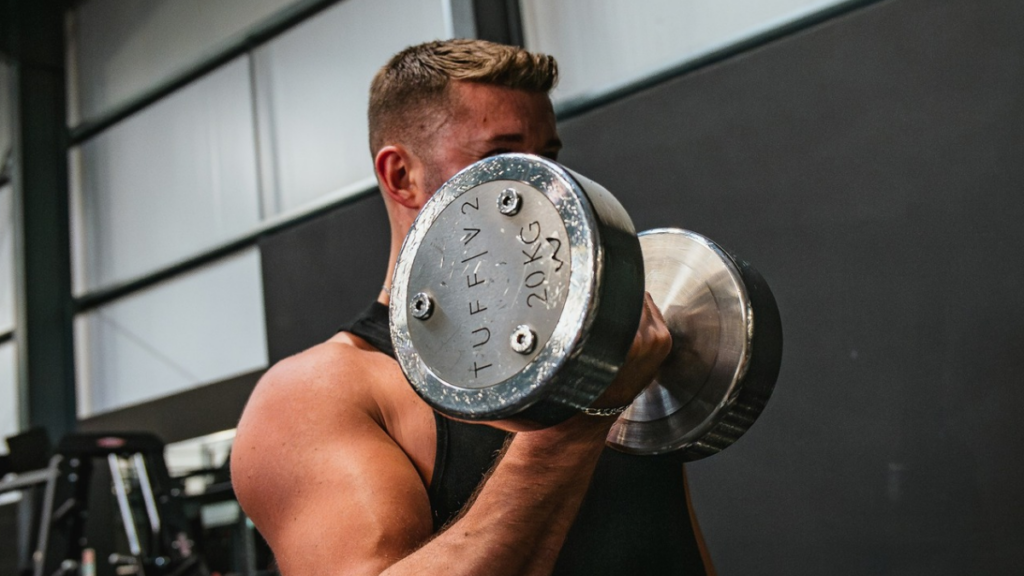
Hammer curls use a neutral grip, which means your palms face one another throughout the movement. You bend your elbows without turning your hands palm up. The biceps still contributes, but the exercise changes the balance of work among the elbow flexors.
The brachialis is an elbow flexor that can contribute to curling regardless of forearm position. The brachioradialis, a muscle that runs along the forearm, also helps bend the elbow. Research examining forearm rotation has found that biceps activity rises when the forearm is supinated, while the brachialis and brachioradialis contribute relatively more as the forearm turns toward a palm down position. A hammer curl sits between those positions, so it still uses the biceps while allowing the other elbow flexors to contribute.
This does not mean hammer curls switch the biceps off. They are still a biceps exercise. The neutral grip simply changes the movement compared with a palm up curl and gives you a way to train the arm without relying on supination.
It is common to hear that hammer curls make the arms look wider because the brachialis lies beneath the biceps and can add to the upper arm’s overall thickness as it grows. This is a reasonable explanation of the muscles involved, but “wider biceps” is not a precise scientific outcome. Muscle shape and the way an arm looks depend on several muscles, their size, and individual anatomy. Hammer curls cannot guarantee a particular change in arm width.
What Does the Research Say About Which Builds More?
The most important limitation is that research has not directly tested preacher curls against hammer curls in a long term trial measuring growth of the biceps, brachialis, and brachioradialis. Some exercise studies measure muscle activity during a single session, but an EMG reading is not the same as a measurement of muscle growth over time.
Research on curl variations does show that changing the exercise can alter which areas of the elbow flexors grow. In a 2026 study, participants trained one arm with incline curls and the other with preacher curls for 12 weeks. Incline curls produced greater growth in the biceps brachii, while preacher curls produced greater growth in the brachialis and brachioradialis. The difference in total elbow flexor growth between the exercises was not statistically significant. This is useful evidence that curl variations may influence individual muscles, but incline curls are not hammer curls, so the results cannot establish that preacher curls or hammer curls are superior.
A separate eight week study in young women compared preacher curls with incline curls. It found that growth differed by the measurement site: incline curls produced a greater increase in muscle thickness closer to the shoulder, while preacher curls produced a greater increase closer to the elbow. The study did not compare hammer curls, and its findings should not be treated as proof that one curl builds more of the whole biceps.
Studies of preacher curls also suggest that how the exercise loads the muscle through the range of motion may not determine total growth on its own. In the 10 week barbell and cable comparison, both groups gained biceps thickness despite the two setups being hardest at different parts of the curl. Together, these findings support a practical point: exercise selection can influence the training stimulus, but a single curl variation is unlikely to decide your overall arm development.
Which Should You Choose?
Choose preacher curls if you want a stable, palm up curl that focuses on elbow flexion and gives you an easy way to control your repetitions. The bench support can help limit swinging, although it does not guarantee perfect form. Use a weight you can lower under control, and avoid forcing your elbow into a painful stretch at the bottom.
Choose hammer curls if you want to train your elbow flexors with a neutral grip and add work for the brachialis and brachioradialis. They can be useful if you want more complete arm development, or if a palm up curl feels uncomfortable. Keep your wrists straight and avoid leaning back or swinging the dumbbells to finish repetitions.
For most people seeking larger arms, there is no need to treat these exercises as competitors. You can include both in a training plan. For example, perform preacher curls for one part of your arm workout and hammer curls for another, or alternate them between sessions. This gives you both a supinated and a neutral grip curl without relying on one movement to cover every elbow flexor.
Whichever exercise you choose, use a repeatable range of motion and gradually increase the challenge over time. That could mean adding a small amount of weight, completing more repetitions with the same weight, or improving control while keeping the load the same. A systematic review of range of motion research found that full range of motion, and partial repetitions performed in the more extended part of a movement, can be favorable for muscle growth in some muscles, including the biceps. For most lifters, controlled curls through a comfortable, substantial range of motion are a sensible starting point.
The Verdict
Preacher curls are the clearer choice if your priority is a palm up curl that directly trains the biceps brachii. Hammer curls train the biceps too, while giving the brachialis and brachioradialis a meaningful role in the movement. That makes them a useful option for building fuller looking arms, but current evidence does not prove they create wider biceps or outperform preacher curls for total arm growth.
If you want bigger arms overall, include both when they fit your program. Train them consistently, use a challenging load with controlled repetitions, and give your muscles enough time to recover. Your results will depend more on sustained training than on finding a single curl variation that supposedly does everything.
Key Takeaways
| Goal | Better fit | What the evidence supports |
|---|---|---|
| Focus on a palm up curl | Preacher curl | Trains elbow flexion with the biceps contributing to the movement |
| Train with a neutral grip | Hammer curl | Trains the elbow flexors, including the biceps, brachialis, and brachioradialis |
| Build wider looking arms | Neither is a guarantee | Hammer curls may help develop muscles beyond the biceps, but direct comparison evidence is lacking |
| Choose one exercise for total growth | No clear winner | There is no long term study directly comparing preacher curls with hammer curls |
References
- Kobayashi, Y., Maeo, S., Eihara, Y., Ono, M., Sato, M., Sugiyama, T., Kanehisa, H. and Isaka, T. (2026) ‘Exercise-specific preferential hypertrophy of individual elbow flexor muscles after incline versus preacher dumbbell curl training’, Journal of Sports Sciences, pp. 1–14.
- Kassiano, W., Costa, B., Nunes, J.P., Ribeiro, A.S., Schoenfeld, B.J. and Cyrino, E.S. (2023) ‘Which ROMs lead to Rome? A systematic review of the effects of range of motion on muscle hypertrophy’, Journal of Strength and Conditioning Research, 37(5), pp. 1135–1144.
- Marcolin, G., Panizzolo, F.A., Petrone, N., Moro, T., Grigoletto, D., Piccolo, D. and Paoli, A. (2018) ‘Differences in electromyographic activity of biceps brachii and brachioradialis while performing three variants of curl’, PeerJ, 6, e5165.
- Naito, A., Sun, Y.J., Yajima, M., Fukamachi, H. and Ushikoshi, K. (1998) ‘Electromyographic study of the elbow flexors and extensors in a motion of forearm pronation/supination while maintaining elbow flexion in humans’, The Tohoku Journal of Experimental Medicine, 186(4), pp. 267–277.
- Nunes, J.P., Jacinto, J.L., Ribeiro, A.S., Mayhew, J.L., Nakamura, M., Capel, D.M.G., Santos, L.R., Santos, L., Cyrino, E.S. and Aguiar, A.F. (2020) ‘Placing greater torque at shorter or longer muscle lengths? Effects of cable vs. barbell preacher curl training on muscular strength and hypertrophy in young adults’, International Journal of Environmental Research and Public Health, 17(16), 5859.
- Kassiano, W., Costa, B., Kunevaliki, G., Lisboa, F., Stavinski, N., Prado, A., Tricoli, I., Francsuel, J., Lima, L., Nunes, J.P., Ribeiro, A.S. and Cyrino, E.S. (2025) ‘Distinct muscle growth and strength adaptations after preacher and incline biceps curls’, International Journal of Sports Medicine, 46(5), pp. 334–343.