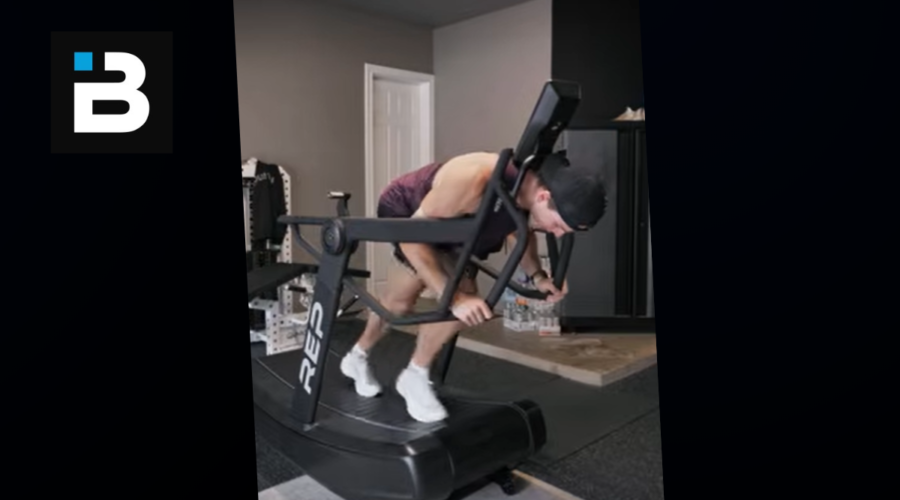


The Strive™ Curved Treadmill from REP Fitness is designed to combine a manual running treadmill with an indoor sled training system. I used it for walking, running, sprint intervals and sled pushes, and I found it to be one of the most versatile conditioning machines I have tested.
I absolutely love the treadmill. What I would give this thing is 100 percent, 10 out of 10. It is incredibly good.


The most noticeable thing for me, compared with every other treadmill that I’ve used in this space, is that this treadmill is silent. Most of the other ones cause a ruckus. They’re almost embarrassing to use in gyms because they are so loud and make so much noise.
With this one, you get on and it’s very, very quiet, which I really appreciate when I sneak in a run.
The quiet running experience is only one reason I rate the Strive™ so highly. It also has eight resistance levels, two deck positions, dedicated sled handles and a separate display that I can see while pushing. These features make it particularly relevant for HYROX training, hybrid workouts and functional fitness.
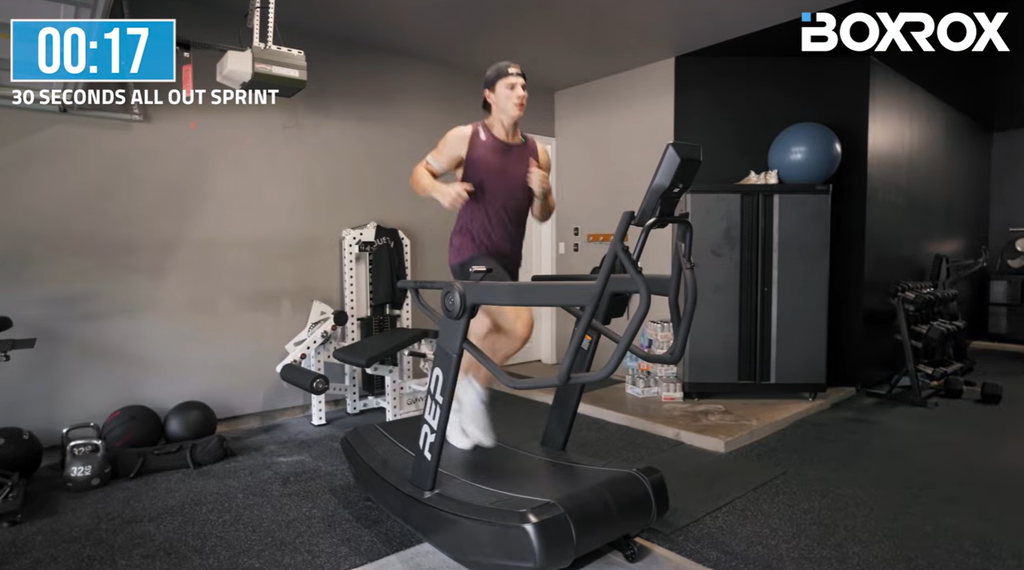
It is not a small or inexpensive machine, though. It weighs 418 pounds, requires plenty of open space and was listed at $3,799.99 in the United States at the time of this review. Those factors make it a serious investment, but I think its versatility helps justify the price for the right athlete or gym.
How the Strive™ Curved Treadmill Works
The Strive™ is a manual treadmill, so it does not use an electric motor to move the running belt.
I power the belt myself by walking or running on its curved surface. When I move farther toward the front of the curve, the belt accelerates. When I move back toward the center, it slows down.
I like the immediate connection between my effort and the speed of the belt. I do not have to press a button and wait for a motor to accelerate. This is especially useful during sprint intervals because I can build speed quickly and slow down as soon as the interval finishes.
The treadmill has a clutch disconnect that removes the additional magnetic sled resistance when I place it in free running mode. The belt still has its natural inertia and friction, but I do not feel as if I am pushing against the high resistance used for sled training.
Scientific research conducted on other curved manual treadmills helps explain why this type of running can feel challenging. Studies have found that running at the same speed on a curved manual treadmill generally requires more oxygen and produces a higher heart rate than running on a motorized treadmill.
One study found that the energy cost of running on a curved manual treadmill was approximately 17% higher than on a motorized treadmill. Another study involving trained runners found substantially greater oxygen consumption and heart rate at matched running speeds.
These studies did not test the Strive™ specifically, so I would not claim that their exact results apply to this machine. However, the research supports what I generally feel when using a manual treadmill. A pace that looks slower on the display can still represent a hard physiological effort.
I therefore do not compare my Strive™ pace directly with my outdoor or motorized treadmill pace. I treat it as its own training tool and monitor my effort, heart rate and progress on the machine.
My Experience Running on the Strive™ Curved Treadmill
I found the running experience smooth, responsive and exceptionally quiet. The noise difference stood out immediately because several other manual treadmills I have used make a considerable amount of noise when their slats move.
The Strive™ provides two deck positions. I can use a level position for controlled walking and longer running efforts, or I can raise the deck to create a 3 degree grade. The inclined position makes the machine feel more responsive and is particularly useful for sprinting and high intensity conditioning.
Because I control the belt, I can change speed naturally without touching the console. This allows me to move from a walk into a sprint and back into a recovery pace without waiting for the treadmill to respond.
I did need to become familiar with where to place my body on the curve. Moving too close to the front causes the belt to accelerate, while moving back reduces the speed. Once I became comfortable with that relationship, controlling the pace felt intuitive.
I would be careful if I had significant balance or mobility limitations. A motorized treadmill maintains a predetermined pace, while the Strive™ requires me to control the belt continuously. I see that as an advantage for athletic training, but it might not suit everyone.
Sled Push Training
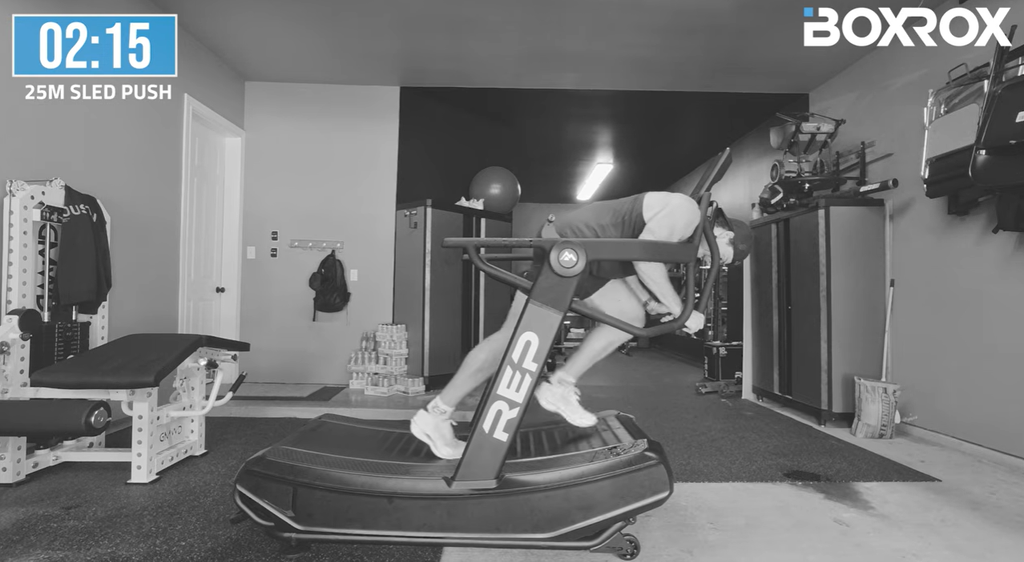
The integrated sled system is the feature that makes the Strive™ particularly interesting to me as a hybrid athlete. A lever allows me to engage the magnetic resistance and choose between eight different levels.
REP lists resistance equivalents ranging from 25 to 550 pounds when the deck is level. With the deck inclined, the listed range is 25 to 525 pounds. I treat these figures as estimated sled resistance rather than the literal weight of a physical sled.
I would not compare a level on the Strive™ directly with a plate loaded sled on turf. My body position, cadence, deck angle and the movement of the belt all affect how hard the push feels. I find it more useful to record the resistance level, distance and time, then compare my performance between sessions on the same machine.
Then moving into the sled push variation, it has the adjustable lever to increase the resistance.
One of my favorite features is that it has actual handles to grip onto, so you can get your body into a proper position. It feels like you’re actually doing a sled push in HYROX.
The dedicated handles make a major difference. I can lean forward, brace my torso and drive through my legs instead of awkwardly holding the front of a standard treadmill. The handles provide a stable gripping position and allow me to create a body angle that feels similar to a normal sled push.
I can lower the resistance for longer conditioning intervals or increase it for shorter strength focused efforts. This gives me more training options than a treadmill with only one fixed level of belt resistance.
Research on resisted sled training suggests that it can improve early sprint acceleration. However, it has not consistently been shown to produce better results than unresisted sprint training. I therefore see sled pushing as one useful part of a complete program rather than a replacement for running, strength training or sprint practice.
The Strive™ also does not perfectly recreate pushing a physical sled across competition turf. The machine remains stationary while the belt moves beneath me. The resistance and movement pattern are similar enough to be useful, but the experience is not identical.
For HYROX preparation, I still think it has considerable value. I can combine running and heavy pushing on one machine, which makes it easier to practice compromised running without needing a long sled lane.
Additionally if you train in a home gym, an actual sled requires much more space, plus an appropriate surface to push the sled across. This machine helps solve those problems.
Backward Walking and Sled Drags
I can move the belt in reverse for backward walking and resisted pulling exercises. For lighter backward walking, I can use the side rails for stability. If I want to perform heavier backward sled drags, REP recommends its treadmill straps and Belt Squat Belt, which are sold separately.
This reverse function gives me another way to train my legs and add variety to conditioning sessions. However, I would always build the movement gradually. Walking backward requires coordination, and the challenge increases significantly when resistance is added.
Before changing between running and sled settings, I stop the belt completely. REP states that a brake engages if the belt is still moving during the transition, but I prefer to stop before touching the adjustment lever.
Displays and Workout Tracking
The main console records time, distance, speed, pace and estimated calorie expenditure. I can also view heart rate after connecting a compatible Bluetooth or ANT+ heart rate monitor.
When I engage the sled resistance, the console displays the estimated sled weight and current deck position. These measurements make it easier for me to repeat sessions and track whether I am completing more distance, working at a higher resistance or maintaining a faster pace.
The smaller display near the front of the belt is one of the most practical design features. During a heavy sled push, I do not want to lift up my head every time I need to look at the main console. The lower display allows me to see my distance while maintaining a strong pushing position.
Then the next cool thing about it is that whenever you’re looking down, you get to see how much distance in meters you’ve gone, which is fantastic because you don’t have to look up at the big display at the top or anything.
I find this particularly useful when training for a specific distance. I can keep driving until I reach my target without asking somebody else to monitor the console.
The console can connect to compatible third party applications through the Bluetooth Fitness Machine Service protocol. REP lists Zwift, Kinomap, GymTrakr and iConsole as compatible options.
Design and Construction
I like the appearance of the Strive™. It has a satin metallic black powder coated frame, a black slat belt and a simple industrial design.
Also, I’d give the overall design an eight out of ten. The black on black design does look cool.
The machine is 82 inches long, 38.5 inches wide and 68 inches high at the top of the console. The running belt is 17.6 inches wide and is made from glass filled nylon with an antistatic covering.
The maximum stated user weight is 400 pounds. The machine itself weighs 418 pounds, so it feels extremely solid when I run or push against it. I do not experience the instability I sometimes notice with lighter cardio equipment.
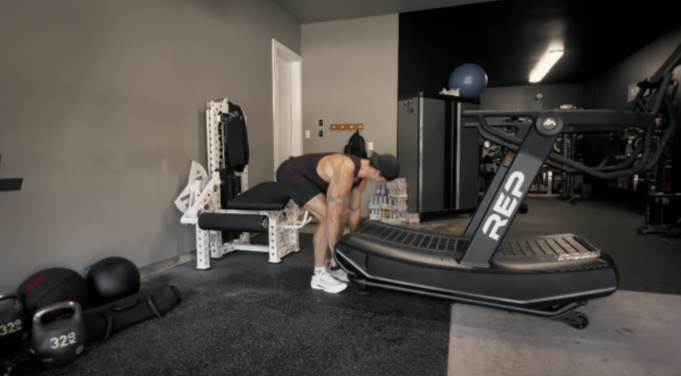
Transport wheels allow me to tilt and move it, although REP estimates that the weight felt while lifting and pivoting is approximately 175 pounds. I consider it movable rather than portable. I would not want to reposition it regularly.
The assembled treadmill is too wide to pass through most standard interior doorways. Removing the cup holder reduces its width to 33.5 inches, but that may still exceed the width of a typical doorway. I would assemble it in the room where I intended to keep it.
I would also measure the surrounding space carefully. REP specifies at least 79 inches of clear space behind the treadmill and identifies the nearest 35 inches as a critical clear area. The company also recommends 24 inches of space on both sides and in front of the machine. The stated minimum ceiling height is 96 inches.
Assembly and Maintenance
REP estimates that assembly takes between one and two hours and recommends completing the process with another person. All the required tools are included. The package also contains a power adapter, phone and cup holder and two D cell batteries for the console.
Overall, I’d say it was a success. It was easy to put together. There were some parts that were a little bit harder to do, like connecting a few of the pieces and wires.
My overall experience matched REP’s estimate. The main structure was relatively straightforward, although connecting some components and wires required more care.
I do not need to lubricate the belt routinely because the bearings arrive sealed and lubricated. The treadmill itself does not require electricity because my movement powers the belt.
I can operate the console with the included batteries or connect it to the supplied power adapter. REP estimates that the batteries provide approximately 300 hours of console use.
Price and Warranty
The Strive™ is $3,799.99 in the United States at the time of my review. I consider that a premium price, particularly for a home gym.
I would not pay that amount if I only wanted a treadmill for casual walking or steady running. The value comes from being able to run, sprint, push and drag on one machine. For me, the sled function is essential to the buying decision.
Who I Think Should Buy It
I think the Strive™ is best suited to HYROX athletes, hybrid athletes, functional fitness gyms and serious home gym owners. I can use it for easy conditioning, sprint intervals, sled pushes, backward walking and resisted drags, so it earns its floor space more effectively than a machine with only one function.
I would also recommend considering it if an indoor sled lane is not practical. The Strive™ allows me to train a similar pushing pattern without needing a long strip of turf or repeatedly turning a physical sled around.
I would not consider it the best option for someone who mainly wants to walk at a fixed pace while watching entertainment. It does not have the large touchscreen or automated speed controls found on premium electric treadmills.
I would also think carefully about the available space. The machine is heavy, wide and difficult to move between rooms. It makes the most sense when it can remain permanently in a dedicated training area.
My Final Verdict
The Strive™ Curved Treadmill succeeds because it feels like a complete hybrid conditioning station rather than a manual treadmill with a few additional features.
I was particularly impressed by how quiet it was. The free running mode felt smooth and responsive, while the eight resistance levels gave me enough range for both longer sled intervals and difficult strength focused pushes.
The dedicated handles allowed me to use a convincing sled position, and the lower display meant I could monitor distance without lifting my head. These are thoughtful features that make the sled mode practical during real training.
The machine does have disadvantages. It is expensive, heavy and too wide to move easily through most doorways. It also requires a significant amount of clear space.
Despite those concerns, my experience was extremely positive. It is one of the few cardio machines I have used that feels specifically designed for the demands of modern hybrid training.
Either way, this is overall my favorite piece of equipment that I’ve ever used as a hybrid athlete. What it suggests to me is the future of treadmills altogether.
References
- Alcaraz, P.E., Carlos-Vivas, J., Oponjuru, B.O. and Martínez-Rodríguez, A. (2018) ‘The effectiveness of resisted sled training for sprint performance: A systematic review and meta-analysis’, Sports Medicine, 48(9), pp. 2143–2165.
- Bruseghini, P., Tam, E., Monte, A., Capelli, C. and Zamparo, P. (2019) ‘Metabolic and kinematic responses while walking and running on a motorised and a curved non-motorised treadmill’, Journal of Sports Sciences, 37(4), pp. 396–403.
- Edwards, R.B., Tofari, P.J., Cormack, S.J. and Whyte, D.G. (2017) ‘Non-motorized treadmill running is associated with higher cardiometabolic demands compared with overground and motorized treadmill running’, Frontiers in Physiology, 8, Article 914.
- Morrow, N., Weighart, H., Alonzo, D., Mitchell, K. and Ives, S.J. (2022) ‘Physiological responses to speed-matched running on non-motorized Assault AirRunner versus traditional treadmills in active females: A pilot study’, International Journal of Exercise Science, 15(4), pp. 1262–1273.
- REP Fitness (2026) ‘Unlock your training with the best manual treadmill: Strive™ Curved Treadmill’. Updated 3 August 2026. Accessed 23 September 2026.
Key Takeaways
| Category | My takeaway |
| Overall rating | I give the Strive™ Curved Treadmill 10 out of 10 overall. |
| Running experience | I found it smooth, responsive and much quieter than other manual treadmills I have used. |
| Best feature | I can combine self powered running with eight levels of magnetic sled resistance. |
| Sled training | I found the dedicated handles and lower display particularly effective for HYROX style sled training. |
| Deck adjustment | I can choose between level and 3 degree deck positions for controlled running or more responsive sprint work. |
| Workout tracking | I can monitor time, distance, speed, pace, calories, heart rate, estimated sled resistance and deck position. |
| Design | I give the black on black appearance eight out of ten. |
| Assembly | I found it generally easy to assemble, although connecting some parts and wires was more difficult. |
| Size | I need a permanent training area because the machine measures 82 by 38.5 by 68 inches and weighs 418 pounds. |
| Price | I consider the listed price of $3,799.99 expensive, but the range of training options adds value. |
| Best for | I recommend it most strongly for HYROX athletes, hybrid athletes and functional fitness facilities. |