

Building a stronger chest does not require complicated workouts or advanced equipment. A few well-chosen pressing exercises can help beginners learn sound technique, build strength, and gradually add muscle. The key is to choose movements you can perform with control and make them more challenging over time.
The pectoralis major is the large muscle across the front of your chest. Pressing movements also use the triceps at the back of your upper arms and the front of your shoulders. The three exercises below give beginners practical options for training these muscles with body weight, a machine, or dumbbells.


How to Choose Beginner Chest Exercises
A good beginner exercise is one you can set up safely, repeat with consistent technique, and adjust as you get stronger. You do not need to test your maximum strength or train through every repetition until you cannot continue. Start with a version that lets you move smoothly and finish each set while your form is still controlled.
Progressive resistance training helps improve strength and muscle size. Research comparing push-ups and bench presses found that both could improve chest muscle thickness and strength when the training load was appropriately matched. Broader reviews of resistance training also find that different combinations of loads and schedules can produce benefits, so there is no single required piece of equipment or rep range for every beginner.
For a simple starting point, train your chest twice per week with at least a day between sessions. Choose one or two of the exercises below for each workout and begin with two controlled sets per exercise. A moderate set of roughly 8 to 12 repetitions is a useful target, but the right number depends on the exercise and your ability. Stop when you could still perform a few more good repetitions. As the movement becomes easier, add repetitions or use a slightly harder variation or more resistance.
1. Push-Up
The push-up is a convenient way to train your chest without weights. It also works your triceps and shoulders, while your trunk muscles help keep your body in a stable position. A small training study found that modified push-ups and low-load bench presses produced similar improvements in pectoral muscle thickness and strength in untrained men over eight weeks.
That does not mean every push-up variation is equivalent to every bench press, but it shows that body-weight training can be a useful starting point.
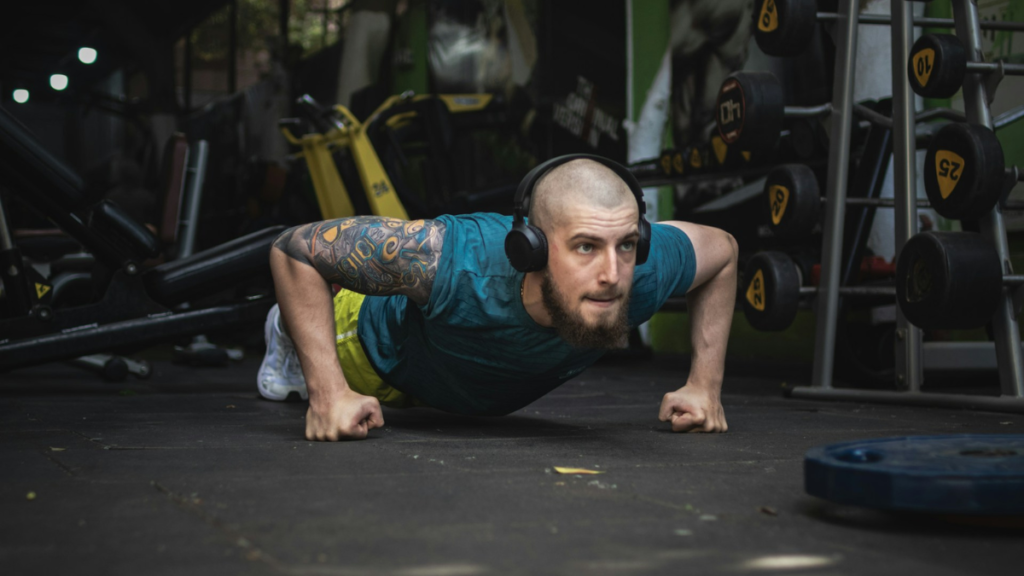
How to Do a Push-Up
Place your hands on the floor slightly wider than shoulder width, with your fingers pointing forward or turned out slightly. Extend your legs behind you and brace your midsection so your body forms a fairly straight line from your head to your heels. Bend your elbows and lower your chest toward the floor, then press through your hands to return to the starting position.
Keep your elbows at a comfortable angle from your torso instead of flaring them directly out to the sides. Lower yourself only as far as you can while maintaining a steady body position and pain-free shoulder movement. If your hips sag or your shoulders shrug toward your ears, the variation may be too difficult for now.
Make the Push-Up Easier or Harder
If a floor push-up is too challenging, place your hands on a stable elevated surface such as a bench or counter. The higher your hands, the less body weight you need to move. You can also start with your knees on the floor, keeping a straight line from your shoulders to your knees as you lower and press.
As you build strength, use a lower hand support or progress to standard push-ups from your toes. Once you can complete your target repetitions with good form, gradually increase the challenge. You can add repetitions, slow the lowering phase, or try a more demanding variation. You do not need to rush to weighted push-ups.
2. Machine Chest Press
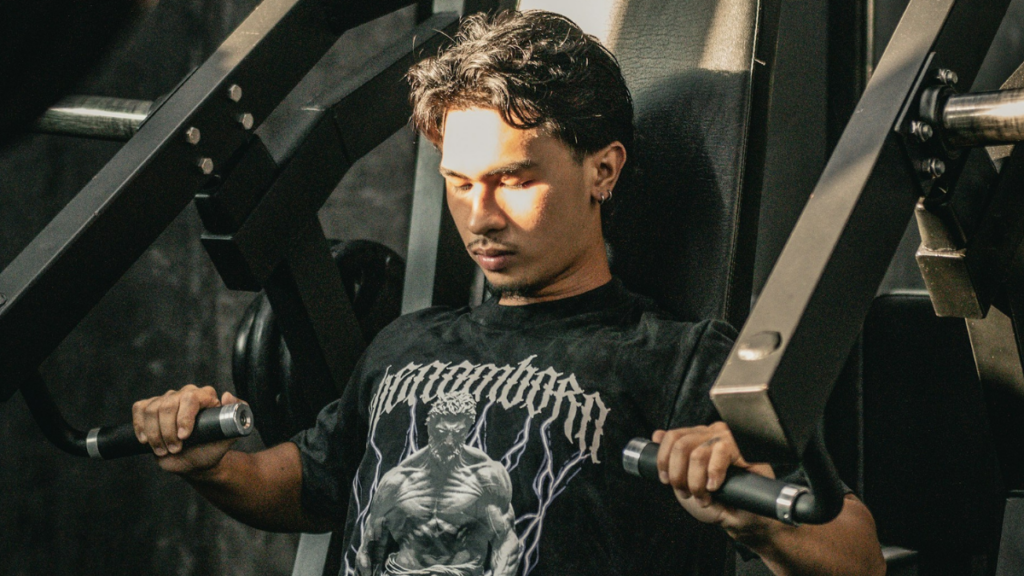
The machine chest press offers a stable way to practice a pressing pattern. The seat and handles guide the movement, which can make it easier to focus on controlled repetitions while learning how to coordinate your arms and shoulders. Machines also make it straightforward to adjust the load in small increments.
How to Do a Machine Chest Press
Adjust the seat so the handles are around the middle of your chest when you hold them. Sit with your back supported and your feet flat on the floor. Hold the handles with your wrists straight, then press forward until your arms are nearly straight without forcefully locking your elbows. Bring the handles back slowly until your elbows are just behind your torso or reach a comfortable depth.
Keep your shoulders relaxed against the pad and avoid letting them roll forward as the handles come back. Use a weight that lets you control both the press and the return. If you need to jerk your body or shorten the movement to complete a repetition, reduce the load.
Why It Works for Beginners
The guided path can help a beginner concentrate on the chest press without needing to balance dumbbells or manage a barbell. It is also easy to record the weight and repetitions from one session to the next. That makes it simple to notice when the current load has become manageable and a small increase may be appropriate.
3 Best Isolation Exercises for Wider Biceps
A machine is not automatically safer or more effective than free weights for everyone. Comfort, equipment availability, and your ability to use the machine correctly all matter. If the handle path feels awkward or causes pain, adjust the seat and range of motion or choose another exercise.
3. Incline Dumbbell Press
The incline dumbbell press is a useful variation for learning to press with each arm independently. Setting the bench at a modest incline changes the angle of the press and may place more emphasis on the upper, clavicular portion of the pectoralis major. Research measuring muscle activity during bench presses found that incline angle affected activation across portions of the chest and the front shoulder.
These short-term muscle activity measurements do not prove that one angle builds more muscle over time, so use the incline as a variation rather than a magic solution for a specific area.
How to Do an Incline Dumbbell Press
Set an adjustable bench to a low or moderate incline and sit with a dumbbell resting on each thigh. Use your legs to help bring the dumbbells to shoulder level as you lie back. Plant your feet, keep your upper back supported by the bench, and hold the dumbbells over your chest with your palms facing forward or slightly inward.
Lower the dumbbells slowly toward the outer part of your chest. Keep your forearms close to vertical and your elbows slightly below shoulder level if that position feels comfortable. Press the dumbbells upward until your arms are nearly straight, then lower them again with control. Choose light weights at first, since dumbbells require each arm to control its own load.
Common Beginner Mistakes
Avoid lowering the dumbbells so far that your shoulders feel stretched or uncomfortable. A larger range of motion is not useful if it makes you lose control or causes pain. Full, comfortable movement is a sensible goal, and systematic reviews have generally found benefits to training through a full range of motion, although the evidence varies by exercise and muscle group.
Do not bounce the weights off your chest or let them drift too far apart at the top. Keep the movement smooth, and ask a trainer to check your setup if you are uncertain about bench positioning or how to bring the dumbbells into place safely.
How to Progress
Progress does not mean adding weight every workout. First, learn the movement and repeat it with consistent technique. When you can complete all of your planned repetitions with control and still have a few good repetitions in reserve, increase the difficulty in a small step. That could mean adding a repetition, choosing a slightly harder push-up variation, or moving to the next available weight on a machine or dumbbells.
Keep a simple record of the exercise, load, and repetitions. It helps you see whether your training is moving forward and prevents you from guessing each time you work out. Consistent training matters more than constantly changing exercises. You can keep the same core movements for several weeks while gradually improving your performance.

You do not need all three exercises in every workout. For example, you could use push-ups and machine chest presses in one session, then use incline dumbbell presses and push-ups in the next. The exercises train related pressing muscles, so choose options that suit your equipment and comfort. If you experience sharp or persistent pain, stop the movement and seek qualified guidance before continuing.
References
- American College of Sports Medicine (2026) ‘Resistance training prescription for muscle function, hypertrophy, and physical performance in healthy adults: An overview of reviews’, Medicine & Science in Sports & Exercise, 58(4), pp. 851-872.
- Calatayud, J., Borreani, S., Colado, J.C., Martin, F., Tella, V. and Andersen, L.L. (2015) ‘Bench press and push-up at comparable levels of muscle activity results in similar strength gains’, Journal of Strength and Conditioning Research, 29(1), pp. 246-253.
- Currier, B.S., McLeod, J.C., Banfield, L. et al. (2023) ‘Resistance training prescription for muscle strength and hypertrophy in healthy adults: A systematic review and Bayesian network meta-analysis’, British Journal of Sports Medicine, 57(18), pp. 1211-1220.
- Kikuchi, N. and Nakazato, K. (2017) ‘Low-load bench press and push-up induce similar muscle hypertrophy and strength gain’, Journal of Exercise Science & Fitness, 15(1), pp. 37-42.
- Rodríguez-Ridao, D., Antequera-Vique, J.A., Martín-Fuentes, I. and Muyor, J.M. (2020) ‘Effect of five bench inclinations on the electromyographic activity of the pectoralis major, anterior deltoid, and triceps brachii during the bench press exercise’, International Journal of Environmental Research and Public Health, 17(19), article 7339.
- Schoenfeld, B.J., Grgic, J. and Krieger, J. (2020) ‘How many times per week should a muscle be trained to maximize muscle hypertrophy? A systematic review and meta-analysis of studies examining the effects of resistance training frequency’, Journal of Sports Sciences, 37(11), pp. 1286-1295.
Key Takeaways
| Focus | Takeaway |
|---|---|
| Exercise choice | Use push-ups, a machine chest press, and an incline dumbbell press to practice chest pressing with different equipment. |
| Starting point | Begin with a manageable variation, controlled repetitions, and a load you can handle without losing form. |
| Weekly plan | Train your chest twice per week and start with two sets per exercise in each session. |
| Progression | Add repetitions or resistance gradually when you can complete the movement with consistent technique. |
| Comfort | Use a pain-free range of motion and adjust or stop an exercise if it causes sharp or persistent pain. |