

A bar hang looks like a simple test, grab a bar, lift your feet off the ground and see how long you can hold on.
But how long should you actually be able to do it? And what is a good goal for your age?
What does a bar hang measure?
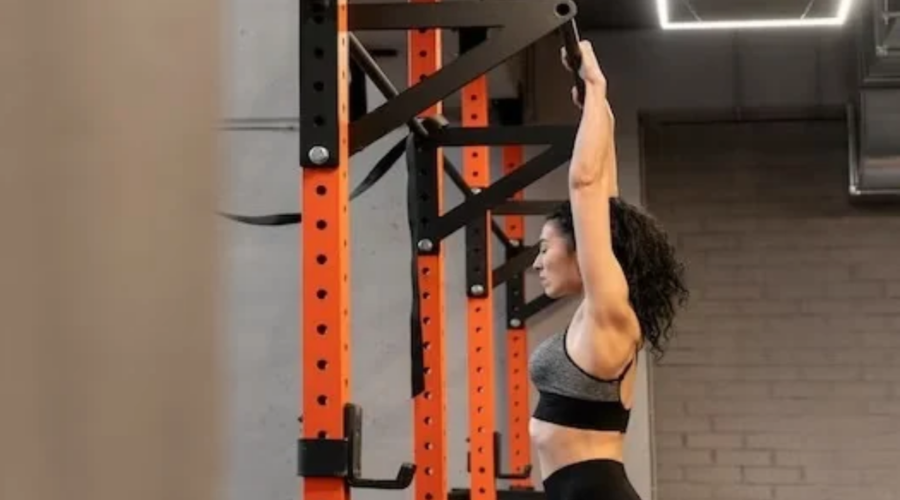
In a standard dead hang, you hold a bar with your feet off the floor and your arms straight. Your fingers and forearms work to keep you from slipping, while your shoulders support your body in an overhead position. How long you last can therefore depend on several things, including grip endurance, body weight, hand size, training experience and how comfortable your shoulders are in that position.
Times to Aim For
| Age | First goal | Next goal |
|---|---|---|
| 18 to 39 | Hold a comfortable hang for 10 to 20 seconds | Build toward 30 seconds |
| 40 to 59 | Hold a comfortable hang for 10 to 20 seconds, using foot support if needed | Build toward 30 seconds |
| 60 and older | Start with a foot-supported hang for 5 to 10 seconds if that feels comfortable | Gradually reduce support, then build toward 20 to 30 seconds |
Large international data on handgrip strength show that average values tend to peak in early to middle adulthood and decline with age. That gives useful context for how a related measure of strength changes across a population. It does not tell us how many seconds you personally should be able to hang.
3 Best Beginner Back Exercises for Muscle Mass in The Gym
Age is only one part of the picture. A person who weighs more has more body mass to support. Someone with climbing or gymnastics experience may have trained their grip and shoulders for hanging. Someone who rarely works overhead may stop because the position feels unfamiliar, even if their grip is not especially weak. These differences make a single age-based number a poor way to judge an individual.
Why hang times are hard to compare
A few seconds can be added or lost through small changes in the test. Bar thickness and texture affect how easy it is to hold. A person’s grip width, whether they wrap their thumbs around the bar, and whether they swing can also change the effort. So can the definition of a finished attempt. Does the timer stop when the fingers begin to open, when one hand slips, or when both feet touch the floor?
Body weight also matters because the test requires you to support yourself. Research on the flexed-arm hang, a related but different test, has found that performance was associated with strength relative to body mass. The study does not establish adult dead-hang norms, but it is a reminder that body weight can influence a timed hanging test.
This is why an online comparison may not mean much unless everyone uses the same test setup. A result can still be useful for you, though, if you repeat it in a consistent way and compare it with your own earlier attempts.
How to test your hang safely and consistently
Choose a sturdy bar that can safely support your weight. Use a step or box to reach it so you can take hold without jumping. Grip the bar with both hands, wrap your thumbs around it, and let your feet leave the floor. Keep your arms straight, avoid swinging and end the attempt when your grip starts to fail or you feel discomfort.
For a repeatable result, use the same bar, grip and timing rule each time. Record your time and note anything that might affect it, such as a recent upper-body workout, a sore hand or a different grip. One attempt is enough for a simple check. If you try again after resting, record that separately rather than treating the longest attempt as directly comparable with a single fresh effort.
Do not force yourself to stay on the bar through pain, numbness or a feeling that your shoulder is unstable. A dead hang places your arms overhead while they support your body weight. If you have a history of shoulder dislocation, shoulder instability, significant pain or a recent injury, ask a qualified health professional whether this position is suitable for you. You can also start with your feet lightly supported so you control how much weight your hands and shoulders carry.
What should you aim for?
A practical first goal is to establish a comfortable baseline with good control. If you can hold the position without pain, you might work on gradually extending your total hanging time over several sessions. You can do this with short, comfortable holds and enough rest to keep each one controlled. Stop before your grip completely gives out, especially when you are new to the exercise.
If a full hang is too demanding, keep some of your weight on a box or the floor. That lets you practice the grip and overhead position while reducing the load. As it becomes more comfortable, you can gradually use less support. For general strength, a hang is only one option among many. Carrying weights, using grip tools and performing pulling exercises train the hands and upper body in different ways.
What your result can and cannot tell you
Your hang time can tell you how long you managed to support your body from that particular bar, on that particular day. Repeating the same test over time may show whether you are improving at the task. It cannot, on its own, tell you your overall fitness level or diagnose a health problem.
Grip strength research is valuable, but it should not be stretched beyond what was measured. In a large international study, lower dynamometer-measured grip strength was associated with higher risk of several health outcomes. The researchers measured grip force, not dead-hang time, and an association does not prove that improving one measure will change a person’s risk. A hang may be a challenging exercise, but it is not a substitute for a health assessment.
The most useful interpretation is a modest one: your time is a specific performance result that can help you track your practice. It is not a universal score for your age. If you want to improve it, build gradually and pay attention to how your hands and shoulders feel. If you want to understand your health, use measures that have actually been studied for that purpose and discuss concerns with a health professional.
References
- Clemons, J.M., Duncan, C.A., Blanchard, O.E., Gatch, W.H., Hollander, D.B. and Doucet, J.L. (2004) ‘Relationships between the flexed-arm hang and select measures of muscular fitness’, Journal of Strength and Conditioning Research, 18(3), pp. 630–636.
- Leong, D.P. et al. (2015) ‘Prognostic value of grip strength: findings from the Prospective Urban Rural Epidemiology (PURE) study’, The Lancet, 386(9990), pp. 266–273.
- Ortega, F.B. et al. (2011) ‘Physical fitness levels among European adolescents: the HELENA study’, British Journal of Sports Medicine, 45(1), pp. 20–29.
- Tomkinson, G.R. et al. (2025) ‘International norms for adult handgrip strength: a systematic review of data on 2.4 million adults aged 20 to 100+ years from 69 countries and regions’, Journal of Sport and Health Science, 14, Article 101014.
Key Takeaways
| Topic | Takeaway |
|---|---|
| Age-based targets | There are no established adult age norms for the straight-arm dead hang. |
| What the test measures | It reflects how long you can support your body from a bar, influenced by grip, body weight, experience and shoulder comfort. |
| How to compare results | Repeat the test with the same bar, grip and timing rule, then compare your result with your own previous attempts. |
| Safety | Use controlled holds, reduce the load with foot support if needed, and stop if you feel pain or instability. |
| Health meaning | Dead-hang time is not a validated measure of health or lifespan. |