

Building a stronger, more muscular back does not require a complicated routine or a long list of exercises. For a beginner, three movements can cover the main jobs.
The goal is to learn each movement, use a weight you can control, and gradually do more over time. Machines can make that learning process more straightforward because they guide the movement and let you focus on your effort. If your gym has different machine designs, ask a qualified trainer to show you how to adjust them.
What beginners should know about training for muscle mass
Muscle growth comes from resistance training that challenges the muscles and is repeated consistently. Research reviews have found that resistance training increases muscle size, and that doing more weekly sets can support greater growth. That does not mean you need to start with a high volume. A manageable routine gives you room to practice and increase your workload as you get used to training.
Start with two working sets of each exercise, twice per week, leaving at least a day between sessions. Use a load that lets you complete about 8 to 12 controlled repetitions. The last few repetitions should feel challenging, but you should still be able to keep your position and control the weight. You do not need to force every set until you cannot complete another repetition.
When you can perform 12 repetitions on both sets with steady technique, increase the weight by the smallest amount available. Your repetitions may drop back toward eight, and you can build them up again. This simple form of progression makes it easy to track whether your training is moving forward.
Use a comfortable range of motion that you can control. Avoid bouncing the weight or twisting your torso to finish a repetition. If you feel sharp pain, stop the exercise and ask a qualified professional for advice. Ordinary effort and muscle fatigue can happen during training, but pain is not a goal.
1. Lat pulldown
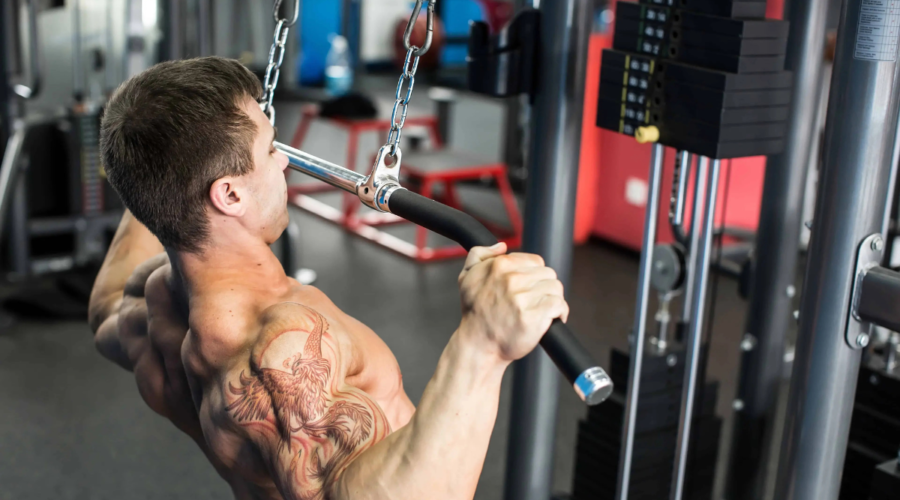
The lat pulldown is a practical way to learn a vertical pulling movement. It trains the latissimus dorsi, often called the lats, along with other muscles that help move the upper arm and shoulder. The lats contribute to the width of the back, while other muscles assist as you pull the bar down.
How to do it
Adjust the thigh pad so it holds your legs securely without pressing uncomfortably. Sit tall, take an even grip on the bar, and set your feet flat on the floor. Begin with your arms extended overhead while keeping your shoulders comfortable. Pull the bar down toward your upper chest, guiding your elbows toward your sides. Pause briefly, then return the bar upward under control until your arms are extended again.
Keep your torso steady throughout the repetition. A small natural lean is fine, but avoid swinging backward to move a weight that is too heavy. Pull the bar in front of your head rather than behind your neck, and choose a grip that feels comfortable on your wrists and shoulders. Research on lat pulldown grip variations has not established that one grip reliably produces more lat activity in every lifter, so comfort and control are useful starting points.
Sets and repetitions
Start with two sets of 8 to 12 repetitions. Choose a weight that lets you reach the same general range without leaning or jerking the bar. As the movement becomes familiar, focus on letting your arms return overhead under control instead of shortening the top of the repetition.
2. Chest-supported row
A chest-supported row is a beginner-friendly horizontal pull. Your chest rests against a pad, which reduces the need to hold your torso in a bent-over position while you row. It also makes it easier to notice whether you are pulling evenly or using momentum.
Rows train the muscles that draw the upper arms back and help move and stabilize the shoulder blades. Electromyography studies have recorded activity in the lats and muscles around the shoulder blades during rowing movements. These studies measure short-term electrical activity, so they do not prove that a particular row variation creates more muscle growth over time. The exercise is useful here because it gives beginners a stable way to practice a rowing pattern.
How to do it
Set the seat and chest pad so you can reach the handles without rounding your back or stretching uncomfortably. Place your chest against the pad, keep your feet planted, and hold the handles with your arms extended. Pull the handles toward your lower ribs, moving your elbows back while keeping your shoulders relaxed. Pause briefly when the handles reach your torso, then extend your arms slowly to return to the start.
Keep your chest in contact with the pad and avoid shrugging your shoulders toward your ears. Do not yank the handles or turn the movement into a torso swing. If the machine has several handle options, use the one that lets your wrists feel comfortable and your elbows travel smoothly.
Sets and repetitions
Perform two sets of 8 to 12 repetitions. Use a weight that lets you pause briefly at the end of each pull without losing your position. As your control improves, add weight gradually when you can complete 12 repetitions on both sets.
3. Seated lumbar extension machine
The lower back is part of your back training, too. A seated lumbar extension machine can train the muscles that extend the lumbar spine, including the lumbar erector spinae. Choose a machine designed for lumbar extension, ideally one that secures your pelvis so the movement happens through your lower back. A general back extension bench may involve more hip movement, so it is not the same exercise.
Research on lumbar extensor conditioning suggests that machines with appropriate pelvic restraint provide more specific training for the lumbar extensors than many movements that also involve the hips. This makes a dedicated machine a useful option for someone who wants to train this area directly while learning to control the movement.
How to do it
Adjust the machine according to its instructions, with the pad resting against your upper back or shoulders and your pelvis secured. Start in the position recommended for that machine, then extend your lower back smoothly against the resistance. Stop when you reach a comfortable upright position. Return slowly to the start without letting the weight pull you forward suddenly.
Use a light load while learning the motion. Do not force a deep stretch or overextend at the top. If the machine causes pain, or if you are unsure how to adjust it, skip it until a trainer can show you the setup.
Sets and repetitions
Begin with two sets of 10 to 15 controlled repetitions. Keep the load light enough to move smoothly through the range you can manage. When you can complete the repetitions with control, increase the resistance by a small amount. This exercise is not a test of how much weight you can move.
Put the exercises into a simple routine
Train these three exercises twice per week, with at least one day between sessions. Begin with two sets per exercise, which gives you a simple routine of six working sets in each session. Keep a brief record of the weight and repetitions you complete so you can see when it is time to progress.
3 Massive Benefits of Hammer Curls for Beginners that Want Bigger Arms
Rest long enough between sets that you can perform the next set with control. You may need more time after a challenging set than after an easier one. The exact rest period can vary, so focus on being ready to repeat good technique rather than rushing through the workout.
For the first few weeks, prioritize learning the movements and keeping your repetitions consistent. Increase the weight gradually once you can perform the top of your repetition range with control. If you feel unsure about a machine, ask a trainer to check the setup. A small amount of patience at the start can make the routine easier to repeat as you build strength.
Key takeaways
| Focus | What to do |
|---|---|
| Exercise selection | Use the lat pulldown, chest-supported row, and seated lumbar extension machine. |
| Starting workload | Begin with two sets per exercise, twice per week. |
| Repetition range | Aim for 8 to 12 controlled repetitions on pulldowns and rows, and 10 to 15 on the lumbar extension machine. |
| Progression | Add a small amount of weight when you can complete the top of the range with steady technique. |
| Technique | Keep the weight controlled, use a comfortable range of motion, and stop if you feel sharp pain. |
References
- American College of Sports Medicine (2026) ‘American College of Sports Medicine Position Stand. Resistance Training Prescription for Muscle Function, Hypertrophy, and Physical Performance in Healthy Adults: An Overview of Reviews’, Medicine & Science in Sports & Exercise, 58(4), pp. 851–872.
- Currier, B.S. et al. (2023) ‘Resistance training prescription for muscle strength and hypertrophy in healthy adults: a systematic review and Bayesian network meta-analysis’, British Journal of Sports Medicine, 57(18), pp. 1211–1220.
- Lehman, G.J. et al. (2004) ‘Variations in muscle activation levels during traditional latissimus dorsi weight training exercises: an experimental study’, Dynamic Medicine, 3, article 4.
- Refalo, M.C. et al. (2023) ‘Influence of resistance training proximity-to-failure on skeletal muscle hypertrophy: a systematic review with meta-analysis’, Sports Medicine, 53(3), pp. 649–665.
- Schoenfeld, B.J., Ogborn, D. and Krieger, J.W. (2017) ‘Dose-response relationship between weekly resistance training volume and increases in muscle mass: a systematic review and meta-analysis’, Journal of Sports Sciences, 35(11), pp. 1073–1082.
- Steele, J. et al. (2013) ‘A review of the specificity of exercises designed for conditioning the lumbar extensors’, British Journal of Sports Medicine, 47(5), pp. 291–297.