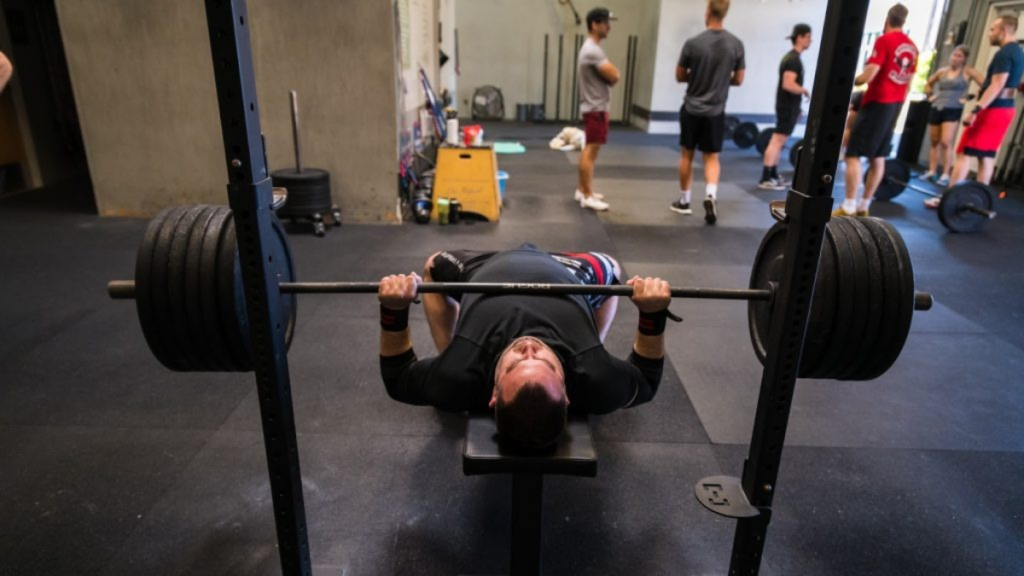


You do not need a bench or a full set of weights to start building your chest at home. Here’s what you need to do instead.
How to choose your starting exercise
The best place to start is the version you can perform comfortably through a controlled range of motion. If a floor push-up feels too difficult, raising your hands onto a wall or sturdy countertop reduces the challenge. As you get stronger, you can lower the height of your hand support or move from wall push-ups to kneeling push-ups.
Changing the angle changes how much force your arms have to manage. Studies comparing push-up variations have measured lower forces in modified push-ups performed from the knees than in standard push-ups from the toes. That makes easier variations useful for people who are building up to more demanding versions.
1. Wall push-up
A wall push-up is a straightforward starting point if a floor variation feels too challenging. Because you stand upright and place your hands against a wall, you lift less of your body weight than you would in a push-up from the floor. You can adjust the difficulty by moving your feet farther from the wall.
How to do it
Stand facing a wall and place your palms against it around chest height, a little wider than your shoulders. Step back until your arms are straight and your body forms a comfortable, straight line from your head to your heels. Keep your feet planted and your midsection gently braced.
Bend your elbows and lean your chest toward the wall under control. Keep your shoulders relaxed and your elbows angled slightly back from your sides. Stop when your chest is close to the wall, then press through your palms to return to the starting position. Move smoothly instead of bouncing toward the wall.
How to make it easier or harder
Stand closer to the wall to make the exercise easier. Step farther away to increase the challenge, as long as you can keep your body steady and complete each repetition without pain. When wall push-ups feel comfortable for your planned sets, try placing your hands on a sturdy countertop. Check that the surface cannot slide or tip before using it.
Wall push-ups are useful for learning the movement and building confidence. They may stop being challenging enough as your strength improves. At that point, choose a lower hand support so the exercise asks more of your chest and arms.
2. Incline push-up
In an incline push-up, your hands are raised on a firm surface while your feet stay on the floor. A wall is the highest and easiest option. A stable countertop or heavy, secure table is lower and usually more challenging. Raising your hands changes the exercise’s demands, so use a height that allows you to maintain steady, controlled repetitions.
How to do it
Place your hands on a stable surface, slightly wider than shoulder width. Walk your feet back until your arms are straight and your body forms a line from head to heels. Brace your midsection so your hips do not sag or rise as you move.
Bend your elbows and lower your chest toward the edge of the surface. Keep your head in line with your body and your elbows angled slightly back. Press through your palms to return to the start. Use a range of motion you can control, and keep your body in one steady line throughout the repetition.
How to progress
Start with a high surface. When you can complete your sets with consistent form, lower your hand support a little. Each step down makes the push-up more demanding, so give yourself time to adapt before lowering the support again.
The aim is not to find a particular perfect height. It is to choose a version that challenges you while allowing good repetitions. If your hips sag, your shoulders shrug, or you cannot lower yourself under control, raise your hands again.
3. Kneeling push-up
A kneeling push-up brings you closer to a floor push-up while reducing the load compared with supporting yourself on your toes. It can be a good next step when incline push-ups feel manageable but standard push-ups are still too difficult.
How to do it
Start on your hands and knees with your palms on the floor, slightly wider than your shoulders. Move your hands forward enough that your body forms a straight line from your head to your knees. Keep your hips in line with your torso rather than folding at the waist.
Bend your elbows and lower your chest toward the floor. Keep your shoulders away from your ears and avoid letting your elbows flare straight out to the sides. Press through your palms to return to the starting position. If you cannot reach the floor without losing control, stop at a comfortable depth and build from there.
How to progress
When kneeling push-ups become manageable, work toward a standard push-up by gradually increasing the challenge. One practical option is to keep doing incline push-ups with a lower support. You can also try a small number of standard push-ups while fresh, followed by kneeling push-ups to finish your sets. Use the version that lets you keep your form steady.
Research on progressive calisthenic training has found that practicing increasingly difficult push-up variations can improve upper body strength. A small study of young men also found increased chest muscle thickness after eight weeks of push-up training. The results support push-ups as a useful home exercise, though they do not guarantee that everyone will gain muscle at the same rate.
How to use these exercises for muscle growth
Start with one push-up variation you can do well. Perform two or three sets, twice a week, leaving time between sessions for recovery. A useful starting point is a set of about six to fifteen controlled repetitions. If you cannot reach six clean repetitions, choose an easier version. If you can do many more than fifteen without much effort, choose a harder version.
3 Massive Benefits of Hammer Curls for Beginners that Want Bigger Arms
The exact repetition count is less important than making the sets challenging while keeping good form. Research reviews suggest that a range of resistance training loads can support muscle growth, and that working closer to the end of what you can comfortably complete may help. You do not have to force every set until you cannot do another repetition. For a beginner, finish when you think you could do only a few more good repetitions.
When you can complete the top end of your chosen repetition range for every set with controlled form, make the exercise slightly harder. For wall and incline push-ups, move your feet farther away or lower your hand support. For kneeling push-ups, increase the number of repetitions or begin including a few standard push-ups. Change one thing at a time so you can tell whether the new version is still manageable.
Keep a simple record of the exercise, sets, and repetitions. That makes it easier to see when you are ready to progress. If you are training twice a week, try to leave at least a day between sessions. More training is not automatically better: the key is to keep practicing, gradually increase the challenge, and recover well enough to repeat the work.
Use a surface that is stable and will not slide. Stop if an exercise causes sharp pain, and choose a more comfortable variation if your wrists or shoulders feel strained. Muscle effort is expected during a challenging set, but pain is not a goal.
Key takeaways
| Focus | Takeaway |
|---|---|
| Starting point | Begin with the easiest variation that lets you use controlled form. |
| Exercise progression | Progress from wall push-ups to incline push-ups and then kneeling push-ups as your strength improves. |
| Training routine | Try two or three sets, twice a week, with a version that makes each set challenging. |
| Progression | When your repetitions become comfortable, increase the challenge gradually by changing the angle or variation. |
| Technique | Use a steady body position, a controlled lowering phase, and a stable surface. |
References
- Cogley, R.M., Archambault, T.A., Fibeger, J.F., Koverman, M.M., Youdas, J.W. and Hollman, J.H. (2005) ‘Comparison of muscle activation using various hand positions during the push-up exercise’, Journal of Strength and Conditioning Research, 19(3), pp. 628 to 633.
- Gouvali, M.K. and Boudolos, K. (2005) ‘Dynamic and electromyographical analysis in variants of push-up exercise’, Journal of Strength and Conditioning Research, 19(1), pp. 146 to 151.
- Kikuchi, N. and Nakazato, K. (2017) ‘低-load bench press and push-up induce similar muscle hypertrophy and strength gain’, Journal of Exercise Science and Fitness, 15(1), pp. 37 to 42.
- Kotarsky, C.J., Christensen, B.K., Miller, J.S. and Hackney, K.J. (2018) ‘Effect of progressive calisthenic push-up training on muscle strength and thickness’, Journal of Strength and Conditioning Research, 32(3), pp. 651 to 659.
- Refalo, M.C., Helms, E.R., Trexler, E.T., Hamilton, D.L. and Fyfe, J.J. (2023) ‘Influence of resistance training proximity-to-failure on skeletal muscle hypertrophy: a systematic review with meta-analysis’, Sports Medicine, 53(3), pp. 649 to 665.
- Schoenfeld, B.J., Ogborn, D. and Krieger, J.W. (2017) ‘Dose-response relationship between weekly resistance training volume and increases in muscle mass: a systematic review and meta-analysis’, Journal of Sports Sciences, 35(11), pp. 1073 to 1082.
- Schoenfeld, B.J., Wilson, J.M., Lowery, R.P. and Krieger, J.W. (2016) ‘Muscular adaptations in low- versus high-load resistance training: a meta-analysis’, European Journal of Sport Science, 16(1), pp. 1 to 10.