

The first place most lifters go to develop their chest is the barbell bench press. However, if you want to take your upper chest development to the next level, you need to add this variation.
Why The Flat Barbell Bench Press Often Falls Short For Upper Chest Growth
The flat barbell bench press is a classic movement for moving heavy weights in a horizontal plane, yet lying flat on a horizontal bench creates specific biomechanical limitations for building the upper chest. The pectoralis major is not a single uniform sheet of muscle; it consists of distinct regions, including the clavicular head near the collarbone and the sternocostal head spanning the middle and lower chest.
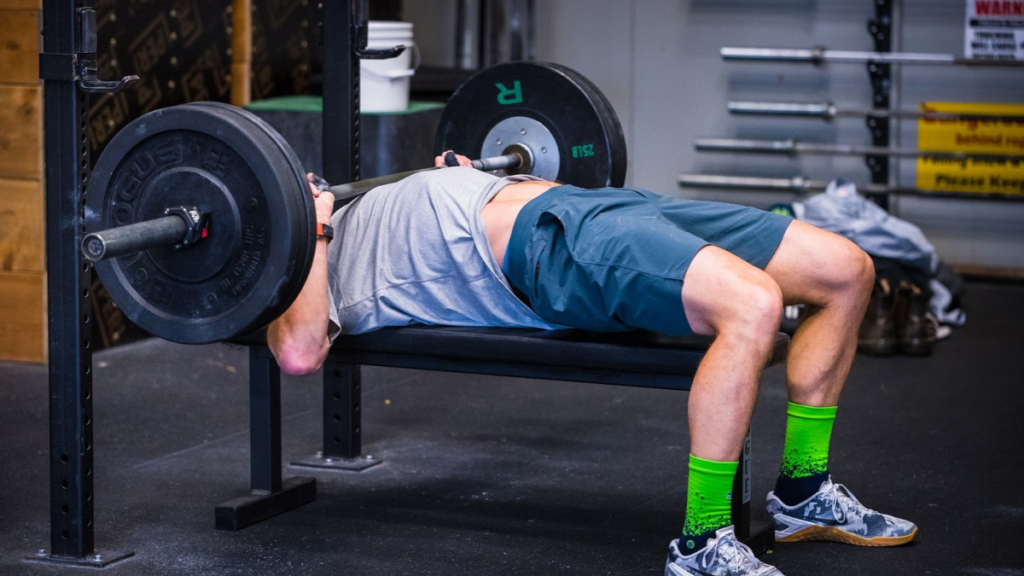
When you press a barbell horizontally from a flat bench, the line of force and the angle of your upper arms primarily emphasize the middle and lower sternocostal fibers while leaving the upper clavicular region under-challenged relative to its growth potential.
Another limitation comes from the rigid nature of a straight barbell and the typical wide grip many lifters use to maximize leverage. When your hands are set wide and your elbows flare outward, your shoulder joint moves through a path that prioritizes horizontal adduction over shoulder flexion, which aligns less directly with the upward angle of the upper chest fibers. In addition, a fixed bar locks both hands into the exact same path and stops against your chest at the bottom, which can limit how deeply your upper chest stretches under load and how naturally your arms move through the press.
Revealing The Exercise: The Incline Dumbbell Press
The undervalued upper chest exercise that can trigger faster muscle growth than the flat barbell bench press for the upper chest is the incline dumbbell press, typically performed on a bench angled between thirty and forty-five degrees. At first glance, tilting the bench up and grabbing dumbbells instead of a straight barbell might seem like a simple swap, yet those two adjustments reshape both muscle targeting and range of motion.
Raising the backrest shifts the angle of the torso and upper arm so that pressing requires meaningful shoulder flexion alongside horizontal adduction, lining up directly with the clavicular head of the pectoralis major.
Using dumbbells rather than a barbell adds another major advantage for muscle growth because each arm moves independently through a natural arc.
Dumbbells allow you to lower the weights slightly deeper into a stretch at the bottom of each repetition and bring them slightly closer together at the top without a barbell bar hitting your chest or restricting your wrists. That combination of a targeted incline angle, a deeper stretch in the lengthened position, and freedom of movement across the shoulder joint makes the incline dumbbell press a powerhouse for building upper chest thickness.
Comparing Incline Dumbbell Press and Flat Barbell Bench Press
| Training Feature | Incline Dumbbell Press | Flat Barbell Bench Press |
|---|---|---|
| Primary Chest Emphasis | Upper clavicular pectoralis major fibers | Middle and lower sternocostal pectoralis major fibers |
| Joint Motion Profile | Combines shoulder flexion and adduction with free hand path | Predominantly horizontal adduction along a fixed bar path |
| Bottom Range of Motion | Deep stretch limited safely by shoulder mobility | Bar contact on chest stops downward travel early |
| Limb Independence | Unilateral control per arm reduces left-right compensation | Bilateral fixed bar allows stronger side to assist |
What Scientific Research Shows About Incline Angles And Hypertrophy
Sports science and electromyography research consistently show that changing bench inclination alters how much electrical activity is recorded in different regions of the pectoralis major and surrounding shoulder muscles. Studies comparing flat pressing against inclined pressing angles around thirty to forty-five degrees demonstrate that inclining the bench increases upper pectoralis major activation compared to a flat horizontal position.
3 Perfect Exercises for Building the Lower Pecs Beginners Often Overlook
Because the clavicular fibers run diagonally downward and outward from the clavicle toward the humerus, elevating the torso brings the line of pull into much closer alignment with those upper fibers.
Research on muscle hypertrophy and training at long muscle lengths also helps explain why exercises that provide a deep, controlled stretch can drive strong muscular adaptation.
When a muscle is loaded through a generous range of motion that includes a safe stretch in the lengthened position, mechanical tension and cellular growth signaling increase across the working fibers. With dumbbells on an incline bench, you can control the lowering phase smoothly and achieve a substantial stretch across the chest and anterior shoulder without sacrificing form, which supports meaningful growth when paired with progressive overload over time.
Why Steep Angles Can Shift Focus Away From The Chest
While inclining the bench is essential for targeting the upper chest, pushing the incline angle too steep, such as sixty degrees or higher, shifts the movement closer to an overhead shoulder press.
Electromyographic comparisons across bench angles show that steeper inclines increase the contribution of the anterior deltoids while reducing relative emphasis on the pectoralis major. Keeping the bench in the moderate incline range, typically around thirty to forty-five degrees, hits the sweet spot where upper chest recruitment stays high without turning the lift into a shoulder-dominated press.
How To Perform And Program The Incline Dumbbell Press For Growth
Executing the incline dumbbell press properly starts with setting up your bench and posture so the upper chest does the heavy lifting safely. Set the bench to a thirty or forty-five degree incline, plant your feet firmly on the floor, and pull your shoulder blades slightly back and down so your chest stays open and supported. Kick the dumbbells up to the starting position above your upper chest with your palms facing slightly forward or in a semi-neutral angle that feels comfortable for your shoulders and wrists.
Lower the dumbbells under smooth control over two to three seconds until you feel a clear, controlled stretch across your upper chest, keeping your elbows tucked at a moderate angle of roughly forty-five degrees from your torso rather than flaring straight out to the sides.
Press the weights back up smoothly until your arms are extended without locking your elbows aggressively or slamming the dumbbells together at the top. For most lifters looking to maximize muscle growth, performing three to four sets of eight to twelve controlled repetitions once or twice per week provides a reliable foundation for steady progress.
Smart Progression And Recovery Habits
To keep making progress with the incline dumbbell press, focus on consistent execution and gradual overload rather than jumping to heavy weights before your form is ready.
You can progress by adding a repetition within your target range, slowing down the eccentric lowering phase with control, or moving up to the next dumbbell weight once all sets are completed cleanly. Give your chest and shoulders adequate recovery between heavy sessions, and pair your incline pressing with balanced back and rear shoulder work so your posture stays strong and resilient over the long haul.
Practical Programming Guide For The Incline Dumbbell Press
| Programming Factor | Recommended Approach | Why It Matters For Growth |
|---|---|---|
| Bench Incline Angle | Thirty to forty-five degrees | Targets upper clavicular fibers without excessive deltoid takeover |
| Repetitions Per Set | Eight to twelve controlled repetitions | Balances mechanical tension and metabolic stress for hypertrophy |
| Weekly Frequency | One to two sessions per week | Provides ample growth stimulus while allowing tissue recovery |
| Lowering Tempo | Two to three seconds on the way down | Increases time under tension and promotes a controlled stretch |
Key Takeaways For Faster Upper Chest Growth
| Key Takeaway | Practical Application |
|---|---|
| Flat Benching Misses Upper Chest Nuance | Horizontal pressing favors middle and lower chest fibers and restricts natural hand movement. |
| Moderate Incline Hits Clavicular Fibers | A thirty to forty-five degree incline aligns resistance more closely with the upper chest. |
| Dumbbells Improve Stretch And Balance | Independent dumbbells allow a deeper stretch and prevent one side from masking weakness. |
| Avoid Overly Steep Angles | Angles that are too steep shift emphasis away from the chest toward the front deltoids. |
| Prioritize Control Over Ego Loads | Smooth lowering and steady progression build upper chest size safely over time. |
References
- Barnett, C., Kippers, V. and Turner, P., 1995. Effects of variations of the bench press exercise on the EMG activity of five shoulder muscles. Journal of Strength and Conditioning Research, 9(4), pp.222-227.
- Glass, S.C. and Armstrong, T., 1997. Electromyographical activity of the pectoralis muscle during incline and decline bench presses. Journal of Strength and Conditioning Research, 11(3), pp.163-167.
- Lauver, J.D., Cayot, T.E. and Scheuermann, B.W., 2016. Influence of bench angle on upper extremity muscular activation during bench press exercise. European Journal of Sport Science, 16(3), pp.309-316.
- Maeo, S., Wu, Y., Huang, M., Sakurai, H., Kusagawa, Y., Sugiyama, T., Kanehisa, H. and Isaka, T., 2023. Triceps brachii hypertrophy is substantially greater after elbow extension training performed in the overhead versus neutral arm position. European Journal of Sport Science, 23(7), pp.1240-1250.
- Rodríguez-Ridao, D., Antequera-Vique, J.A., Martín-Fuentes, I. and Muyor, J.M., 2020. Effect of five bench inclinations on the electromyographic activity of the pectoralis major, anterior deltoid, and triceps brachii during the bench press exercise. International Journal of Environmental Research and Public Health, 17(19), p.7339.
- Trebs, A.A., Brandenburg, J.P. and Pitney, W.A., 2010. An electromyography analysis of 3 muscles surrounding the shoulder joint during the performance of a chest press exercise at several angles. Journal of Strength and Conditioning Research, 24(7), pp.1925-1930.