




























5 Things Beginners Should Know Before Trying to Build Bigger Biceps


Bigger arms are a goal for almost every new lifter in the gym. But where should you start and what should you do? These 5 things to consider will help you start your journey in the right direction, and speed up your progress once you start taking your first steps.
5 Things Every Beginner Should Know About Bicep Growth
1. Your Biceps Are Only Part of Upper-Arm Size
When you picture thicker arms filling out a T-shirt, it is easy to assume your biceps do most of the heavy lifting for overall arm size. In reality, anatomical research measuring upper-limb muscle volume shows that the triceps brachii accounts for roughly sixty percent of total upper-arm muscle mass, while the elbow flexors on the front and side make up the rest.
Focusing exclusively on curls while neglecting pressing movements and direct triceps work leaves a massive portion of your potential arm size on the table.
2. Heavy Compound Pulls Already Work Your Biceps Hard
Beginners often treat bicep curls as the only way to stimulate their front arm muscles, overlooking what happens during heavy back training. Rows, pulldowns, and pull-ups require substantial elbow flexion and forearm stabilization, which places real mechanical demand on the biceps brachii, brachialis, and brachioradialis.
Because your biceps are already getting meaningful stimulus during compound pulls, you do not need endless sets of isolation curls to trigger growth.
3. Controlled Technique and Effort Matter More Than Ego Weights
Swinging a heavy barbell with your lower back or driving your elbows far forward at the top of a curl takes tension off the biceps and hands it to momentum and your front deltoids. Exercise science research on resistance training loads demonstrates that moderate weights lifted with strict control close to muscular failure build muscle effectively across repetition ranges.
Controlling a smooth lowering phase and stopping sets roughly one to two clean repetitions shy of failure keeps mechanical tension right where it belongs.
4. Muscle Length and Curl Angle Change the Stimulus
The biceps brachii has a long head and a short head, and changing how your shoulder and elbow are positioned shifts tension across the movement arc. Research examining bicep curl variations indicates that different arm positions and grips alter muscle activity across the elbow flexors, while broader studies on range of motion show that loading muscles at longer, stretched lengths supports strong hypertrophy.
Pairing an exercise that stretches the biceps, such as incline dumbbell curls, with a movement that challenges a neutral or braced position, such as hammer or EZ bar curls, gives you well-rounded coverage.
5. Training Frequency and Recovery Drive Steady Progress
New lifters often fall into the trap of doing marathon arm sessions once a week or training curls every single day until their elbows ache. Meta-analytic evidence on resistance training frequency indicates that training a muscle group twice per week supports superior hypertrophy compared to once-weekly training, provided you allow adequate recovery between sessions.
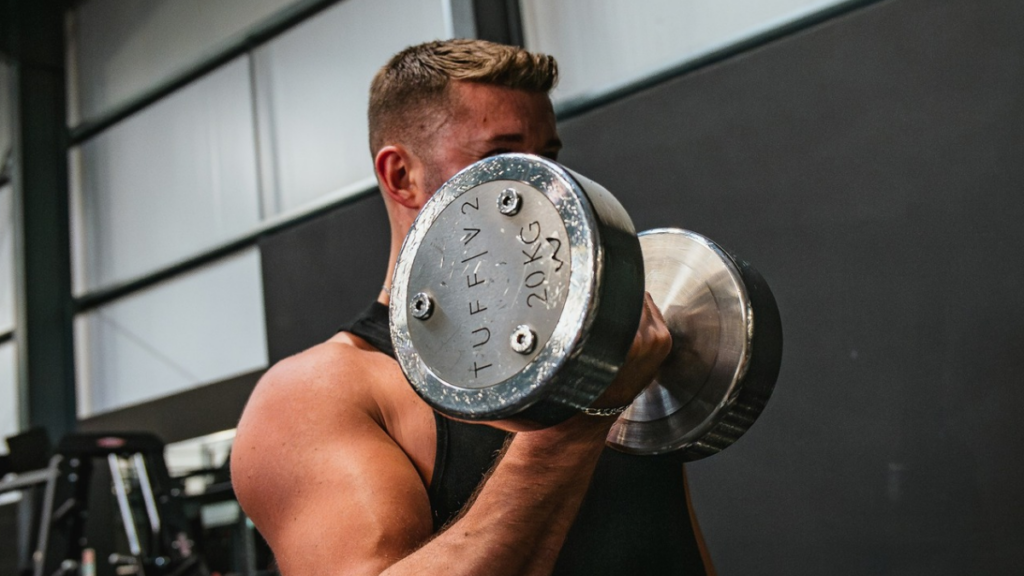
Keeping weekly direct bicep volume moderate, typically around six to eight quality sets split across two workouts, lets you progress reps smoothly without overtaxing your tendons.
Practical Beginner Guidelines for Training Biceps Effectively
| Training Variable | Common Beginner Mistake | Smarter Evidence-Based Approach | Why It Helps Your Progress |
| Direct Curl Volume | Doing 15 to 20 sloppy sets on one single arm day | Perform 6 to 8 controlled sets split across 2 sessions weekly | Supports steady growth without irritating elbow tendons |
| Lifting Form and Tempo | Heaving heavy weights with body swing and fast drops | Use manageable loads with a 2-second lowering phase near failure | Keeps mechanical tension on the biceps instead of momentum |
| Exercise Selection | Doing only one standing barbell curl variation | Combine a stretched curl with a hammer or EZ bar curl | Targets elbow flexors across varied angles and grip positions |
| Broader Arm Context | Ignoring triceps, rows, and pull-ups while chasing curls | Pair curls with compound pulls and triceps presses or extensions | Builds balanced upper-arm size and overall strength |
Putting These 5 Principles Into a Simple Routine
You do not need a complicated split or hours of extra gym time to put these five lessons into practice starting this week. Keep your main compound lifts at the front of your workouts when your energy and focus are highest, then finish two upper-body or full-body days per week with two straightforward curl variations.
Walking Faster vs Walking Longer: Which Is Better for Your Heart?
Aim for eight to fifteen clean repetitions per set, stop one to two reps shy of failure, and add a rep or a small weight increase over time as your control improves.
Key Takeaways
| Key Lesson | Core Evidence-Based Point | Practical Action Step |
| Total Arm Composition | Triceps make up roughly 60% of upper-arm muscle mass | Train triceps and upper-body presses alongside your curls |
| Compound Pull Carryover | Rows, pulldowns, and pull-ups already challenge elbow flexors | Count heavy pulling work when planning total weekly arm volume |
| Technique and Effort | Controlled reps near muscular failure drive growth without heavy swing | Lower weights smoothly and stop 1 to 2 reps shy of failure |
| Weekly Schedule | Twice-weekly training with moderate volume beats extreme one-day blasts | Do 6 to 8 direct curl sets across two workouts each week |
References
- Holzbaur, K.R., Murray, W.M., Gold, G.E. and Delp, S.L., 2007. Upper limb muscle volumes in adult subjects. Journal of Biomechanics, 40(4), pp.742-749.
- Marcolin, G., Panizzolo, F.A., Petrone, N., Moro, T., Grigoletto, D., Piccolo, D. and Paoli, A., 2018. Differences in electromyographic activity of biceps brachii and brachioradialis while performing three variants of curl. PeerJ, 6, p.e5165.
- Schoenfeld, B.J., Grgic, J., Ogborn, D. and Krieger, J.W., 2017. Strength and hypertrophy adaptations between low- vs. high-load resistance training: a systematic review and meta-analysis. Journal of Strength and Conditioning Research, 31(12), pp.3508-3523.
- Schoenfeld, B.J., Ogborn, D. and Krieger, J.W., 2016. Effects of resistance training frequency on measures of muscle hypertrophy: a systematic review and meta-analysis. Sports Medicine, 46(11), pp.1689-1697.
- Wolf, M., Androulakis-Korakakis, P., Fisher, J., Schoenfeld, B. and Steele, J., 2023. Partial vs full range of motion resistance training: a systematic review and meta-analysis. International Journal of Strength and Conditioning, 3(1), pp.1-15.
Robbie Wild Hudson
Editor-In-Chief at BOXROX. I come from a background of rugby and weightlifting. Growing up in the English Lake District, I spent a great deal of time swimming in its stunning lakes and rivers. In 2015 my brothers and I became the first people to swim the 145km length of the River Eden, from source to mouth, in 9 days. We also swam the Corryvreckan whirlpool, the third largest in the world, and Crossfit is a huge part of my training for these events.
More from Robbie Wild Hudson