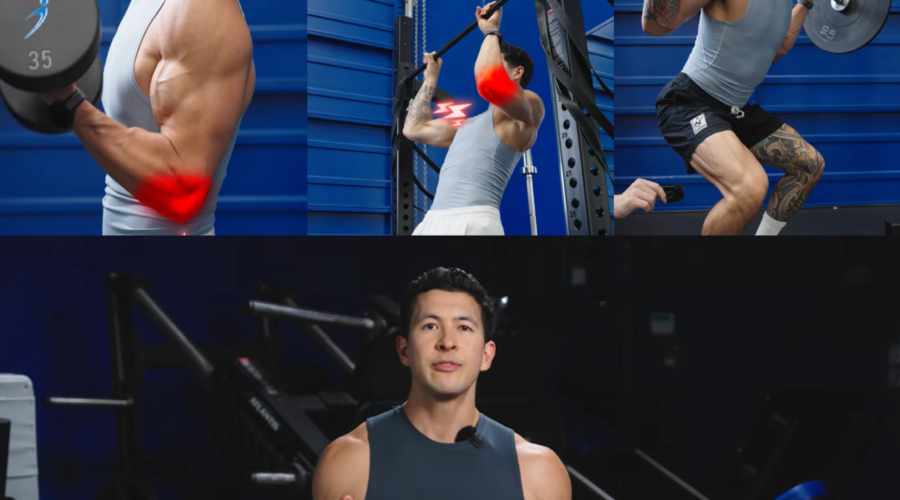


Sore elbows, aching knees, and nagging shoulder pain are often blamed on aging or hard training. But according to fitness educator and kinesiologist Jeremy Ethier, the real culprit is frequently your tendons, not your muscles or bones.
In a recent YouTube video, Ethier teamed up with leading molecular exercise physiologist and tendon researcher Dr. Keith Baar, along with physiotherapist Coach Q Wiley, to explain why tendon injuries are so common, why complete rest often makes them worse, and how simple isometric exercises can help rebuild stronger tendons in as little as 30 days.


Tendons Need Different Training Than Muscles
Ethier explains that tendons act like strong cables connecting muscles to bones while also absorbing force during movement. Whether you’re bench pressing, curling a dumbbell, or landing from a jump, healthy tendons protect your muscles by handling rapid loads.
However, muscles adapt much faster than tendons.
As Dr. Keith Baar explains, “The biggest thing that we’re discovering now is that tendons don’t like what muscle likes to get stronger.”
Ethier says this mismatch can create a strength imbalance where muscles become capable of producing more force than tendons can safely tolerate. That imbalance is one reason tendon injuries are so common in athletes and recreational lifters alike.

He also notes that warning signs can appear before pain develops. Clicking joints aren’t always cause for concern, but persistent pain combined with clicking may indicate a tendon that isn’t functioning properly.
Why Rest Alone Doesn’t Solve Tendon Pain
One of the biggest misconceptions surrounding tendon injuries is that complete rest is the best solution. Instead, Dr. Baar argues the opposite.
“A tendon isn’t a tendon without load. So if you’re just resting it, it’s never going to fix itself,” he says.
Ethier explains that while avoiding activity may temporarily reduce pain, it doesn’t repair the damaged tissue. Worse, the healthy portions of the tendon may gradually weaken, making symptoms more likely to return once training resumes.
He also identifies poor load management as another major contributor to tendon problems. Rapid increases in training volume or intensity, particularly jumps greater than about 30 percent, can overload tissues before they have time to adapt.
Momentum is another hidden issue. Ethier advises lifters without sport-specific power goals to control the lowering phase of each repetition instead of bouncing weights, reducing unnecessary stress on connective tissue while potentially improving muscle growth.
Isometric Exercises Help Rebuild Tendons
The centerpiece of Ethier’s recovery strategy is isometric training, where muscles contract without changing length.
According to Dr. Baar, “When we do isometrics, we maximize the creep in the tendon… By two weeks, almost everybody is like, ‘Oh yeah, I can do pretty much everything again.'”
Ethier recommends selecting an isometric exercise that matches the movement causing pain. Someone experiencing discomfort during bench presses, for example, should perform a bench press hold or push-up hold for 30 seconds.
The same principle applies to shoulder presses, curls, triceps extensions, and knee extensions. He recommends performing three 30-second holds twice per day initially, then continuing three to four times per week for four to eight weeks to promote long-term tendon remodeling.
The Takeaway
Jeremy Ethier’s message is clear: tendon pain rarely improves through rest alone. Instead, gradual load progression, controlled lifting technique, and targeted isometric exercises provide the stimulus tendons need to heal and become stronger. By treating tendons differently than muscles, lifters may not only recover faster but also reduce the likelihood of recurring injuries while continuing to train safely.
About the Author
Jeremiah Oliva

Jeremiah Oliva is a writer passionate about fitness, sports, and active living. He has experience in songwriting and managing content and social media for online radio and magazine platforms.
He covers HYROX, CrossFit®, and competitive fitness, with a focus on performance, mindset, and athlete development.
Outside of writing, Jeremiah trains in boxing, cycles, explores the outdoors with his kids, and plays the guitar.