

The speed of each repetition can change how a set feels, how much weight you can lift, and how quickly you fatigue. That has led to a common question in the gym: should you slow every rep down to keep your muscles working longer, or move the weight quickly to create a stronger effort?
The research suggests that neither slow reps nor fast reps have a clear advantage for muscle growth when the rest of the training program is similar. A 2025 systematic review and meta analysis found that slower and faster repetition tempos produced broadly similar increases in muscle size. Earlier research reached a similar conclusion across repetition durations ranging from about half a second to eight seconds.



That does not mean rep speed is irrelevant. It affects how you perform an exercise and may shape the training stimulus. For most people trying to build muscle, the useful approach is to lower the weight under control and lift with effort, using a speed that lets you maintain good form and train hard.
What Counts as a Slow or Fast Rep?
There is no single definition of a slow or fast repetition that applies to every study or workout. Researchers may measure the full repetition, the lowering phase, the lifting phase, or a pause between them. One review compared slower repetitions averaging about three and a half seconds with faster repetitions averaging about one second. Those labels describe the programs in the studies, rather than a universal rule for classifying every rep.
A repetition has a lifting phase, often called the concentric action, and a lowering phase, often called the eccentric action. For example, during a dumbbell curl, raising the dumbbell is the lifting phase and lowering it is the lowering phase. A lifter might move through both phases at a similar pace, or deliberately slow one phase while moving through the other more quickly.
When people talk about fast reps, they usually mean trying to lift the weight quickly. That does not mean letting the weight bounce or losing control. The actual lifting speed will also slow as a set becomes challenging, even if you are still trying to move the weight with speed. A slow rep, meanwhile, is a deliberate change in pace. It should not be confused with a repetition that slows down because the weight is too heavy or the lifter is close to failure.
What the Research Says About Muscle Growth
A 2015 systematic review and meta analysis examined studies that compared different repetition durations during resistance training. It found similar muscle growth across repetition durations ranging from about 0.5 to 8 seconds. This suggests that a wide range of rep speeds can support hypertrophy, provided the training is challenging and the other program variables are suitable.

A newer systematic review and meta analysis, published in 2025, looked separately at changes to the lifting and lowering phases. It included 14 studies in which other training variables were controlled. The researchers found that faster and slower tempos both produced muscle growth, while the average difference between them was trivial. Their conclusion was that repetition tempo appears to have little overall effect on muscle hypertrophy, although individual conditions may matter.
The earlier and newer reviews support a practical conclusion: deliberately slowing every repetition is not a reliable shortcut to bigger muscles, and moving through every rep as quickly as possible is not a proven shortcut either. Both approaches can work. The training needs to provide a challenging stimulus, and the tempo needs to let you complete the exercise with sound technique.
The evidence has limits. Studies use different exercises, participants, tempo instructions, training lengths, and ways of measuring muscle size. Some compare the total time for a repetition, while others change only the lifting or lowering phase. The results cannot establish that every possible speed works equally well in every exercise or for every person. They do, however, make it difficult to claim that one ordinary rep speed consistently builds more muscle than another.
Does More Time Under Tension Mean More Growth?
Slow repetitions make each set last longer, so they increase time under tension. This is often presented as a reason that slow reps should build more muscle. But a longer set is not automatically a more effective set. The 2015 review found similar growth across a broad range of repetition durations, and the 2025 analysis found no meaningful overall advantage for slower tempos.
Slowing a repetition can also change what you can do during the set. You may need to use less weight or complete fewer repetitions. That can be useful if it helps you keep control and target the intended muscles, but it does not guarantee a better result. The key is not to chase a stopwatch. Choose a pace that allows you to train the muscle effectively and repeat that work consistently.
This is especially relevant when a very slow tempo makes an exercise feel difficult mainly because the set has become long and uncomfortable. Burning muscles and a strong pump can accompany hard training, but those sensations alone do not prove that the tempo will lead to greater long term growth. The tempo evidence points to similar muscle growth across a broad range of speeds, rather than a special benefit from making every repetition last as long as possible.
How Fast Should You Lift and Lower?
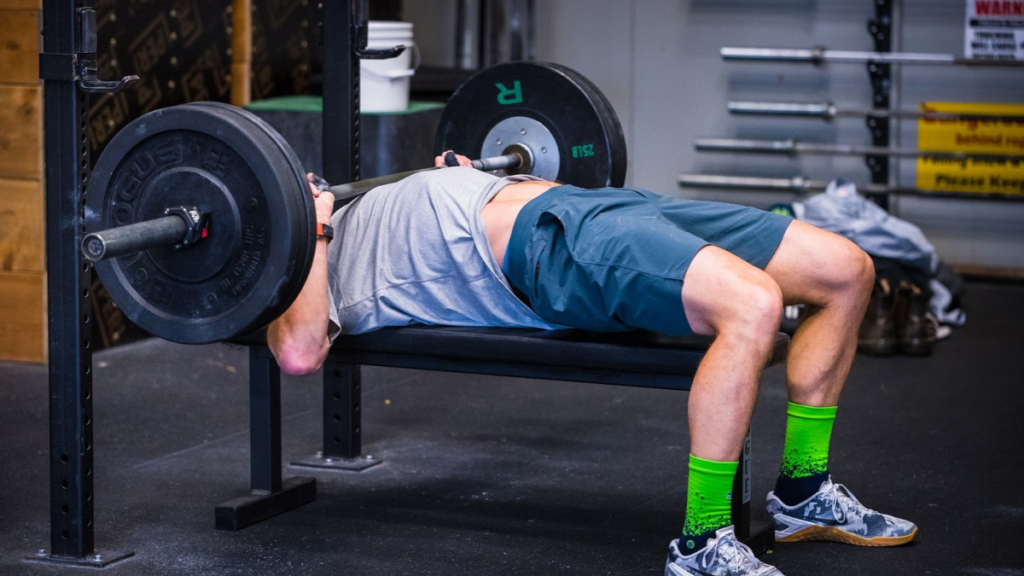
A useful default is to lower the weight smoothly and maintain control, then lift it with a strong effort. You do not need to count every second. On an exercise such as a leg press, bench press, or dumbbell curl, avoid dropping the weight quickly or bouncing out of the bottom position. At the same time, you do not need to make the lifting phase deliberately slow if you can move the load with good form.

The 2023 review on resistance training technique recommends repetition durations between 2 and 8 seconds for hypertrophy. The authors also note that more research is needed to establish whether changing the duration of the lifting or lowering phase produces a further muscle building benefit. This recommendation fits the broader evidence: use controlled repetitions, but do not treat one exact tempo as essential.
Trying to lift with intent can be useful even when the weight moves slowly. As fatigue builds, the bar or dumbbells may not travel quickly, but you can still try to move them forcefully while keeping the exercise controlled. This gives you a clear effort cue without requiring you to turn the movement into a swing or a bounce.
When Slower Reps May Be Useful
Slower repetitions can be a practical choice when you are learning an exercise and want time to feel the movement. They can also help you avoid rushing through a set or losing control of a load. If a slower pace feels more comfortable or helps you maintain consistent technique, there is no need to avoid it.
How Long Should Beginners Be Able to Hold a Plank
A slower tempo may also be useful when you need to adjust training to your comfort or ability. The 2025 review notes that people who cannot perform high load or high velocity movements, including some people dealing with joint discomfort or rehabilitation needs, may choose a tempo based on comfort and safety. That is not a claim that slow repetitions treat an injury. Anyone managing an injury should follow appropriate professional guidance.
Slower reps become less useful when they force you to cut the load or repetitions so much that you cannot train effectively, or when maintaining an exaggerated pace makes it hard to finish a set with good technique. The research does not show that making a repetition extremely slow is necessary for muscle growth.
When Faster Reps May Be Useful
Faster repetitions can be useful when you want to train with more intent and avoid turning every set into a long, slow effort. They are also relevant to strength and power goals, although those goals are different from muscle growth. A 2017 meta analysis on dynamic strength found that fast and moderate to slow resistance training produced similar strength gains overall, with a possible small advantage for fast movement at moderate loads. That finding concerns strength, not proof that fast reps build more muscle.
Fast lifting should still be controlled. If the weight is bouncing, the body is swinging, or the range of motion is shrinking to keep the speed up, the repetition has changed in ways beyond tempo. Choose a load that lets you move with intent while keeping the muscles you want to train involved and the movement consistent.
What Matters More Than Rep Speed?
The strongest conclusion from tempo research is not that speed never matters. It is that rep speed on its own does not appear to determine muscle growth. The 2025 review recommends prioritizing other training variables, including training volume and how close sets come to failure. A separate systematic review and meta analysis on proximity to failure found that training to absolute failure is not required to produce muscle growth. Together, these findings support focusing on a challenging, repeatable program rather than treating every set as a tempo experiment.
For a practical routine, use a load you can control through a consistent range of motion. Lower it without letting it drop, then lift with effort. End most sets when you are close to the point where you could no longer complete another good repetition, rather than forcing ugly reps just to prove how hard you trained. Progress your training over time by adding repetitions, load, or sets when appropriate, while keeping your technique consistent.
If you enjoy slower repetitions, use them. If you prefer a more natural pace, that can work too. The best tempo is one you can apply safely and consistently while training hard enough to support progress.
Key Takeaways
| Key takeaway | What the evidence suggests |
|---|---|
| Neither tempo has a clear overall advantage | Reviews find broadly similar muscle growth with slower and faster repetitions. |
| Control matters more than counting seconds | Lower the weight smoothly and keep the exercise consistent. |
| Fast does not mean uncontrolled | Lift with effort while avoiding bouncing, swinging, or shortened reps. |
| Very slow repetitions are optional | Longer time under tension has not been shown to reliably produce more growth. |
| Focus on the full training program | Use challenging sets, suitable volume, and consistent progression. |
References
- Enes, A., Piñero, A., Hermann, T., Zamanzadeh, A., Hennessy, T., Montenegro, D., Parnell, C., Jia, A., Weitzman, T., Wolf, M., Korakakis, P.A., Swinton, P.A. and Schoenfeld, B.J. (2025) ‘How slow should you go? A systematic review with meta-analysis of the effect of resistance training repetition tempo on muscle hypertrophy’, Journal of Strength and Conditioning Research, 39(12), pp. 1331–1339.
- Refalo, M.C., Helms, E.R., Trexler, E.T., Hamilton, D.L. and Fyfe, J.J. (2023) ‘Influence of resistance training proximity-to-failure on skeletal muscle hypertrophy: a systematic review with meta-analysis’, Sports Medicine, 53(3), pp. 649–665.
- Schoenfeld, B.J., Ogborn, D.I. and Krieger, J.W. (2015) ‘Effect of repetition duration during resistance training on muscle hypertrophy: a systematic review and meta-analysis’, Sports Medicine, 45(4), pp. 577–585.
- Wilk, M., Zajac, A. and Tufano, J.J. (2021) ‘The influence of movement tempo during resistance training on muscular strength and hypertrophy responses: a review’, Sports Medicine, 51(8), pp. 1629–1650.
- Androulakis Korakakis, P., Wolf, M., Coleman, M., Burke, R., Piñero, A., Nippard, J. and Schoenfeld, B.J. (2023) ‘Optimizing resistance training technique to maximize muscle hypertrophy: a narrative review’, Journal of Functional Morphology and Kinesiology, 9(1), article 9.