






















The 3 Muscles Every Beginner Needs to Train for Thicker Arms

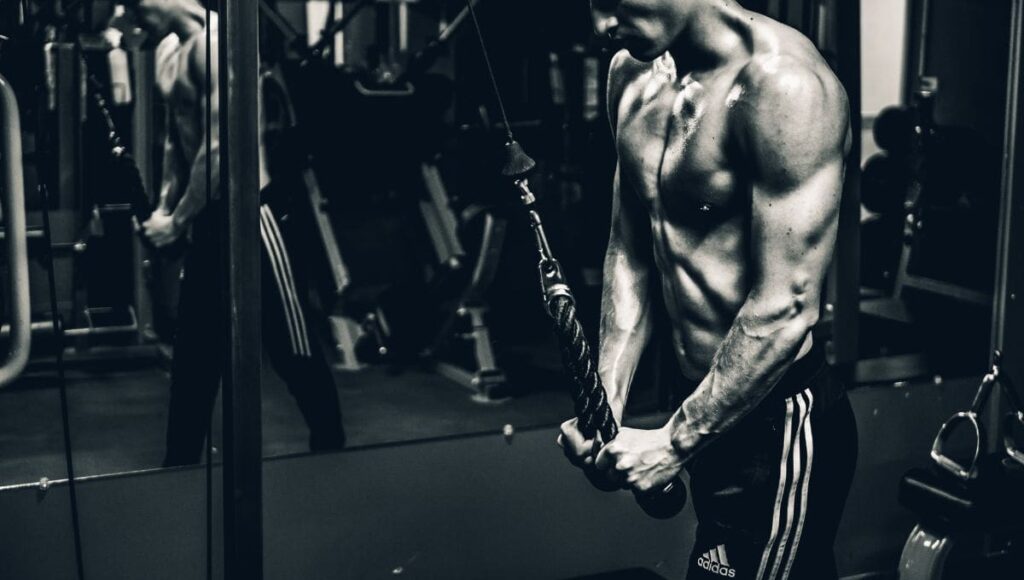
Want bigger arms? Then you need to dedicate time and effort to training these three muscles.
Why Arm Thickness Requires More Than Just Bicep Curls
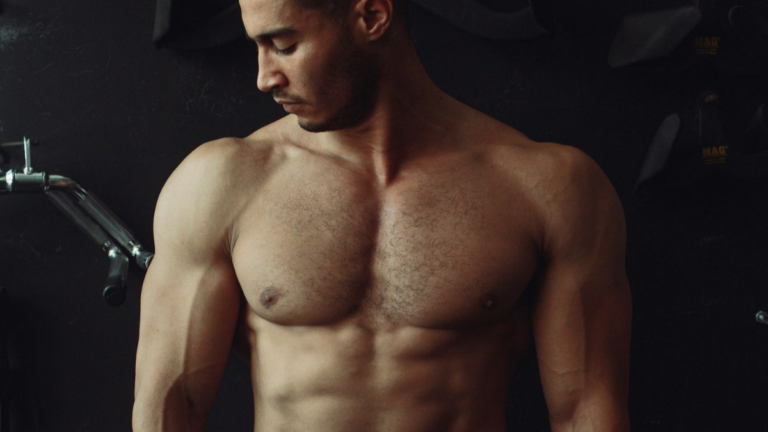
When people admire thick, muscular arms, they are seeing the combined cross-sectional volume of the anterior upper arm, the posterior upper arm, and the lower elbow flexors wrapping into the forearm. Anatomical research measuring upper-limb muscle volume confirms that the triceps brachii accounts for roughly sixty percent of total upper-arm muscle mass, while the biceps brachii and deeper elbow flexors make up the remaining forty percent.
Ignoring the larger back half of your upper arm or the deeper muscles sitting underneath your biceps leaves the vast majority of your arm growth potential untapped.

Exercise science research on muscle hypertrophy also shows that skeletal muscles grow best when exposed to progressive mechanical tension across full ranges of motion and trained consistently across the week. Beginners respond remarkably quickly to structured resistance training because neural adaptations and muscle protein synthesis ramp up rapidly when new movements are introduced cleanly. Targeting the right three muscles ensures that every set you perform adds real, three-dimensional thickness around the entire circumference of your arms.
The 3 Muscles That Drive Real Arm Thickness
1. The Triceps Brachii
If your primary goal is adding measurable inches to your tape measure, the triceps brachii is the single most important muscle to prioritize from day one. Consisting of the lateral head, medial head, and long head, the triceps cover the entire back and outer sweep of your upper arm and give your arms a thick, powerful silhouette even when hanging relaxed at your sides. Because the long head crosses both the shoulder and elbow joints, training the triceps with your arms both at your sides and elevated overhead stimulates complete growth across all three heads.
Sports science research examining shoulder elevation during elbow extensions demonstrates that overhead triceps extensions produce substantially greater hypertrophy of the long head than pressdowns alone, while standard pressdowns effectively load the lateral and medial heads. Pairing a heavy compound push or dip variation with both a cable pressdown and an overhead extension gives beginners complete triceps stimulation without beating up their elbows.
2. The Biceps Brachii
The biceps brachii sits prominently on the front of the upper arm and consists of a long head on the outer side and a short head on the inner side, both of which flex the elbow and supinate the forearm by turning your palm upward. While beginners rarely forget to train their biceps, many rush through heavy, swinging barbell curls that shift tension onto the front deltoids and lower back rather than loading the biceps through a full stretch and squeeze.
Electromyography and hypertrophy studies comparing curl angles show that changing upper-arm position alters regional tension across the biceps, with incline dumbbell curls placing the long head into a deep stretch and preacher or concentration curls challenging the mid-to-shortened range. Using strict control with a two-second lowering phase and stopping sets one to two clean reps shy of muscular failure builds far thicker biceps than heaving weights with momentum.
3. The Brachialis and Brachioradialis
The third crucial piece of the arm-thickness puzzle is the brachialis, a thick elbow flexor sitting directly underneath the biceps brachii, working alongside the brachioradialis running from the lower upper arm into the upper forearm. Even though the brachialis stays hidden beneath the biceps, growing it thicker physically pushes your biceps upward, creating a higher arm peak and noticeably wider arms when viewed from the front.
Unlike the biceps brachii, the brachialis attaches strictly to the ulna bone in the forearm and does not rotate the wrist, meaning it works hardest when your palms face each other in a neutral hammer grip or face downward in a pronated grip.
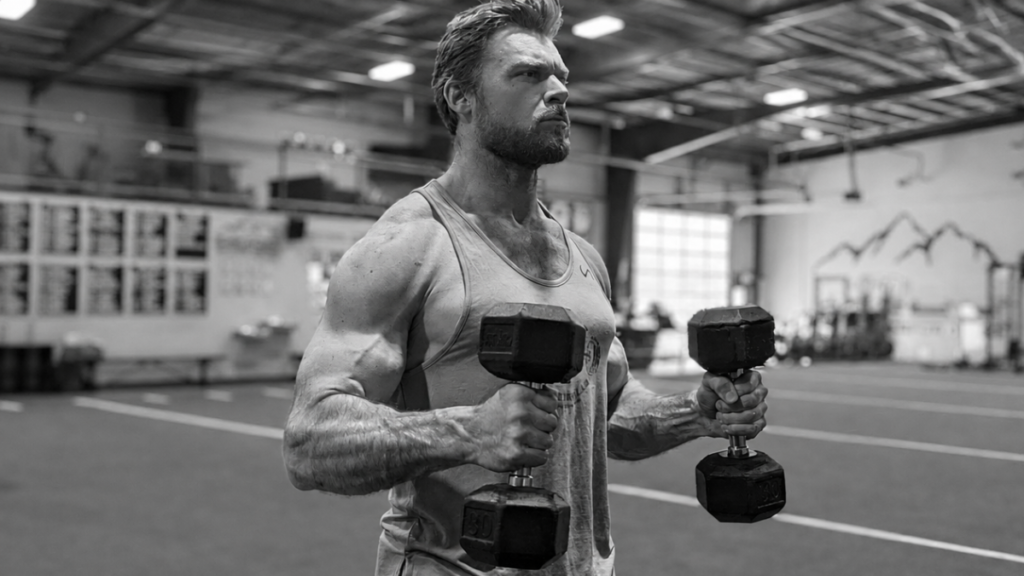
Biomechanical and electromyographic investigations of elbow flexors confirm that neutral-grip hammer curls and reverse-grip curls recruit the brachialis and brachioradialis strongly while taking stress off sensitive wrist tendons. Adding a dedicated hammer curl variation into your weekly routine rounds out the junction between your upper arm and forearm so your arms look dense and athletic from every angle.
The 3 Essential Muscles for Thicker Arms and How Beginners Should Train Them
| Target Muscle | Anatomical Role in Arm Size | Best Beginner Exercises | Recommended Weekly Sets |
| Triceps Brachii (Long, Lateral, Medial Heads) | Makes up roughly 60% of upper-arm muscle mass and builds outer sweep | Cable rope pressdowns, overhead dumbbell extensions, close-grip presses | 6 to 10 direct sets split across 2 sessions |
| Biceps Brachii (Long and Short Heads) | Forms the prominent front upper-arm peak and flexes or supinates the arm | Incline dumbbell curls, EZ bar curls, standing alternating dumbbell curls | 6 to 8 direct sets split across 2 sessions |
| Brachialis and Brachioradialis | Sits beneath the biceps to push it upward and thickens the upper forearm | Dumbbell hammer curls, cable rope hammer curls, reverse EZ bar curls | 4 to 6 direct sets split across 2 sessions |
How Beginners Should Program Arm Training Each Week
You do not need a dedicated two-hour arm day to grow impressive arms as a beginner, because your biceps, triceps, and brachialis already receive substantial indirect work during heavy rows, pull-ups, bench presses, and overhead presses. Meta-analytic evidence on resistance training frequency indicates that training muscle groups twice per week produces superior hypertrophy compared to once-weekly training, while research on training loads confirms that moderate weights in the eight to fifteen repetition range taken close to muscular failure drive robust muscle growth.
3 Best Kettlebell Exercises for a Jacked and Great Looking Upper Body
Adding two or three focused arm exercises at the end of two upper-body workouts each week keeps your total session time under an hour while giving all three key arm muscles consistent progressive overload. Focus on adding one clean repetition per set week over week before bumping up dumbbell weights, and keep your elbows steady so your target muscles do all the work.
Key Takeaways
| Training Factor | Evidence-Based Guidance | Why It Matters for Thicker Arms |
| Top Priority Muscle | Prioritize the triceps brachii alongside curls rather than curling exclusively | Triceps account for roughly 60% of total upper-arm muscle volume |
| Hidden Thickness Booster | Train the brachialis and brachioradialis with neutral-grip hammer curls | Thickens the lower upper arm and pushes the biceps upward for greater size |
| Exercise Angle Variety | Include both overhead and arms-at-sides movements for triceps and biceps | Ensures complete growth across long and short heads in stretched positions |
| Weekly Programming | Train arms twice per week with 8 to 15 controlled reps near muscular failure | Maximizes hypertrophy and recovery without causing joint overuse early on |
References
- Holzbaur, K.R., Murray, W.M., Gold, G.E. and Delp, S.L., 2007. Upper limb muscle volumes in adult subjects. Journal of Biomechanics, 40(4), pp.742-749.
- Maeo, S., Wu, Y., Huang, M., Sakurai, H., Kusagawa, Y., Sugiyama, T., Kanehisa, H. and Isaka, T., 2023. Triceps brachii hypertrophy is substantially greater after elbow extension training performed in the overhead versus neutral arm position. European Journal of Sport Science, 23(7), pp.1240-1250.
- Marcolin, G., Panizzolo, F.A., Petrone, N., Moro, T., Grigoletto, D., Piccolo, D. and Paoli, A., 2018. Differences in electromyographic activity of biceps brachii and brachioradialis while performing three variants of curl. PeerJ, 6, p.e5165.
- Schoenfeld, B.J., Grgic, J., Ogborn, D. and Krieger, J.W., 2017. Strength and hypertrophy adaptations between low- vs. high-load resistance training: a systematic review and meta-analysis. Journal of Strength and Conditioning Research, 31(12), pp.3508-3523.
- Schoenfeld, B.J., Ogborn, D. and Krieger, J.W., 2016. Effects of resistance training frequency on measures of muscle hypertrophy: a systematic review and meta-analysis. Sports Medicine, 46(11), pp.1689-1697.
Robbie Wild Hudson
Editor-In-Chief at BOXROX. I come from a background of rugby and weightlifting. Growing up in the English Lake District, I spent a great deal of time swimming in its stunning lakes and rivers. In 2015 my brothers and I became the first people to swim the 145km length of the River Eden, from source to mouth, in 9 days. We also swam the Corryvreckan whirlpool, the third largest in the world, and Crossfit is a huge part of my training for these events.
More from Robbie Wild Hudson