

The upper chest is one of the most noticeable areas of the torso. When it is well developed, it can make the chest look fuller from the front and create a stronger line between the shoulders and chest. Beginners often try to solve this with a long list of chest exercises, but a better approach is to learn a few movements, perform them consistently, and gradually make them more challenging.
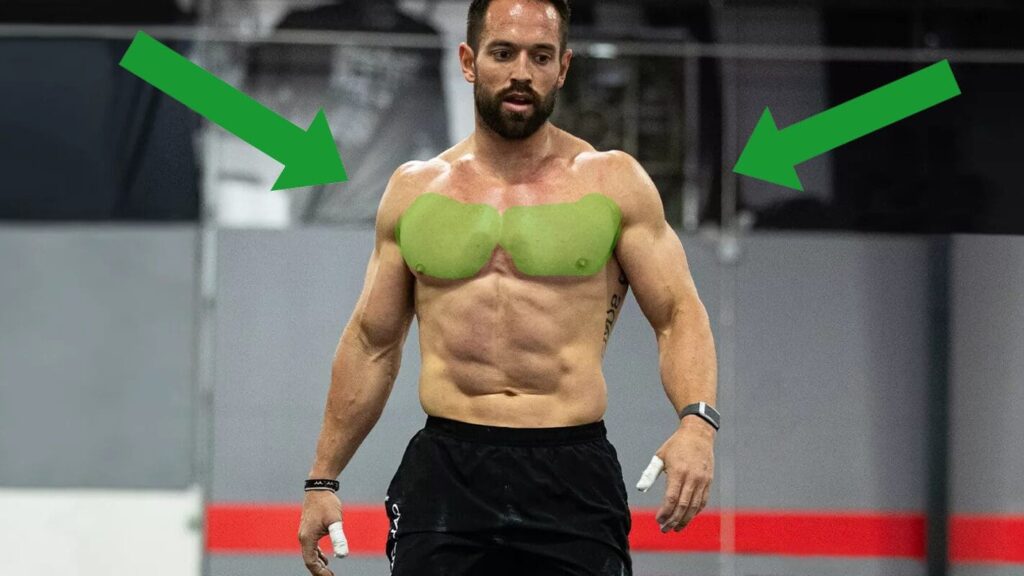
The upper part of the chest is primarily formed by the clavicular head of the pectoralis major. It shares the job of bringing the upper arm toward the body with the larger sternal portion of the muscle, while the front deltoid and triceps contribute to pressing movements. You cannot completely isolate one small part of a large muscle, but exercise angle, arm path, effort, and progressive overload can shift the emphasis enough to make your training more productive.


For most beginners, the best results come from pressing with stable technique, using a full comfortable range of motion, and accumulating enough hard sets each week. The exercises below give you a simple, evidence informed way to build a bigger upper chest without needing complicated programming.
What Builds the Upper Chest?
The pectoralis major has two broad sections. The clavicular portion begins along the collarbone, while the sternal portion begins along the breastbone and nearby rib cartilage. Both portions work together during pressing and horizontal adduction, which is the action of drawing the upper arm across the body. The clavicular fibers are especially well positioned to contribute when the arm moves forward and upward from a lower position.
Research using muscle activity measurements suggests that pressing at a modest incline can increase activity in the clavicular portion of the pectoralis major compared with flat pressing. Extremely steep inclines are less useful for this goal because the front deltoids take on more of the work. For a beginner, an incline of roughly 15 to 30 degrees is a sensible starting point. It is high enough to change the line of press, yet low enough to keep the chest as a major contributor.
Muscle activity research can help explain exercise choices, but it does not directly prove long term muscle growth. Hypertrophy depends on repeated training over time, with enough effort, volume, food, and recovery. Still, using movements that allow you to train the chest hard and comfortably is a practical way to give the clavicular fibers plenty of useful work.
The Best Beginner Exercises for Bigger Upper Chest Muscles
Low Incline Dumbbell Bench Press
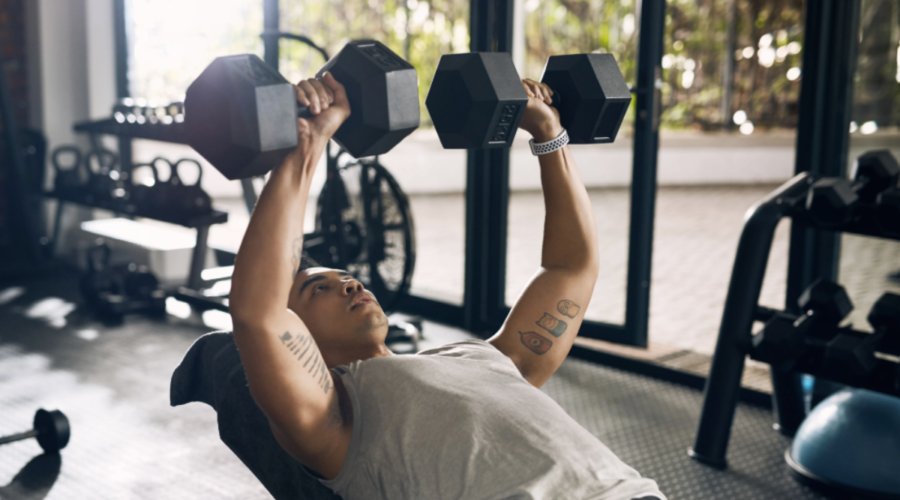
The low incline dumbbell bench press is the best starting exercise for many beginners. Dumbbells allow each arm to move independently, which can make the motion feel more natural than a barbell. They also encourage you to control the lowering phase, train through a substantial range of motion, and correct obvious differences in strength or coordination between sides.
Set the bench to a low incline, ideally around 15 to 30 degrees. Sit with the dumbbells resting on your thighs, then use your legs to help bring them into position as you lean back. Start with the dumbbells above the upper chest and your wrists stacked over your elbows. Lower them under control until your upper arms are slightly below parallel with the floor if your shoulders tolerate that position. Press up and slightly inward, keeping your shoulder blades gently pulled back and down against the bench.
3 Best Cable Back Exercises for a More Attractive V Shaped Torso
Do not turn the exercise into a high incline shoulder press. Keep your elbows at a comfortable angle between your sides and a straight out position. A moderate arm angle normally feels more secure at the shoulder and keeps the chest involved. A controlled repetition with a lighter load will build more useful practice than forcing heavy dumbbells into a shaky path.
Free weight training is effective for increasing muscular strength and size when it is performed consistently. The key advantage here is not that dumbbells have a magical property, but that the movement is easy to progress. When you can complete the top of your chosen repetition range with clean technique, increase the load by the smallest available amount.
Incline Push Up
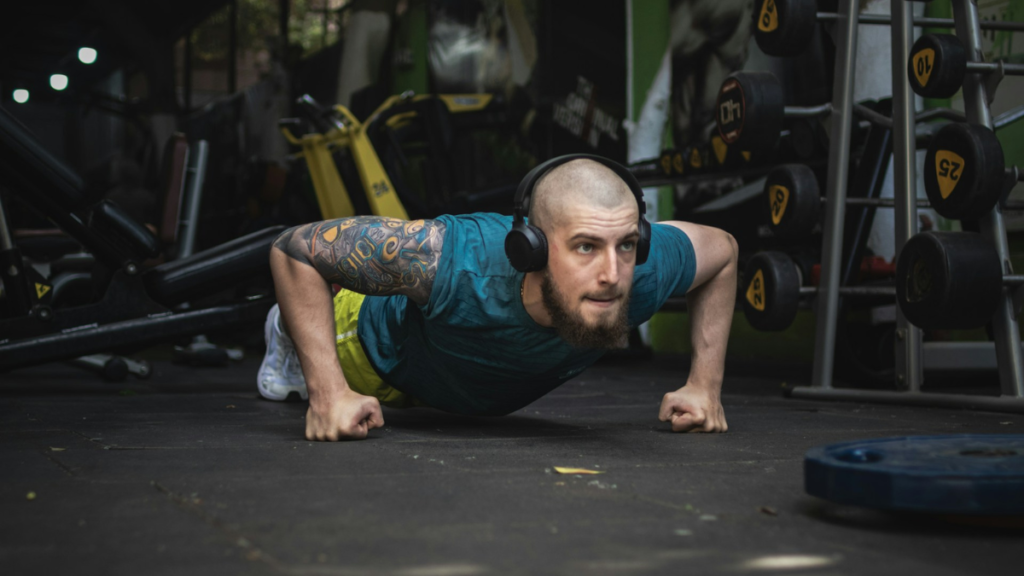
An incline push up is one of the most overlooked chest exercises for beginners. Placing your hands on a stable bench, bar, or countertop reduces the percentage of body weight you have to press. This lets you learn the movement, build confidence, and perform useful repetitions long before you are ready for difficult floor push ups.
Choose a surface height that lets you complete about 8 to 15 good repetitions while leaving one to three repetitions in reserve. Place your hands a little wider than shoulder width and create a straight line from your head to your heels. Lower your chest toward the support by bending the elbows, then press the support away until your arms are straight without aggressively locking the elbows.
The higher the hands, the easier the movement becomes. As you become stronger, lower the support height until you can perform floor push ups. Push ups can produce similar chest and triceps strength improvements to the bench press when the resistance is matched appropriately. This makes them much more than a fallback exercise. They are a scalable pressing pattern that can keep producing results as you adjust leverage, repetitions, tempo, or external load.
For a little more upper chest focus, think about pushing your body upward and back from the bottom rather than simply moving your torso straight away from your hands. The change is subtle, and the main goal should remain a smooth full range repetition. Progression and consistency matter far more than trying to create a perfect sensation in one area of the chest.
Incline Machine Chest Press
An incline chest press machine is a highly effective choice when it fits your gym. Machines provide external stability, which means a beginner can focus more attention on pushing hard through the chest instead of balancing the weight. That can be particularly useful after learning basic pressing technique with dumbbells or push ups.
Adjust the seat so the handles begin around upper chest level. Your feet should be planted firmly on the floor and your back should remain in contact with the pad. Use a grip that lets your wrists stay straight. Press the handles forward and slightly together if the machine path allows it, then return slowly without letting the stack crash between repetitions.
Research comparing free weights and machines indicates that both can build muscle when training volume and effort are sensible. The best choice is often the one you can perform pain free, control well, and progress over months. A machine can also be an excellent final chest movement, because you can safely train close to muscular fatigue without a spotter managing a barbell.
Cable Low to High Fly
The cable low to high fly is a useful accessory exercise once you have a pressing movement in your program. Cables create resistance throughout much of the range of motion, including the shortened position when the hands come together. The low starting position and upward arm path are also a logical match for the direction of the clavicular chest fibers.
Set the cable handles at the lowest position. Stand with one foot slightly forward, soften your knees, and brace your torso. Begin with your hands low and slightly behind the line of your body, using only a range that feels comfortable at the front of the shoulders. With a small bend in the elbows, sweep the handles upward and together until your hands meet around upper chest or chin height. Return slowly and keep the torso still.
This is not an exercise for very heavy loads. Use a weight you can control for roughly 10 to 20 repetitions, and make the chest do the work rather than swinging your body or shrugging your shoulders. Single joint movements can add valuable weekly volume for hypertrophy, particularly when they are paired with compound presses that already train the chest, shoulders, and triceps together.
How to Program These Exercises
Beginners do not need to perform every exercise in the same workout. Start with two or three chest movements per week across two sessions. A simple plan could use the low incline dumbbell bench press for three sets of 6 to 10 repetitions, followed by incline push ups for two sets of 8 to 15 repetitions. In the second session, use an incline machine chest press for three sets of 8 to 12 repetitions and cable low to high flyes for two sets of 10 to 20 repetitions.

This gives you around 10 challenging chest sets each week, which is a practical starting point for a beginner. Research shows a dose response relationship between weekly resistance training volume and muscular hypertrophy, although more sets are not automatically better. Your results depend on quality repetitions, recovery, and your ability to keep improving. If your performance is rising and your joints feel good, stay with the plan before adding extra work.
Train most sets close to failure, but do not make every set an all out effort. Stopping with one to three good repetitions still possible is a reliable way to make sets demanding while protecting technique. Studies suggest that a wide range of repetition loads can build muscle when sets are performed close enough to failure. That gives beginners flexibility. Moderate loads are often easiest to learn, but lighter sets can work well when a machine, cable, or body weight exercise makes small loading jumps difficult.
Rest for at least one to two minutes between hard sets. Longer rests can be useful for your main dumbbell or machine press, because they help you maintain repetition quality and total training volume. Do not rush through the workout just to create fatigue. Mechanical tension from hard, controlled repetitions is the main training stimulus you are trying to accumulate.
The Simple Route to a Bigger Upper Chest
The best beginner upper chest program is not the one with the most exercises. It is the one you can repeat long enough to become stronger. Start with a low incline dumbbell press, use incline push ups to build quality pressing volume, add a machine press if it suits your gym, and use low to high cable flyes as controlled accessory work.
Keep the incline modest, record your sets and repetitions, and try to make small improvements over time. Bigger upper chest muscles are the result of many well performed sessions, not a single perfect workout. If you learn the movements, train close to your current capacity, and recover properly, you will have a strong foundation for steady chest growth.
References
- Baechle, T.R., Earle, R.W. and Wathen, D. (2008) ‘Resistance training’, in Baechle, T.R. and Earle, R.W. (eds.) Essentials of Strength Training and Conditioning. 3rd edn. Champaign, IL: Human Kinetics, pp. 381 to 412.
- Fink, J., Kikuchi, N. and Nakazato, K. (2018) ‘Effects of rest intervals and training loads on metabolic stress and muscle hypertrophy’, Clinical Physiology and Functional Imaging, 38(2), pp. 261 to 268.
- Grgic, J., Schoenfeld, B.J., Skrepnik, M., Davies, T.B. and Mikulic, P. (2021) ‘Effects of rest interval duration in resistance training on measures of muscular strength’, Sports Medicine, 51(2), pp. 305 to 317.
- Kubo, K., Ikebukuro, T. and Yata, H. (2013) ‘Effects of 4, 8 and 12 repetition maximum resistance training protocols on muscle volume and strength’, Journal of Strength and Conditioning Research, 27(3), pp. 724 to 731.
- Lasevicius, T., Schoenfeld, B.J., Silva Batista, C., Barros, T.S., Aihara, A.Y., Brendon, H., Longo, A.R., Tricoli, V. and Teixeira, E.L. (2018) ‘Muscle failure promotes greater muscle hypertrophy in low load but not in high load resistance training’, Journal of Strength and Conditioning Research, 36(2), pp. 346 to 352.
- Lauver, J.D., Cayot, T.E. and Scheuermann, B.W. (2015) ‘Influence of bench angle on upper extremity muscular activation during bench press exercise’, European Journal of Sport Science, 16(3), pp. 309 to 316.
- Morton, R.W., Murphy, K.T., McKellar, S.R., Schoch, R.D., Henselmans, M., Helms, E., Aragon, A.A., Devries, M.C., Banfield, L., Krieger, J.W. and Phillips, S.M. (2018) ‘A systematic review, meta analysis and meta regression of the effect of protein supplementation on resistance training induced gains in muscle mass and strength’, British Journal of Sports Medicine, 52(6), pp. 376 to 384.
- Schoenfeld, B.J., Ogborn, D. and Krieger, J.W. (2017) ‘Dose response relationship between weekly resistance training volume and increases in muscle mass: A systematic review and meta analysis’, Journal of Sports Sciences, 35(11), pp. 1073 to 1082.
Key Takeaways
| Focus | Practical takeaway |
|---|---|
| Best primary movement | Use a low incline dumbbell bench press to train the chest through a controlled range of motion. |
| Useful incline | Start with a bench angle of about 15 to 30 degrees so the chest remains a major contributor. |
| Beginner progression | Use incline push ups, then lower the hand support as your strength improves. |
| Weekly work | Begin with about 8 to 10 challenging chest sets across two weekly sessions. |
| Growth priority | Train with clean technique, progress gradually, eat enough protein, and recover between sessions. |