

A strong pair of legs changes far more than how you look in shorts. Well planned lower body training can build muscle, improve force production, strengthen bones, and make everyday tasks such as climbing stairs, carrying heavy objects, and getting up from a chair feel easier.
Barbells are especially effective because they allow you to use meaningful loads, progress gradually, and train several large muscle groups at once. You do not need an endless list of exercises to build impressive legs. You need a small number of movements that cover the main functions of the lower body, performed consistently with solid technique.


The three exercises in this article are the barbell back squat, Romanian deadlift, and barbell hip thrust. Together, they train the quads, hamstrings, glutes, adductors, and lower back through different movement patterns. Each exercise gives you a clear way to become stronger over time, which is essential if you want your legs to grow.
Why Barbells Work So Well for Leg Growth
Muscle growth requires repeated exposure to challenging resistance training. The body adapts when the muscles are asked to produce force against a load that is difficult enough to create fatigue while allowing good form. Barbell exercises make this practical because you can make small, measurable increases in load over weeks and months.
Research shows that resistance training volume is closely linked with muscle growth. In simple terms, completing enough challenging sets for a muscle group each week gives you a better chance of building size, provided you can recover from the work. You do not need to take every set to complete failure, but your working sets should feel demanding and usually finish with only a few good repetitions left in the tank.
A barbell also gives you stability and control that can be harder to achieve with awkwardly loaded exercises. This lets you focus on steadily adding weight, repetitions, or better range of motion. The goal is not to chase a personal record in every session. The goal is to give your legs a repeated reason to adapt.
1. Barbell Back Squat
The barbell back squat is the foundation of this three exercise plan because it trains the entire lower body while placing major demand on the quadriceps. Your glutes, adductors, trunk muscles, and calves also contribute to the lift, making it one of the most efficient movements you can include in a leg workout.
What the Back Squat Builds
The quads are responsible for straightening the knee, and they work hard every time you stand up from the bottom of a squat. Research using squat training has shown increases in the size of all four quadriceps muscles when participants trained with a consistent squat program. This makes the back squat a powerful choice for people who want more size through the front of their thighs.
The glutes also contribute strongly as you rise from the bottom position. They extend the hips and help drive you upward when the bar gets heavy. Your adductors, especially the large adductor magnus muscle, also work hard to extend the hips from a deep squat position.
Squats are not only useful for adding muscle. Heavy resistance training can improve maximal strength and physical function. That matters whether your goal is better performance in sport, more confidence under a barbell, or simply a more capable body.
How to Perform the Barbell Back Squat
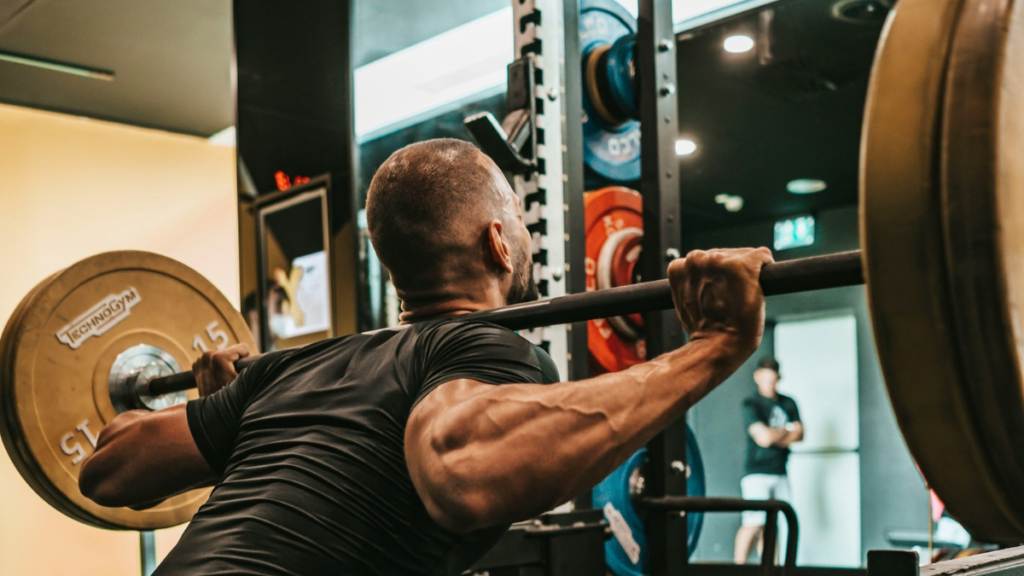
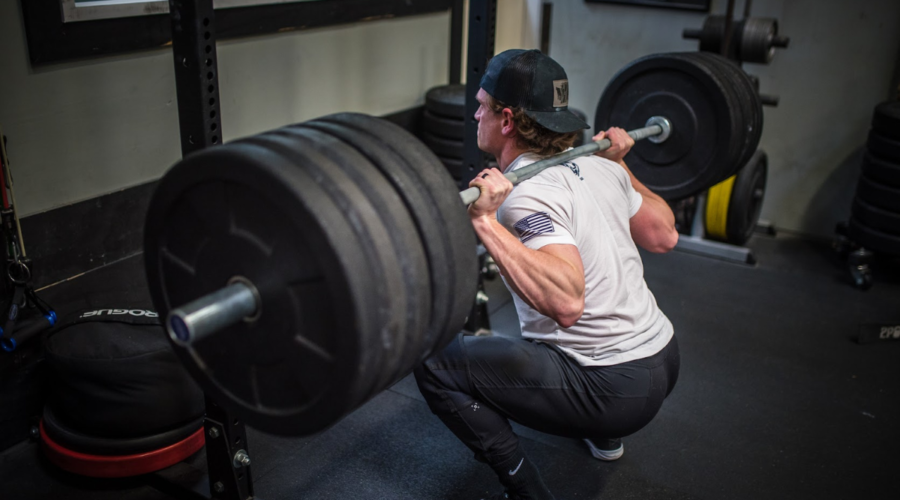
Set the bar in a rack at around upper chest height. Step under the bar, place it securely across the upper back, and pull your shoulder blades down and back to create a stable shelf. Take a firm grip on the bar and brace your midsection before you lift it from the rack.
Take one or two controlled steps backward and set your feet about shoulder width apart. Your exact stance will depend on your mobility and build, but you should feel balanced and able to keep your whole foot in contact with the floor.
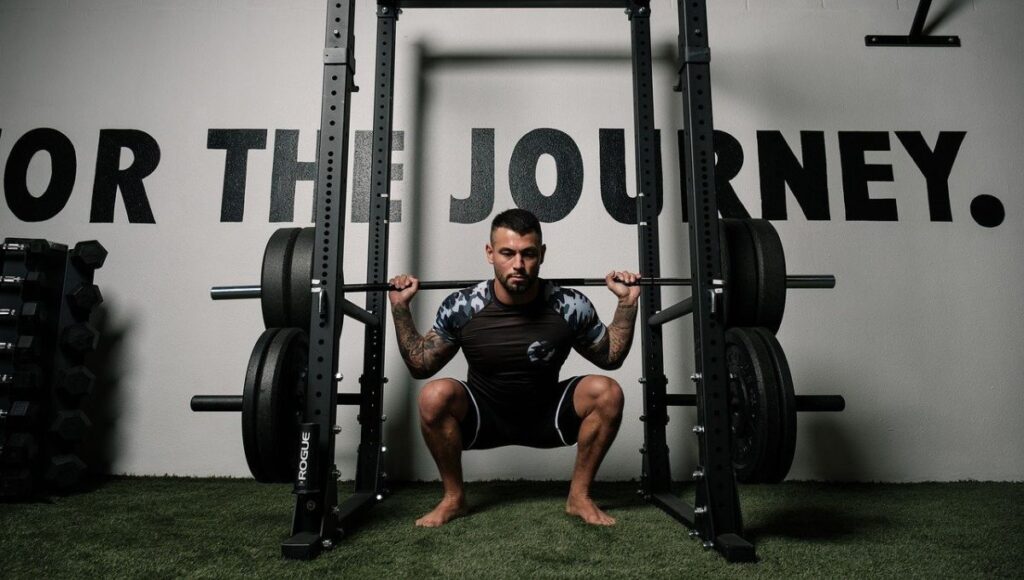
Start the descent by bending your knees and hips together. Keep your chest proud, your torso braced, and your knees tracking in the same direction as your toes. Lower under control to a depth that you can own without your lower back rounding or your feet collapsing inward.
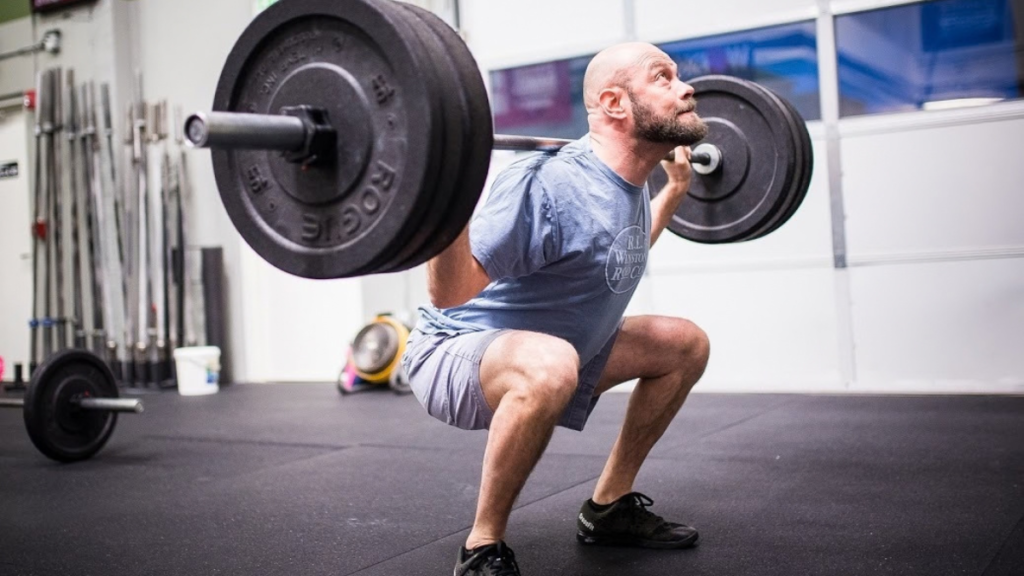
Drive upward by pushing the floor away. Keep pressure through your full foot and stand tall at the top before beginning the next repetition.
How Deep Should You Squat?
You do not need to force yourself into an extreme range of motion that your body cannot control. However, a deeper squat that is performed well can be highly productive for building the quads and glutes. Research comparing different squat ranges has found that training through a larger range can produce greater improvements in lower body muscle size and strength than very shallow squatting.
For most lifters, squatting until the top of the thigh reaches at least parallel with the floor is a useful target. If you can go lower while maintaining balance, control, and a neutral spine, that can be a good option as well.
The key is consistency. Use the same depth for most of your working sets so you can accurately judge progress. A heavier squat is not necessarily a better squat if every repetition becomes shallower.
How to Program the Back Squat
Perform the back squat one or two times per week. Start with three working sets of six to ten repetitions. Choose a load that makes the final two or three repetitions challenging but still technically controlled.
When you can complete the top end of the repetition range for every set with good form, add a small amount of weight next time. This slow progression is more valuable than making large jumps that force you to compromise technique.
2. Romanian Deadlift
The Romanian deadlift is your main hamstring exercise in this plan. It teaches you to load the hips while keeping only a small bend in the knees. Unlike the squat, where the quads do much of the work, the Romanian deadlift places greater emphasis on the muscles at the back of the thighs and the glutes.
This balance matters. Strong, muscular legs need more than big quads. Building the hamstrings and glutes gives the lower body a fuller appearance while improving your ability to extend the hips powerfully.
What the Romanian Deadlift Builds
The hamstrings cross both the hip and knee joints. During a Romanian deadlift, they work hard as the hips travel backward and the muscles lengthen under load. This is one reason the exercise is so useful for developing the posterior side of the legs.
Biomechanical research has found that Romanian deadlifts create substantial demand on the hamstrings and hip extensors. Studies on related straight leg hip hinge training also show that hamstring muscles can grow in response to this type of loaded movement.
The glutes contribute as you drive your hips forward to stand tall. Your upper back, forearms, and trunk also have to work isometrically to keep the bar close and your position stable. That makes the Romanian deadlift an excellent movement for building strength across the whole posterior chain.
How to Perform the Romanian Deadlift
Start with the barbell in a rack set around mid thigh height, or lift it from the floor using a controlled deadlift. Stand tall with your feet around hip width apart and hold the bar close to your thighs.
Soften your knees slightly, then push your hips backward as if you are trying to reach a wall behind you. Keep the bar close to your legs throughout the movement. Your torso will lean forward, but your spine should remain neutral and your chest should not collapse toward the floor.
Lower the bar only as far as you can while keeping tension in the hamstrings and control through your trunk. For many people, this will be around knee level or just below it. Your individual range will depend on your hamstring flexibility and ability to maintain position.
Once you reach your deepest controlled point, drive your feet into the floor and bring your hips forward. Finish tall with your ribs stacked over your pelvis. Do not lean backward at the top or turn the finish into a lower back movement.
Common Romanian Deadlift Mistakes
The most common error is turning the Romanian deadlift into a squat. If your knees keep bending more as you lower the bar, you will shift work away from the hamstrings and make the movement less distinct from your squat.
Another common problem is allowing the bar to drift away from the legs. The farther the bar moves forward, the more stress your lower back has to manage. Keep the bar close enough that it almost brushes your legs as you lower and lift.
Avoid chasing depth for its own sake. A slightly shorter range with strong hamstring tension and a neutral spine is better than lowering the bar to the floor with a rounded back.
How to Program the Romanian Deadlift
Perform Romanian deadlifts once or twice per week for three or four sets of six to twelve repetitions. Use a controlled lowering phase of around two or three seconds. You should feel the hamstrings lengthen as you lower the bar, rather than rushing through the portion of the lift that makes the exercise so useful.
Because the hamstrings can be sore after challenging hip hinge work, start conservatively. Add volume gradually and give yourself enough time to recover before repeating the movement.
3. Barbell Hip Thrust
The barbell hip thrust is the final piece of the plan because it directly trains hip extension with a strong emphasis on the glutes. It is not a replacement for squats or Romanian deadlifts. It complements them by challenging the glutes in a position where they are working hard near full hip extension.
For people who want legs that look powerful from every angle, the hip thrust deserves a place in their training.
What the Barbell Hip Thrust Builds
The gluteus maximus is the largest muscle in the body and a major hip extensor. It contributes to running, jumping, climbing, and rising from a squat. Building stronger glutes can improve lower body performance while creating more muscle through the back of the hips and upper thighs.
Research comparing barbell hip thrust and squat programs has shown that both exercises can increase gluteal muscle size. Other research suggests that squat training may create more quadriceps growth, while hip thrust training offers a direct way to load the glutes heavily through hip extension.
This is why the combination works so well. The squat gives you a large amount of quad and glute work. The Romanian deadlift develops the hamstrings and glutes in a lengthened position. The hip thrust adds more focused glute work in a shortened position.
How to Perform the Barbell Hip Thrust
Sit on the floor with your upper back against a secure bench. The bottom of your shoulder blades should rest near the edge of the bench when you are in the top position. Roll a padded barbell over your legs until it sits in the crease of your hips.
Place your feet flat on the floor around shoulder width apart. At the top of the movement, your shins should be close to vertical. Brace your trunk, tuck your chin slightly, and drive through your feet to lift your hips.
Finish when your torso and thighs form a straight line. Squeeze your glutes hard at the top, but avoid arching your lower back to create extra range. Lower the bar under control and repeat.
It can take a few sessions to find the right foot position. If you feel the movement mostly in your quads, move your feet slightly farther away. If you feel cramping in the hamstrings, bring them a little closer. The right position should let you feel strong glute tension while keeping the movement stable.
How to Program the Barbell Hip Thrust
Perform hip thrusts one or two times per week for three or four sets of eight to fifteen repetitions. Since the movement is stable and does not create the same level of whole body fatigue as a heavy squat, it often works very well with moderate to higher repetitions.
3 Top Exercises for a More Muscular Upper Body Without Barbells
Pause briefly at the top of each repetition instead of bouncing through the lockout. This keeps the glutes under tension and makes it harder to use momentum.
How to Build These Exercises Into a Leg Plan
You can perform all three exercises in one lower body workout, particularly if you train legs once or twice per week. Start with the back squat because it requires the most coordination and total body energy. Follow it with Romanian deadlifts, then finish with barbell hip thrusts.
A simple approach is to use three sets of six to ten repetitions for the squat, three sets of eight to ten repetitions for Romanian deadlifts, and three sets of ten to fifteen repetitions for hip thrusts. This gives you enough quality work to stimulate growth without making every session excessively long.
As you become more experienced, you can add another set to one or more exercises, or train the movements across two separate lower body sessions. The most important principle is progressive overload. Over time, aim to add a little weight, complete an extra repetition, improve your control, or use a better range of motion.
Do not change exercises every week because a new variation feels exciting. Stay with the basics long enough to become skilled and strong. The biggest changes in your legs will come from months of consistent effort, not a single perfect workout.
References
- Bloomquist, K., Langberg, H., Karlsen, S., Madsgaard, S., Boesen, M. and Raastad, T. (2013) ‘Effect of range of motion in heavy load squatting on muscle and tendon adaptations’, European Journal of Applied Physiology, 113(8), pp. 2133 to 2142.
- Coratella, G., Tornatore, G., Longo, S. and Esposito, F. (2022) ‘An electromyographic analysis of Romanian, step Romanian, and stiff leg deadlift: Implication for resistance training’, International Journal of Environmental Research and Public Health, 19(3), 1903.
- Kubo, K., Ikebukuro, T., Yata, H. and Tsunoda, N. (2019) ‘Time course of changes in muscle and tendon properties during strength training and detraining’, Journal of Strength and Conditioning Research, 33(10), pp. 2595 to 2601.
- Plotkin, D.L., Vigotsky, A.D., Schoenfeld, B.J., Beardsley, C. and Contreras, B. (2023) ‘Hip thrust and back squat training elicit similar gluteus muscle hypertrophy and transfer similarly to the deadlift’, Frontiers in Physiology, 14, 1199100.
- Schoenfeld, B.J., Ogborn, D. and Krieger, J.W. (2017) ‘Dose response relationship between weekly resistance training volume and increases in muscle mass: A systematic review and meta analysis’, Journal of Sports Sciences, 35(11), pp. 1073 to 1082.
- Schoenfeld, B.J., Contreras, B., Vigotsky, A.D. and Peterson, M. (2016) ‘Differential effects of heavy versus moderate loads on measures of strength and hypertrophy in resistance trained men’, Journal of Sports Science and Medicine, 15(4), pp. 715 to 722.
- Shibata, K., Takahashi, M., Kubota, N., Otsuka, S., Yamada, E. and Fukunaga, T. (2022) ‘Does back squat exercise lead to regional hypertrophy among quadriceps femoris muscles?’, European Journal of Applied Physiology, 122(1), pp. 165 to 174.
- Wackerhage, H., Schoenfeld, B.J., Hamilton, D.L., Lehti, M. and Hulmi, J.J. (2019) ‘Stimuli and sensors that initiate skeletal muscle hypertrophy following resistance exercise’, Journal of Applied Physiology, 126(1), pp. 30 to 43.
Key Takeaways
| Exercise | Main muscles trained | Best use | Practical starting point |
|---|---|---|---|
| Barbell back squat | Quads, glutes, adductors, trunk | Building overall leg size and strength | Three sets of six to ten repetitions |
| Romanian deadlift | Hamstrings, glutes, upper back | Building the back of the legs and stronger hip hinge mechanics | Three sets of eight to ten repetitions |
| Barbell hip thrust | Glutes, hamstrings | Adding focused hip extension work and glute size | Three sets of ten to fifteen repetitions |
| Long term strategy | Entire lower body | Building muscle consistently | Add load, repetitions, control, or range gradually over time |