

Leg training is hard, and it breeds mental toughness and impressive gains when done properly. But are you including the right exercises in your training that will help to maximize your results?
The Mechanical Bottlenecks of Machine Leg Presses
To understand why traditional leg presses eventually fall short of optimal hypertrophy, we have to look at how force is produced and transferred across human joints. Machine based exercises isolate the target muscles by removing the demand for active balance and trunk stabilization.
While this isolation allows you to push heavy weight without worrying about falling over, it drastically alters the neural signaling sent to your working muscle groups. When your body is fully supported by a padded seat, your nervous system does not need to recruit high threshold motor units across stabilizing muscles in the hips, glutes, and core.
| Performance Variable | Machine Leg Press | Standard Free Weight Squat |
| Stabilization Requirements | Minimal due to fixed machine track | High core and pelvic stabilization |
| Kinetic Energy Recoil | Very high elastic rebound at bottom | High stretch shortening cycle boost |
| Systemic Hormonal Drive | Moderate localized muscular stress | Exceptionally high central recruitment |
| Peak Tension Angle | Variable due to lever arm angle | Diminished at bottom by stretch reflex |
The reliance on passive kinetic rebound explains why someone can leg press six hundred pounds yet struggle to move half that weight during free standing lower body movements. By allowing elastic energy to shoulder the load during the transition phase, you miss out on the crucial force generation needed to stimulate deep muscle fibers. To unlock accelerated hypertrophic gains, you must eliminate this elastic advantage completely and force your muscles to perform concentric work from a complete mechanical standstill.
Reclaiming Tension with Zero Momentum Training
The concept of eliminating momentum to maximize muscular tension is one of the most effective strategies in exercise science. When you remove the stretch shortening cycle from a lower body exercise, your nervous system can no longer count on elastic recoil to initiate movement. Every single pound of resistance must be overcome purely through voluntary muscular contraction and high frequency motor unit recruitment. This physiological environment produces immense mechanical tension, which research consistently identifies as the primary driver of myofibrillar hypertrophy.
By forcing a complete pause at the bottom position of a movement, you allow stored elastic energy in the tendons to dissipate as heat over the course of two to three seconds. When you initiate the ascent from this dead stop position, your brain must signal high threshold motor units to fire instantly to overcome gravity. This sudden spike in rate of force development activates fast twitch muscle fibers that rarely get fully recruited during standard continuous repetition sets.
| Training Parameter | Continuous Rebound Repetitions | Dead Stop Stationary Repetitions |
| Stretch Reflex Contribution | Significant force assistance | Completely dissipated and eliminated |
| Rate of Force Development | Gradual transition through turn | Maximal instantaneous force demand |
| Target Fiber Recruitment | Sequential medium threshold fibers | Immediate high threshold fast twitch fibers |
| Joint Stress Profile | High dynamic impact at direction change | Controlled static transition with zero bounce |
When you examine muscle activation profiles, dead stop training forces your legs to work significantly harder at lower absolute loads. This means you can achieve greater hypertrophic stimulation without subjecting your knee joints to the brutal compressive forces associated with extreme machine weights. The reduction in joint wear coupled with superior fiber recruitment makes zero momentum training an extraordinary tool for long term athletic longevity.
The Science and Mechanics of the Dead Stop Barbell Back Squat
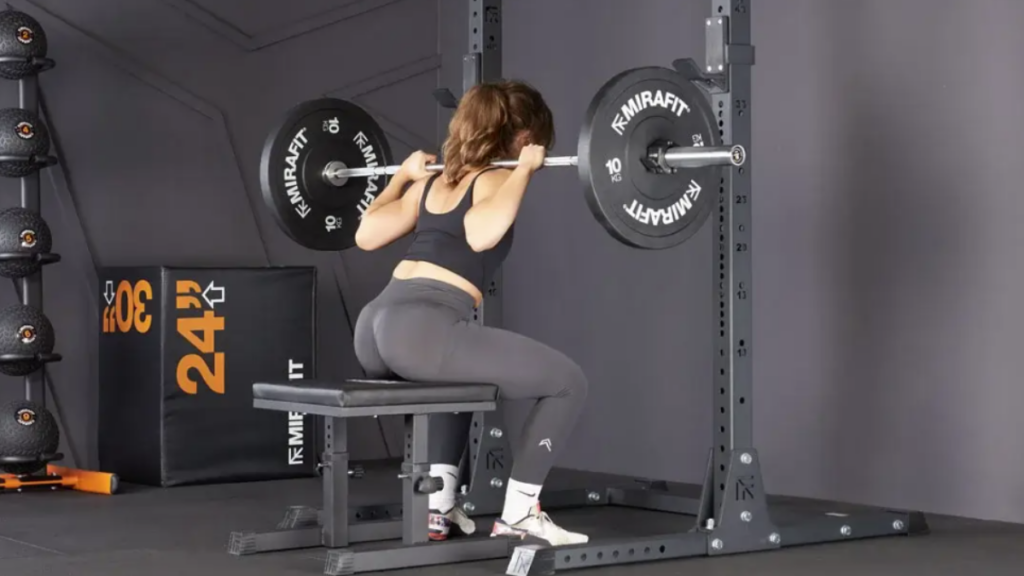
The exercise that outperforms leg presses across every metric of hypertrophic potential is the dead stop barbell back squat, often referred to by strength coaches as the Anderson squat. Named after legendary strength pioneer Paul Anderson, this movement involves setting safety bars in a power rack at the bottom height of your squat depth, lowering the barbell until it rests completely on the pins, pausing for two to three full seconds, and then driving upward from a absolute standstill.
By bringing the barbell to a complete halt on the safety pins, you systematically strip away all stored kinetic rebound while retaining the massive systemic benefits of a heavy axial load. Unlike a leg press where your back rests against a cushion, the dead stop barbell back squat forces your posterior chain, spinal erectors, and core bracing musculature to maintain active structural integrity while sitting under the bar at the bottom.
The effort required to blast off the safety pins from a dead stop triggers a massive neural cascade that recruits the quadriceps, adductors, and glutes simultaneously.
Executing the dead stop barbell back squat correctly requires methodical setup and unwavering discipline. You must set the safety pins in your power rack so that when the barbell rests on them, your hips sit parallel to or slightly below your knees. Unrack the barbell, step back, and lower yourself under full control until the weight makes firm contact with the steel pins. You must deliberately relax your momentum without collapsing your posture, holding the barbell motionless on the pins for two full seconds while keeping your abdominal wall braced.
| Movement Execution Phase | Technical Focus Point | Muscular Objective |
| Controlled Descent | Maintain tight posture and smooth cadence | Build controlled eccentric fatigue |
| Pin Rest Phase | Allow bar to settle completely for two seconds | Dissipate passive stretch shortening recoil |
| Concentric Launch | Drive feet through floor with explosive intent | Maximum recruitment of high threshold fibers |
| Lockout Transition | Finish hips fully while maintaining bracing | Complete muscle contraction under load |
The moment you begin the upward drive from the pins, concentrate on pushing the floor away aggressively rather than peeling your shoulders backward. Because there is zero momentum helping you past the bottom sticking point, the initial drive feels exceptionally heavy, requiring maximum voluntary effort from the very first millimeter of movement. This sudden explosion from zero velocity is precisely what makes the dead stop barbell back squat so ridiculously effective for generating rapid muscle growth.
Programming the Pin Squat for Maximum Muscular Growth
Integrating the dead stop barbell back squat into your existing routine requires an honest assessment of your current strength levels and recovery capabilities. Because this exercise completely eliminates momentum, you will not be able to lift as much weight as you normally do on standard back squats or leg presses. Most lifters need to drop their working weight by roughly fifteen to twenty five percent when transitioning to pin squats, but the vastly increased muscular effort more than compensates for the reduced load on the bar.
Dumbbell vs Cable Lateral Raises – Which Exercise Builds Wider Shoulders for Beginners?
Because every repetition begins from a complete dead stop, high repetition sets can quickly lead to technique breakdown and fatigue in your postural stabilizers. The most effective strategy for hypertrophic programming is to keep your repetition ranges moderate while focusing on absolute quality and maximal speed during the concentric phase. Performing three to five sets of three to six reps allows you to maintain peak force production on every single effort without allowing your lower back posture to collapse under fatigue.
| Program Variable | Beginner Application | Advanced Application |
| Weekly Frequency | Once per week as primary lift | Twice per week alternating intensity |
| Set and Rep Scheme | Three sets of five repetitions | Four to five sets of three to five repetitions |
| Pin Rest Duration | Two full seconds of complete stillness | Three full seconds to ensure zero recoil |
| Load Selection | Sixty five percent of standard one rep max | Seventy five percent of standard one rep max |
Rest periods between sets should be generous, lasting anywhere from two to three minutes, because the neural demand of exploding from a dead stop is exceptionally high. Treat every single repetition as a standalone event rather than rushing through a continuous sequence. Step under the bar, settle into your brace, pause completely on the pins, and blast upward with maximum intent to trigger the ultimate hypertrophic signal in your lower body.
Key Takeaways
| Core Takeaway Label | Summary of Practical Application |
| Mechanical Advantage | Machine presses rely on momentum and passive tendon elasticity that reduces tension on working muscles. |
| The Zero Momentum Fix | Pausing completely on safety pins dissipates elastic energy and forces raw muscle fiber recruitment. |
| Superior Hypertrophy | Dead stop barbell back squats recruit high threshold motor units faster than continuous machine repetitions. |
| Programming Strategy | Use moderate rep ranges with lower absolute weight and focus on explosive concentric drive from the pins. |
References
- Clark, D. R., Lambert, M. I., and Hunter, A. M. 2012. Muscle activation in the loaded free barbell squat: A brief review. Journal of Strength and Conditioning Research, 26(4), pp. 1169-1178.
- Escamilla, R. F. 2001. Knee biomechanics of the dynamic squat exercise. Medicine and Science in Sports and Exercise, 33(1), pp. 127-141.
- Kubo, K., Ikebukuro, T., and Yata, H. 2019. Effects of squat training with different depths on lower limb muscle volumes. European Journal of Applied Physiology, 119(9), pp. 1933-1942.
- Wilk, M., Zajac, A., and Tufano, J. J. 2021. The influence of movement tempo during resistance training on muscular strength and hypertrophy responses: A review. Sports Medicine, 51(8), pp. 1629-1650.