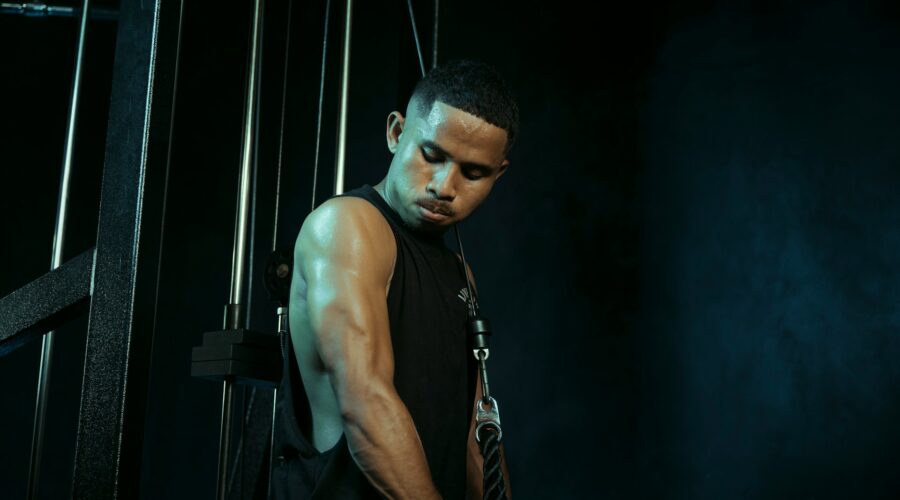


Cable pushdowns are useful, but they are far from essential if your goal is to build bigger triceps. You can train the triceps effectively with dumbbells, barbells, bodyweight, and a pair of parallel bars. In some cases, these alternatives may even give you a better opportunity to load the muscle through a large range of motion.
The triceps brachii sits on the back of the upper arm and has three sections called heads. The long head crosses both the shoulder and elbow joints, while the lateral and medial heads primarily cross the elbow. This structure matters because shoulder position changes the length of the long head during elbow extension. A good triceps plan should therefore include exercises that challenge the muscle in more than one position.


The three exercises below cover the major needs for triceps growth. One emphasizes the long head in a stretched position, one lets you progressively overload the triceps with heavy weight, and one provides a challenging bodyweight option that can become a serious muscle builder.
Why You Do Not Need Cable Pushdowns for Bigger Triceps
Cable pushdowns are simple to set up and easy to learn. They can also provide a consistent resistance profile through the movement. However, muscle growth does not depend on using a cable station. It depends on performing enough hard, technically sound sets over time, progressing your training, and recovering well enough to repeat that work consistently.
Research consistently shows that resistance training can produce hypertrophy across a wide range of loads, provided the sets are sufficiently challenging. This means dumbbells, barbells, weighted bodyweight movements, and machines can all contribute to muscular growth when training volume and effort are appropriate.
Chin-Ups vs Biceps Curls: Which Builds Bigger Arms for Beginners?
Cable pushdowns also keep your upper arm close to your torso. This is not a problem, but it means they do not place the long head of the triceps under the same degree of stretch as an overhead extension. Since the long head makes a substantial contribution to the size of the upper arm, it makes sense to include at least one movement that trains it with the arm elevated.
You do not need to abandon pushdowns if you like them. But if the cable stack is busy, unavailable, or simply boring, these three exercises can form the foundation of an excellent triceps program.
1. Overhead Dumbbell Triceps Extension
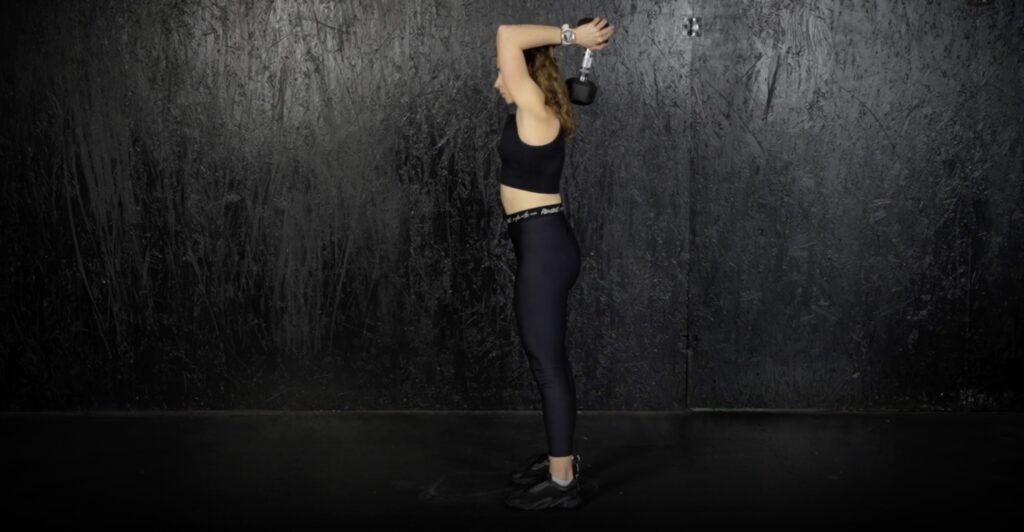
The overhead dumbbell triceps extension is arguably the most valuable pushdown alternative for building bigger arms. It directly trains elbow extension while your upper arm is raised overhead. This position lengthens the long head of the triceps because that head crosses the shoulder joint.
A controlled training study found that elbow extension performed with the arms overhead produced substantially greater triceps hypertrophy than elbow extension performed with the arms in a neutral position. The advantage was particularly notable for the long head, although the whole triceps also grew more in the overhead condition. This makes overhead extensions a strong choice for anyone whose goal is maximum triceps development rather than simply getting a pump.
How to Perform It
Sit on an upright bench with back support if possible, or stand with your feet firmly planted. Hold one dumbbell with both hands above your head, keeping your palms against the inside of the top weight plate. Begin with your elbows pointing generally upward and your upper arms close to your ears.
Lower the dumbbell behind your head by bending your elbows. Keep your torso stable and allow the weight to travel as low as your shoulder mobility comfortably permits. Then extend your elbows to raise the dumbbell back overhead. Finish with your elbows straight, but avoid aggressively forcing them backward at the top.
The key is to keep your upper arms relatively still. Some movement is normal, especially with a heavy dumbbell, but the exercise should remain an elbow extension rather than turning into a loose whole body lift.
How to Get More From the Exercise
Use a load that allows you to control the bottom position. Rushing through the lowering phase often reduces the tension you can create in the stretched position, which is one of the biggest benefits of this movement.
Many lifters do well with moderate to higher repetitions here. A range of eight to fifteen repetitions is practical for most people, although lighter sets can work too when they are performed close to muscular failure. Start with two or three hard sets and add weight or repetitions gradually when you can complete the top end of your chosen range with clean technique.
If one heavy dumbbell feels awkward, perform the exercise one arm at a time with a single dumbbell. This can make it easier to find a comfortable arm path and may reduce the temptation to arch your lower back.
2. Close Grip Barbell Bench Press
The close grip barbell bench press is a compound movement that allows you to use considerably more load than an isolation exercise. Your chest and front shoulders assist, but the triceps must produce a large amount of force to extend the elbows and finish each repetition.
A narrower grip increases triceps activity compared with a wide grip during the bench press. It also shifts the exercise toward elbow extension without requiring the extreme wrist position or cramped hand placement that some lifters associate with a very narrow grip. The goal is not to place your hands touching each other. A grip around shoulder width, or slightly inside shoulder width, is usually close enough.
This exercise is particularly useful for lifters who want bigger triceps and stronger pressing performance. It gives you a clear route for progressive overload because you can add small amounts of weight to the bar over time.
How to Perform It
Lie on a flat bench with your eyes below the bar. Take a grip that is approximately shoulder width apart. Before lifting the bar out, pull your shoulder blades gently back and down into the bench, place your feet firmly on the floor, and create a stable base.
Lower the bar under control toward the lower part of your chest. Keep your elbows angled closer to your body than they would be during a wide grip bench press, but do not force them tightly against your ribs. Press the bar upward by driving through your hands and straightening your elbows.
The bar should move in a smooth path. Avoid bouncing it from your chest or allowing the wrists to fold backward under the load. Keeping the knuckles pointed toward the ceiling and the forearms close to vertical near the bottom will usually create a strong and comfortable pressing position.
How to Get More From the Exercise
Because this is a multi joint movement, it is often best performed earlier in your upper body session when you are fresh. Use three or four challenging sets of about six to ten repetitions. If your main goal is muscle growth, there is no need to test maximal strength every week. Consistent, controlled work with a challenging load is more productive than repeatedly grinding low quality repetitions.
Do not judge the exercise solely by how much you feel your triceps burn. Compound lifts can build muscle even when the sensation is shared across the chest, shoulders, and arms. Focus instead on good mechanics, gradual progression, and completing enough quality work over the weeks.
3. Parallel Bar Dips
Parallel bar dips are a demanding bodyweight exercise that can become an outstanding triceps builder. They train elbow extension while requiring the triceps, chest, shoulders, and upper back to stabilize the body. Once bodyweight repetitions become manageable, a dipping belt and weight plates offer a straightforward way to continue progressing.
Research examining bar dips shows that they effectively involve the triceps brachii and pectoralis major. Dips are not an isolation exercise, and they should not be treated as one. However, their combination of a deep range of motion, meaningful loading potential, and direct elbow extension makes them a valuable option for building bigger upper arms.
They are also convenient. If your gym has dip bars, you need very little setup. If you train at home, a sturdy dip station can provide years of useful training.
How to Perform It
Start by supporting yourself above the bars with straight elbows and shoulders held away from your ears. Cross your legs behind you if needed. Lower your body by bending your elbows, keeping your chest tall and your torso only slightly leaned forward.
Descend only as far as you can while maintaining shoulder comfort and control. Then push the bars away and extend your elbows to return to the starting position. Finish with straight elbows and stable shoulders.
A more upright torso will usually make the movement feel more triceps focused, while a larger forward lean tends to increase the contribution from the chest. Neither version is automatically wrong. Choose the position that feels secure and pain free, then keep it consistent so you can measure your progress.
How to Get More From the Exercise
If full bodyweight dips are currently too difficult, use an assisted dip machine or bands until you can perform controlled repetitions. If they are too easy, add load in small increments using a belt. You can also slow the lowering phase and pause briefly near the bottom if additional load is not available.
Avoid chasing depth at the expense of your shoulders. The triceps do not need an extreme stretch at the bottom of every dip for the exercise to work. A repeatable range of motion that you can load progressively is far more useful than forcing your way into an uncomfortable position.
Two or three sets of six to twelve repetitions are a practical starting point. Keep at least one repetition in reserve during your first few weeks if you are not already accustomed to dips, as the movement can create significant soreness.
How to Build a Better Triceps Program
You do not need to perform every triceps exercise in a single session. A simple approach is to use the close grip bench press as your heavier press, then add overhead dumbbell extensions afterward. On another upper body day, use dips and include one or two additional overhead extension sets if your recovery is good.
Weekly training volume matters, but more is not always better. Research suggests that greater weekly set volumes can support greater hypertrophy, although the ideal amount differs between individuals. For many lifters, beginning with around six hard direct triceps sets per week is sensible. You can increase toward eight, ten, or more weekly sets if you are recovering well and continuing to progress.
Your chest pressing already contributes some work for the triceps, especially if you bench press regularly. Still, direct triceps training is useful because it ensures the muscle receives enough targeted stimulus. Track your repetitions and loads, prioritize controlled technique, and make small improvements over time.
You should also train close enough to failure for the final repetitions to feel genuinely difficult. That does not mean every set needs to end with failed repetition. Leaving a small margin can help preserve technique and make your training more repeatable. The goal is hard, productive work that you can sustain week after week.
References
- Coratella, G., Tornatore, G., Longo, S., Esposito, F. and Cè, E. (2021) ‘The effect of grip width on muscle strength and electromyographic activity in bench press among novice and resistance trained men’, International Journal of Environmental Research and Public Health, 18(13), 7025.
- Kubo, K., Kanehisa, H. and Fukunaga, T. (2007) ‘Influence of repetitive muscle contractions with different modes on muscle and tendon properties in vivo’, Journal of Applied Physiology, 103(2), pp. 579 to 586.
- Maeo, S., Yoshitake, Y., Takahashi, H., Kanehisa, H. and Isaka, T. (2023) ‘Triceps brachii hypertrophy is substantially greater after elbow extension training performed in the overhead versus neutral arm position’, European Journal of Sport Science, 23(7), pp. 1240 to 1250.
- Saeterbakken, A.H., Mo, D.A. and Scott, S. (2017) ‘The effects of bench press variations in competitive athletes on muscle activity and performance’, Journal of Sports Sciences, 35(23), pp. 2333 to 2339.
- Schoenfeld, B.J., Grgic, J., Ogborn, D. and Krieger, J.W. (2017) ‘Strength and hypertrophy adaptations between low versus high load resistance training: A systematic review and meta analysis’, Journal of Strength and Conditioning Research, 31(12), pp. 3508 to 3523.
- Schoenfeld, B.J., Ogborn, D. and Krieger, J.W. (2017) ‘Dose response relationship between weekly resistance training volume and increases in muscle mass: A systematic review and meta analysis’, Journal of Sports Sciences, 35(11), pp. 1073 to 1082.
- Welsch, E.A., Bird, M. and Mayhew, J.L. (2005) ‘Electromyographic activity of the pectoralis major and anterior deltoid muscles during three upper body lifts’, Journal of Strength and Conditioning Research, 19(2), pp. 449 to 452.
- Welsch, E.A., Bird, M., Mayhew, J.L. and Davis, J.R. (2014) ‘Bench, bar, and ring dips: Do kinematics and muscle activity differ?’, Journal of Strength and Conditioning Research, 28(10), pp. 2673 to 2679.
Key Takeaways
| Exercise | Main reason to use it | Practical starting point |
|---|---|---|
| Overhead dumbbell triceps extension | Trains the long head in a lengthened overhead position | Two or three sets of eight to fifteen repetitions |
| Close grip barbell bench press | Allows heavy progressive loading for the triceps and pressing muscles | Three or four sets of six to ten repetitions |
| Parallel bar dip | Combines bodyweight loading, elbow extension, and a large controlled range of motion | Two or three sets of six to twelve repetitions |
| Weekly approach | Combine direct work with gradual progression and good recovery | Begin with around six hard direct triceps sets each week |