

A 100kg bench press is a satisfying milestone because it represents more than chest strength. It asks you to coordinate the chest, triceps, shoulders, upper back, legs, and trunk while keeping a barbell under control. It also demands enough practice to make the movement efficient when the weight feels intimidating.
There is no research study that says every lifter must pass the same three tests before benching 100kg. Body size, training history, limb length, and individual technique all influence performance. Still, the science on strength training gives us clear principles that matter: you need repeatable technique through an appropriate range of motion, sufficient exposure to progressively heavier work, and enough muscle and strength capacity to tolerate productive training.


Use the three standards below as practical checkpoints. They are not magic rules, but they will make your path to a 100kg bench press more efficient and much less dependent on lucky attempts.
Why 100kg Is Not Just a Chest Exercise
The bench press is a multi joint lift. The pectoralis major, anterior deltoid, and triceps brachii contribute substantially to pressing the bar, while the upper back, rotator cuff, trunk, and lower body help create a stable platform. A strong chest alone does not guarantee a strong bench because force has to travel through the entire system without a weak link.

Strength is also specific to the task being trained. Heavy bench pressing improves bench press performance particularly well because it practices the same coordination, range of motion, and force demands used in the test. General pressing exercises can help build muscle, but they do not fully replace time spent practicing the actual lift.
For that reason, your first goal should not be to force a 100kg attempt. Your goal should be to make the lighter weights look organized, repeatable, and progressively stronger. The following three abilities show that your training is moving in that direction.
1. You Can Perform Consistent, Controlled Full Range Bench Reps
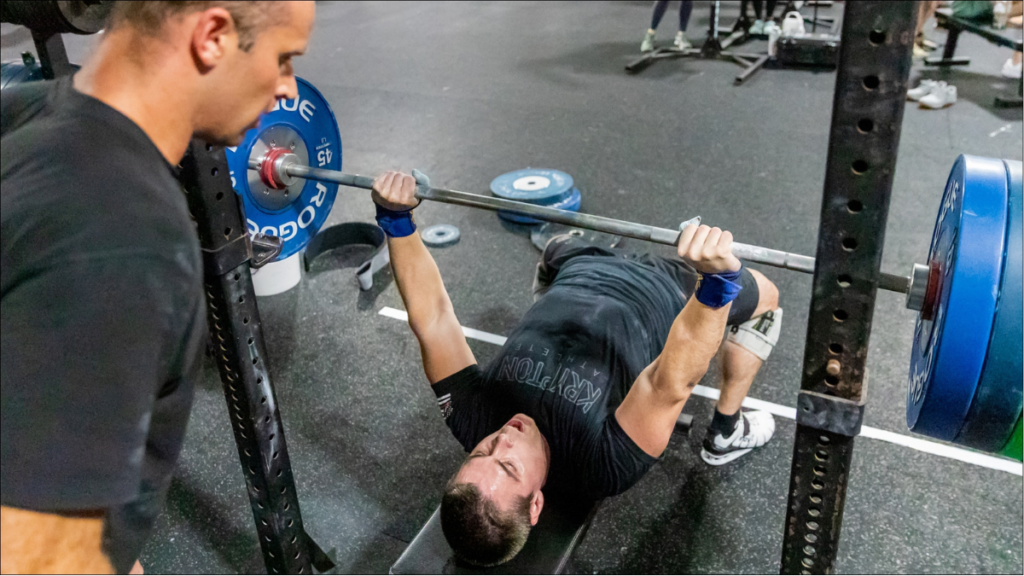
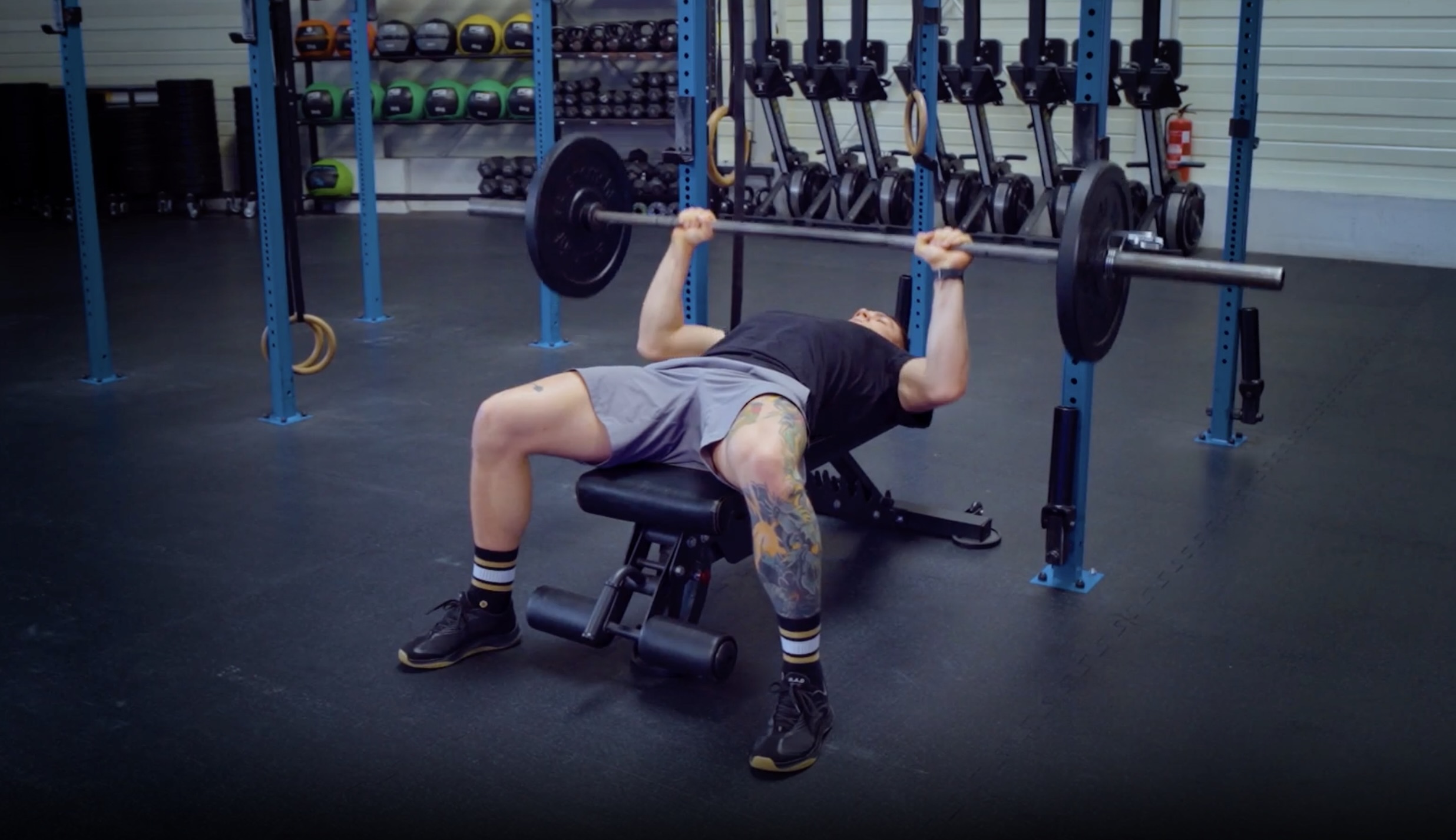
A strong bench press begins with a repeatable setup. Your feet should create stable contact with the floor, your upper back should stay firmly connected to the bench, and your shoulder blades should remain set throughout the rep. From there, lower the bar with control, touch the chest at a comfortable and consistent point, and press the bar without allowing your shoulders to roll forward.
The key word is consistent. If the bar touches your chest on one rep but stops several centimeters high on the next, your progress is difficult to measure. If your hips lift dramatically or your shoulders lose position as the set gets hard, the weight is probably exceeding what you can currently control well.
Why Range of Motion Matters
Resistance training through a fuller range of motion tends to produce greater muscle development than partial range training, although the best range for an individual must still be comfortable and tolerable. More importantly for a bench press goal, the lower portion of the movement is the exact position you need to overcome during a standard repetition. Regularly avoiding it means you are practicing a different lift.
This does not mean forcing the bar into a painful position. Shoulder pain, prior injury, and individual anatomy can change the most appropriate grip width and depth. A pain free, controlled range that consistently brings the bar to the chest is a sensible target for most healthy lifters. If pain persists, get assessed by a qualified health professional rather than trying to train through it.
A Practical Standard
Before treating 100kg as a realistic near term goal, you should be able to complete multiple work sets with the same bar path and the same depth. The final rep should look like a slower version of the first, not a completely different movement. You should also be able to pause the bar briefly on the chest with a load you can handle confidently.
The pause matters because it removes the temptation to bounce the bar and reveals whether you can create force from the bottom position. It is not necessary to pause every training rep, but paused repetitions are an excellent way to check whether your technique is real or merely dependent on momentum.
2. You Can Build a Productive Weekly Bench Press Training Dose
Getting to 100kg requires more than occasional hard singles. You need enough quality training to build muscle, improve skill, and strengthen the tissues that repeatedly handle the load. Training volume, usually represented by the number of challenging sets performed, is a major driver of strength and muscle gain.
Research shows a dose response relationship between weekly resistance training volume and muscle growth. More hard sets generally produce more hypertrophy up to the point where recovery becomes a problem. Since larger muscles have greater potential to produce force, intelligently managed volume is highly useful for a bench press target.

However, volume only helps when it is recoverable. A lifter who performs too many difficult sets with poor technique may accumulate fatigue without getting a worthwhile training effect. The better approach is to use enough work to progress, then gradually add weight, repetitions, or sets as your performance improves.
Why Two Weekly Exposures Often Work Well
Training a muscle group or lift more than once per week can make it easier to distribute productive work across the week. When total weekly volume is matched, frequency itself has a smaller effect on strength than many people assume. Still, two bench press sessions can be useful because they give you more opportunities to practice the skill with less fatigue in each workout.
For example, one session can focus on heavier work with lower repetitions, while another can emphasize more controlled repetitions with a slightly lighter load. This gives you exposure to both the heavy loading that supports maximal strength and the additional volume that supports muscle growth and technical practice.
A sensible weekly plan does not require complicated programming. It requires regular practice, progressive overload, and enough recovery to improve from one session to the next. If your bench performance has stalled for weeks, review sleep, nutrition, total pressing volume, and whether every session has become a test instead of training.
A Practical Standard
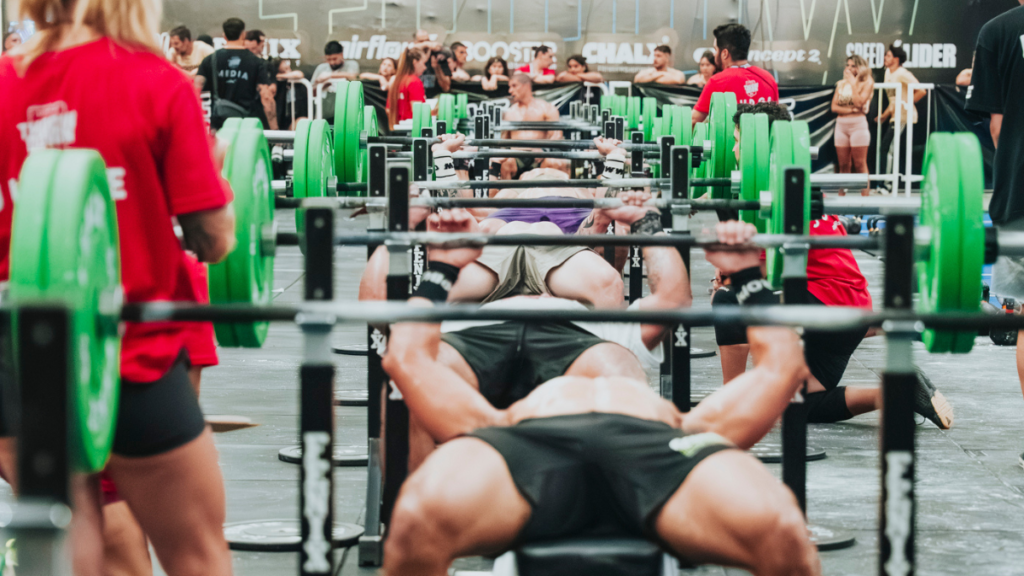
You should be able to bench press twice per week for several weeks while your technique stays intact and your performance trends upward. One day should include work that feels meaningfully heavy, while another should include controlled volume. You should leave most training sets with a small amount of repetition capacity remaining instead of grinding every set to failure.
This standard is important because a 100kg bench is usually earned through accumulated work. A program made entirely of maximal attempts gives you very little room to practice high quality repetitions or build enough volume to support progress.
3. You Can Handle Heavy Submaximal Weight Without Losing Position
The final step is becoming comfortable with loads that are close enough to your goal to feel heavy, but light enough to train repeatedly. Heavy resistance training is particularly effective for improving maximal strength because it exposes the nervous system and muscles to the force demands of near maximal lifting.
You do not need to attempt 100kg every week. In fact, repeated maximal attempts can interfere with quality training if they create excessive fatigue or reinforce poor technique. Instead, build confidence with submaximal loads that you can control. The goal is to make 80kg, 85kg, and 90kg feel familiar before asking your body to produce 100kg.
What Heavy, Controlled Training Looks Like
For maximal strength, the American College of Sports Medicine recommends relatively heavy loading, often in the range of one to six repetitions per set for trained individuals. That does not mean every set must be very heavy. Lighter loads can still build muscle effectively when effort is high, but heavier training remains especially useful when the goal is a one repetition maximum.
Your heavy work should teach you how to stay tight. Lower the bar under control, maintain pressure through your feet, keep your upper back stable, and press with intent. Bar speed may slow near the end of a hard set, but loss of position is a sign that the load or fatigue level is too high for the purpose of that session.
Assistance exercises can support this process. Triceps work can improve pressing strength near lockout, while rows and other upper back training can help build the stable base needed to bench effectively. These movements are useful additions, but they should support the main lift rather than replace it.
A Practical Standard
A helpful readiness sign is being able to bench 90kg for a clean single that includes a clear pause on the chest, without a spotter touching the bar or your setup falling apart. Another useful sign is being able to perform several controlled repetitions with a load around 80kg. These are not universal requirements, and they will not predict every lifter’s exact result, but they provide a realistic bridge between basic training weight and a 100kg attempt.
If you cannot hold position with 90kg, spend more time getting stronger at lower loads. If you can control 90kg but miss 100kg near lockout, your next block may benefit from more triceps focused work and additional heavy practice. If the bar fails off the chest, improve your paused work, chest strength, and control in the bottom position.
Putting the Three Things Together
The most reliable route to a 100kg bench press is not dramatic. Build a consistent full range repetition, train the bench often enough to accumulate quality work, and gradually get stronger with heavy submaximal loads. Each part supports the others.
Good technique lets you train hard without unnecessary inconsistency. Productive weekly volume builds the muscle and skill needed for progress. Heavy submaximal training prepares you to express that strength when the bar reaches 100kg.
Be patient with the final jump. A 100kg barbell does not care how motivated you feel on the day. It responds to your preparation. When your repetitions are repeatable, your weekly training is sustainable, and 90kg feels composed rather than chaotic, the 100kg attempt becomes a reasonable test of strength instead of a gamble.
Key Takeaways
| Checkpoint | What it looks like | Why it matters |
|---|---|---|
| Controlled full range reps | The bar touches the chest consistently, with stable shoulders and no bouncing | It improves movement consistency and trains the portion of the lift required in a standard bench press |
| Sustainable weekly training | You bench twice weekly with a balance of heavier work and controlled volume | It supports skill practice, strength development, and sufficient training volume |
| Heavy submaximal control | You can handle 80kg to 90kg with a stable setup and deliberate technique | It prepares you for the force and coordination demands of a 100kg single |
References
- American College of Sports Medicine (2009) ‘American College of Sports Medicine position stand. Progression models in resistance training for healthy adults’, Medicine and Science in Sports and Exercise, 41(3), pp. 687 708.
- Grgic, J., Schoenfeld, B.J., Davies, T.B., Lazinica, B., Krieger, J.W. and Pedisic, Z. (2018) ‘Effect of resistance training frequency on gains in muscular strength: A systematic review and meta analysis’, Sports Medicine, 48(5), pp. 1207 1220.
- Schoenfeld, B.J., Ogborn, D. and Krieger, J.W. (2017) ‘Dose response relationship between weekly resistance training volume and increases in muscle mass: A systematic review and meta analysis’, Journal of Sports Sciences, 35(11), pp. 1073 1082.
- Schoenfeld, B.J., Grgic, J., Ogborn, D. and Krieger, J.W. (2017) ‘Strength and hypertrophy adaptations between low versus high load resistance training: A systematic review and meta analysis’, Journal of Strength and Conditioning Research, 31(12), pp. 3508 3523.
- Schoenfeld, B.J. and Grgic, J. (2020) ‘Effects of range of motion on muscle development during resistance training interventions: A systematic review’, SAGE Open Medicine, 8, pp. 1 10.