

The glutes are among the most important muscles in the human body. They influence athletic performance, posture, sprinting speed, jumping ability, lower back health, and overall strength. Strong glutes are not only an aesthetic goal. They are essential for producing force, stabilizing the pelvis, and reducing injury risk during both sports and everyday activities.
Yet many people spend months training their glutes without seeing meaningful results. Often the problem is not effort. It is exercise selection. Some movements simply create more mechanical tension, activate more muscle fibers, and provide better opportunities for progressive overload than others.



Research consistently shows that muscle growth is driven primarily by mechanical tension, sufficient training volume, and progressive overload. Choosing exercises that maximize these factors can dramatically improve results. The good news is that you do not need dozens of exercises or endless workout variations. A handful of highly effective movements can deliver impressive glute development when performed correctly and consistently.
This article explores four of the best science-backed exercises for building stronger, larger glutes quickly. We will examine why they work, what the research says, and how to get the most from each movement.
Understanding the Glute Muscles
Before looking at the exercises, it helps to understand what the glutes actually do. The gluteal muscle group consists of three muscles:
Gluteus Maximus
The gluteus maximus is the largest muscle in the body. Its primary functions include hip extension, external rotation, and assisting with powerful movements such as sprinting, jumping, and lifting. Because of its size and force-producing capabilities, the gluteus maximus contributes significantly to lower body strength and athletic performance.
Gluteus Medius
Located on the outer side of the pelvis, the gluteus medius helps stabilize the hip and pelvis during walking, running, and single-leg movements. Weakness in this muscle is associated with knee pain, poor movement mechanics, and increased injury risk.
Gluteus Minimus
The gluteus minimus sits beneath the gluteus medius and assists with hip stabilization and movement control. Although all three muscles matter, most people seeking bigger glutes focus primarily on maximizing growth of the gluteus maximus while ensuring the smaller glute muscles remain strong and functional.
What Builds Glutes Fast?
The fastest route to glute development combines three key principles.
Progressive Overload
Muscles grow when they are exposed to increasing demands over time. This can involve adding weight, increasing repetitions, improving technique, or performing more challenging variations. Without progressive overload, muscle growth eventually stalls.
Sufficient Training Volume
Research consistently demonstrates a dose response relationship between training volume and hypertrophy. In general, more challenging sets produce greater muscle growth up to an individual recovery limit. Most people benefit from approximately 10 to 20 hard sets per week for the glutes.
Full Range of Motion
Recent evidence suggests that training muscles through a large range of motion can enhance hypertrophy by increasing mechanical tension and muscle fiber recruitment. Exercises that challenge the glutes in both stretched and contracted positions often produce superior growth.
With these principles in mind, let’s examine four exercises that consistently rank among the best for glute development.
Exercise 1: Barbell Hip Thrust
The barbell hip thrust has become one of the most researched glute exercises in modern strength training. Popularized by strength coach Bret Contreras, the movement specifically targets hip extension while placing substantial tension directly on the gluteus maximus.
Why It Works
Unlike many lower body exercises that divide the workload between the glutes, quadriceps, and hamstrings, the hip thrust emphasizes the glutes throughout the movement.
Electromyography studies have repeatedly shown exceptionally high glute activation during hip thrusts compared to many traditional lower body exercises. The exercise also allows lifters to use substantial loads while maintaining a relatively low level of spinal stress.
At the top of the movement, the glutes reach peak contraction when the hips are fully extended. This creates significant mechanical tension in a position where the glutes are strongest.
How to Perform It
- Sit on the floor with your upper back against a bench and a loaded barbell positioned across your hips.
- Plant your feet firmly on the floor approximately shoulder width apart.
- Drive through your heels and extend your hips upward until your torso becomes parallel to the ground.
- Squeeze your glutes forcefully at the top before lowering under control.
Common Mistakes
- Many lifters hyperextend their lower back instead of fully extending the hips.
- Others place their feet too far forward, shifting tension toward the hamstrings.
- Maintaining a neutral spine and focusing on glute contraction helps maximize effectiveness.
Best Rep Range
For hypertrophy, sets of 6 to 15 repetitions work exceptionally well. Most lifters can progressively increase weight over time, making the hip thrust an ideal long-term muscle building exercise.
Exercise 2: Bulgarian Split Squat
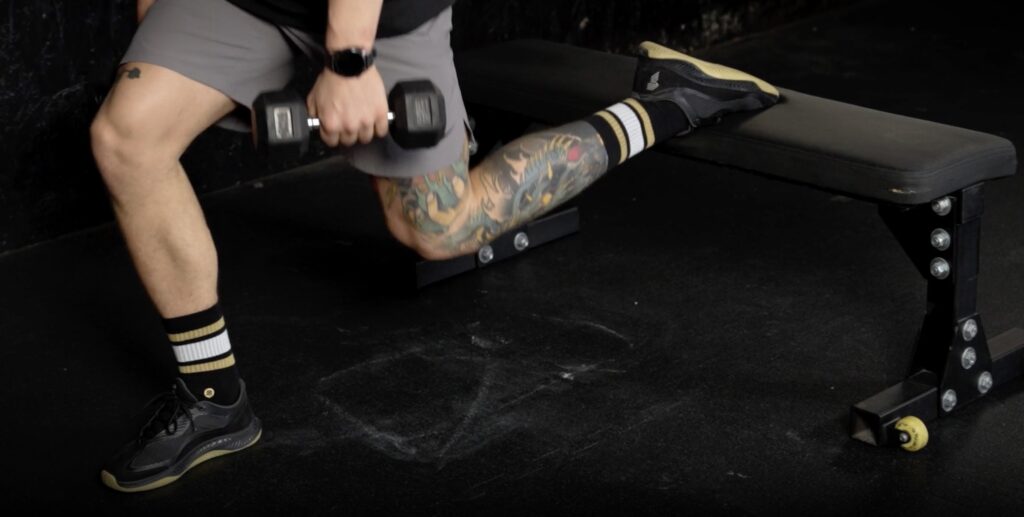
The Bulgarian split squat is one of the most effective unilateral exercises for building the glutes while simultaneously improving balance, stability, and athletic performance. Despite its reputation for being challenging, few exercises provide as much glute stimulation with relatively little equipment.
How to Perform It
- Stand a few feet in front of a bench.
- Place one foot behind you on the bench.
- Lower yourself by bending the front knee and hip until your front thigh approaches parallel to the floor.
- Drive through the front heel to return to the starting position.
- Keep your torso slightly inclined forward to increase glute involvement.
Best Rep Range
Sets of 8 to 15 repetitions per leg work particularly well for hypertrophy. Dumbbells are often the simplest way to add progressive resistance.
Exercise 3: Romanian Deadlift
The Romanian deadlift is arguably the best exercise for loading the glutes in a stretched position. It develops the posterior chain as a whole while creating tremendous tension in the glutes and hamstrings.
How to Perform It
- Stand holding a barbell in front of your thighs.
- Maintain a slight bend in your knees.
- Push your hips backward while lowering the bar close to your legs.
- Continue descending until you feel a strong stretch in the glutes and hamstrings.
- Drive your hips forward to return to the standing position.
Common Mistakes
Many lifters turn the movement into a squat by bending their knees excessively. Others round their lower back, reducing efficiency and increasing injury risk.
A proper hip hinge is essential. Think about moving your hips backward rather than simply lowering the bar.
Best Rep Range
Six to twelve repetitions per set works extremely well. The focus should remain on maintaining tension and control rather than simply moving heavy weight.
Exercise 4: Walking Lunge
The walking lunge combines strength, stability, mobility, and glute activation in one movement. It is highly functional and carries over well to athletic activities.
Why It Works
- Walking lunges place each leg through a substantial range of motion while requiring continuous stabilization.
- The glutes play a major role in controlling hip position and producing force during each stride.
- Longer steps increase hip flexion and place greater demand on the gluteus maximus.
- Research shows that unilateral lower body exercises can effectively recruit glute muscles while improving movement quality and lower body coordination.
How to Perform It
- Stand tall holding dumbbells at your sides.
- Step forward with one leg.
- Lower your body until both knees approach ninety degrees.
- Push through the front heel and immediately step into the next repetition with the opposite leg.
- Maintain an upright posture throughout the movement.
Best Rep Range
Ten to twenty steps per leg is generally effective for hypertrophy and muscular endurance. The exercise responds particularly well to moderate to high repetition training.
Sample Glute Building Workout
A simple but highly effective workout could include:
- Barbell Hip Thrust: 4 sets of 8 to 10 reps
- Romanian Deadlift: 4 sets of 8 to 12 reps
- Bulgarian Split Squat: 3 sets of 10 to 12 reps per leg
- Walking Lunge: 3 sets of 12 to 15 steps per leg
Performed twice weekly with progressive overload, this program provides sufficient volume for most lifters to build stronger glutes efficiently.
Final Thoughts
Building better glutes does not require complicated workouts or endless exercise variety. The most effective approach is often the simplest.
The barbell hip thrust, Bulgarian split squat, Romanian deadlift, and walking lunge each target the glutes from a different angle while providing excellent opportunities for progressive overload and muscle growth. Together they create a complete glute training system supported by current exercise science.
Focus on proper technique, train consistently, eat enough protein, and progressively challenge your muscles over time. Do that, and these four exercises can help you build stronger, more powerful glutes faster than almost any other combination of movements.
Key Takeaways
| Topic | Key Point |
|---|---|
| Main Goal | Build stronger and larger glutes through proven compound exercises |
| Exercise 1 | Barbell hip thrust maximizes glute activation and peak contraction |
| Exercise 2 | Bulgarian split squat develops unilateral strength and deep glute loading |
| Exercise 3 | Romanian deadlift loads the glutes under stretch, promoting hypertrophy |
| Exercise 4 | Walking lunge improves glute strength, stability, and athletic function |
| Training Volume | Aim for roughly 10 to 20 challenging sets per week |
| Progressive Overload | Gradually increase weight, reps, or difficulty over time |
| Protein Intake | Consume approximately 1.6 to 2.2 g/kg body weight daily |
| Recovery | Sleep and nutrition are essential for muscle growth |
| Results Timeline | Noticeable growth often appears after 6 to 12 weeks of consistent training |
References
• Contreras, B., Vigotsky, A.D., Schoenfeld, B.J., Beardsley, C. and Cronin, J., 2015. A comparison of gluteus maximus, biceps femoris, and vastus lateralis electromyographic activity in the back squat and barbell hip thrust exercises. Journal of Applied Biomechanics, 31(6), pp.452-458.
• Schoenfeld, B.J., 2010. The mechanisms of muscle hypertrophy and their application to resistance training. Journal of Strength and Conditioning Research, 24(10), pp.2857-2872.
• Schoenfeld, B.J., Ogborn, D. and Krieger, J.W., 2017. Dose response relationship between weekly resistance training volume and increases in muscle mass. Journal of Sports Sciences, 35(11), pp.1073-1082.
• Grgic, J., Schoenfeld, B.J., Davies, T.B., Lazinica, B., Krieger, J.W. and Pedisic, Z., 2018. Effect of resistance training frequency on gains in muscular strength. Sports Medicine, 48(5), pp.1207-1220.
• McCurdy, K., Langford, G., Cline, A., Doscher, M. and Hoff, R., 2004. The reliability of one and three repetition maximum strength tests in untrained women. Journal of Sports Science and Medicine, 3(3), pp.190-194.