

Strong legs are built through progressive resistance training, enough challenging weekly work, and consistent practice. The more difficult question is which exercises deserve the most attention. Should you prioritize big compound lifts such as squats, deadlifts, lunges, and leg presses? Or can isolation exercises such as leg extensions, leg curls, calf raises, and hip abductions build equally impressive strength?
The answer depends on what you mean by strong legs. If your goal is to move the most weight in demanding whole body movements, compound exercises should be the foundation of your training. They train several major muscle groups at once and require you to coordinate the hips, knees, trunk, and often the ankles under load. If you want to improve a specific weak muscle, add productive volume without excessive whole body fatigue, or build strength around a joint after an injury has been cleared by a qualified professional, isolation work becomes extremely valuable.


For most people, the best answer is not choosing one category and ignoring the other. Compound exercises create the base. Isolation exercises help you build more complete, balanced, and resilient legs around that base.
What Makes an Exercise Compound or Isolation?
A compound exercise involves movement at more than one major joint. In a squat, the knees and hips both extend as you stand up. Your quadriceps, glutes, adductors, hamstrings, calves, and trunk muscles all contribute in different ways. A leg press, split squat, step up, Romanian deadlift, and conventional deadlift also fit this category because each trains several muscles and joints in one coordinated movement.
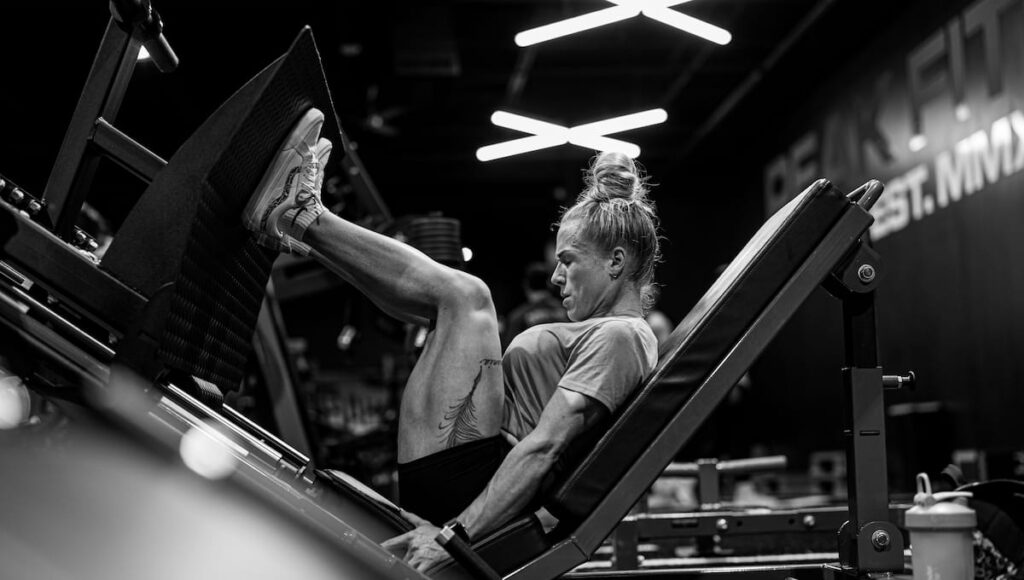
An isolation exercise emphasizes movement at one primary joint. A leg extension mainly challenges knee extension and places most of the training demand on the quadriceps. A seated or lying leg curl trains knee flexion and primarily targets the hamstrings. Calf raises train ankle plantar flexion, while hip abduction and adduction machines focus on muscles that move and stabilize the hip.

Neither category is automatically superior. Exercise selection should match the result you want. Scientific research consistently shows that strength gains are highly specific to the movements practiced. Training the squat is therefore the most direct route to a stronger squat, while training the leg extension is especially useful for improving strength in knee extension.
Why Compound Exercises Should Lead Your Leg Training
Compound lifts are the most efficient way to train your lower body when time is limited. A few hard sets of squats, leg presses, split squats, or deadlift variations can expose several major leg muscles to meaningful mechanical tension. They also make it easier to progressively overload your training because you can gradually add load, repetitions, range of motion, or sets over time.
They Build Strength That Transfers to Big Movements
Leg strength is not only about how much force one muscle can produce. It is also about how well your body coordinates force across multiple joints. A heavy squat requires the quadriceps to extend the knees, the glutes and adductors to extend the hips, the trunk to stay stable, and the ankles and feet to maintain a strong base.
The Only 3 Exercises Beginners Need to Transform Their Abs
This coordination matters for athletes and everyday lifters alike. Rising from a low chair, carrying heavy objects, climbing stairs, sprinting, jumping, and changing direction all require the lower body to work as a system. Compound exercises provide a practical way to train that system under progressively heavier loads.
Research comparing different resistance training movements supports the principle of specificity. A recent controlled trial found that squat training produced greater improvement in squat strength than leg extension training, even when both programs used challenging sets and similar repetition ranges. The leg extension still improved knee extension strength, but it did not fully replace practice of the squat itself.
They Train More Muscle in Less Time
The quadriceps are important, but powerful legs also need strong glutes, hamstrings, adductors, and calves. Compound movements usually distribute work across several of these muscles. A deep squat can challenge the quadriceps and glutes substantially, while a Romanian deadlift emphasizes the hamstrings and glutes. Split squats and lunges can build leg strength while also asking each side to control its own position.

This does not mean every compound lift trains every leg muscle equally. A squat is not a complete hamstring exercise, particularly for the hamstring role of bending the knee. A Romanian deadlift does not train the quadriceps through the same knee extension demands as a squat or leg press. That is one reason well designed leg training usually includes more than one movement pattern.
They Allow Meaningful Progressive Overload
Progressive overload means exposing the body to a training challenge it can adapt to. This can involve lifting more weight, completing more high quality repetitions, performing more productive sets, improving the range of motion, or using better control at the same load.
Compound exercises are excellent for this because they allow relatively high loading. You may be able to add a small amount of weight to a squat, leg press, or Romanian deadlift over months of training while maintaining solid technique. These long term improvements are a clear and useful measure of growing leg strength.
However, heavy loading is not the only route to muscle growth. Research shows that lighter resistance can also build muscle when sets are performed hard enough and close enough to muscular failure. For maximum strength in demanding compound movements, though, regular exposure to heavier loading remains especially important.
Where Isolation Exercises Become Essential
Isolation exercises do not replace compound training for most people who want strong legs. They do solve problems that compound lifts cannot always solve on their own. Their value comes from precision, local muscular challenge, and lower technical complexity.
They Help You Target Weak Muscles
A compound exercise can be limited by the weakest link in the movement. During a squat, the trunk, hips, quadriceps, balance, mobility, and confidence under load can all affect performance. If your quadriceps are the limiting factor, adding leg extensions can provide extra direct work without asking the lower back or hip extensors to do more.
This matters because leg muscles do not always grow or strengthen uniformly. In the controlled comparison of squats and leg extensions, leg extensions produced greater growth in several measured regions of the rectus femoris, while squat training produced greater growth in a measured area of the vastus lateralis. The practical lesson is that different exercises can create different adaptations, even when they train the same broad muscle group.
Hamstring curls offer another clear example. Hip hinge movements such as Romanian deadlifts train the hamstrings strongly while they assist hip extension. Leg curls train their other major function, knee flexion. Using both can provide more complete hamstring training than relying on only one movement pattern.
They Add Productive Volume With Less Whole Body Fatigue
Hard squats and deadlifts are demanding. They can challenge your breathing, grip, trunk, and concentration as well as your legs. This is useful, but it also means there is a limit to how much heavy compound work you can recover from while maintaining high quality technique.
Isolation exercises often create less systemic fatigue. A leg extension can push the quadriceps close to fatigue without placing a bar on your back or requiring the same level of spinal loading. A seated calf raise can train the calves hard without draining energy needed for your squats. This makes isolation work a practical way to increase weekly training volume for a muscle group.
Weekly volume is one of the important drivers of hypertrophy, provided that sets are challenging and recovery is adequate. More work is not always better, but adding carefully selected isolation sets can help you reach an effective amount of training without turning every session into a physically exhausting test.
They Are Useful for Technique Development and Training Around Limitations
Some lifters need time to develop the mobility, coordination, or confidence required for a deep squat. Others may have temporary limitations that make one compound exercise uncomfortable, even though they can still train certain muscles safely with a different movement. In these situations, machines and isolation exercises can provide a controlled path to build capacity.
This does not mean you should train through pain or use exercise selection as a substitute for medical advice. Persistent pain, swelling, instability, or a major strength loss should be assessed by an appropriate healthcare professional. Once you have guidance, a controlled exercise such as a leg extension, leg curl, or machine based press may be easier to adjust for range of motion and loading than a free weight movement.
Which Is Better for Super Strong Legs?
Compound exercises are better for building broad, practical lower body strength because they train multiple muscles together and improve your ability to produce force in large movements. If you want a strong squat, a strong leg press, powerful lunges, or better performance in jumping and field sports, you need regular practice with compound patterns.

Isolation exercises are better for directly strengthening individual muscles, bringing up weak points, and adding extra leg training volume with less whole body fatigue. They are particularly useful for the rectus femoris, hamstrings through knee flexion, calves, hip abductors, and hip adductors.
The strongest approach combines both. Begin your workout with compound exercises while you are fresh enough to use good technique and generate high force. Then use isolation work to give extra attention to muscles that need more direct training.
A Practical Structure for Stronger Legs
A productive lower body session can start with one primary compound movement. This could be a squat, leg press, front squat, hack squat, split squat, or trap bar deadlift. Choose an exercise you can perform consistently through a comfortable and controlled range of motion.
Next, add a second compound movement that complements the first. If you start with a knee dominant movement such as a squat or leg press, a Romanian deadlift or hip thrust can add more direct hip extension work. If you begin with a hinge movement, a split squat or leg press can increase knee extension work for the quadriceps.
Finish with one or two isolation exercises based on your needs. Leg extensions are useful for additional quadriceps work. Leg curls provide direct hamstring knee flexion training. Standing and seated calf raises can train the calves through slightly different emphasis. Hip abduction and adduction work can build muscles that contribute to hip control and force production.
You do not need to take every set to complete failure. Most people can make excellent progress by finishing many sets with a small number of high quality repetitions still possible. Isolation movements are often safer and easier to take closer to failure because the technique is simpler and the consequences of a missed repetition are lower.
How to Progress Without Stalling
Track your training. Record the load, repetitions, sets, and how difficult each exercise felt. When you can perform the top of your planned repetition range with solid form, increase the load slightly in your next session. Small improvements repeated over months produce dramatic changes in strength.
Use enough range of motion to challenge the muscles you want to develop, provided it is comfortable and controlled. Research on squatting suggests that deeper ranges of motion can produce greater adaptations in some lower body muscles than partial ranges. The best depth is the deepest position you can control without pain, loss of balance, or a major breakdown in technique.
Train each major leg muscle consistently across the week. Two lower body sessions can work extremely well for many lifters, especially when one day has a slightly greater quadriceps emphasis and the other gives more attention to the hamstrings and glutes. Recovery also matters. Sleep, sufficient food intake, and enough protein support the adaptations your training is designed to create.
The Bottom Line
Compound exercises are the foundation for super strong legs. They teach your lower body to produce force as a coordinated unit, allow progressive loading, and give you the most training return for your time. Squats, leg presses, split squats, lunges, and hinge movements should do most of the heavy lifting in a leg strength program.
Isolation exercises are the valuable support system. They help you build muscles that compounds may not fully challenge, address weak points, and add targeted work without piling on excessive fatigue. The best program does not treat them as rivals. It uses compound lifts to build the structure, then uses isolation exercises to make that structure stronger and more complete.
Key Takeaways
| Focus | Best choice | Why it matters |
|---|---|---|
| Overall lower body strength | Compound exercises | They train several muscles and joints together under meaningful load. |
| Squat strength | Squat variations | Strength improves most in the movement you practice consistently. |
| Direct quadriceps work | Leg extensions | They provide focused knee extension training and can add useful volume. |
| Complete hamstring development | Hip hinges plus leg curls | Hamstrings contribute to hip extension and knee flexion, so both functions deserve training. |
| Efficient training | Compound exercises | They train several major lower body muscles in one movement. |
| Weak point development | Isolation exercises | They allow more direct work for a specific muscle with less whole body fatigue. |
| Best long term plan | Both exercise types | Compound lifts build the base and isolation work fills the gaps. |
References
- American College of Sports Medicine (2009) ‘American College of Sports Medicine position stand: Progression models in resistance training for healthy adults’, Medicine & Science in Sports & Exercise, 41(3), pp. 687–708.
- Bloomquist, K., Langberg, H., Karlsen, S., Madsgaard, S., Boesen, M. and Raastad, T. (2013) ‘Effect of range of motion in heavy load squatting on muscle and tendon adaptations’, European Journal of Applied Physiology, 113(8), pp. 2133–2142.
- Brandão, L., de Salles Painelli, V., Lasevicius, T., Schoenfeld, B.J., de Souza, E.O., Barquilha, G., Aihara, A.Y., Cardoso, F.N., Roschel, H. and Tricoli, V. (2020) ‘Varying the order of combinations of single and multi joint exercises differentially affects resistance training adaptations’, Journal of Strength and Conditioning Research, 34(5), pp. 1254–1263.
- Grgic, J., Schoenfeld, B.J., Orazem, J., Sabol, F., Bishop, D.J. and Pedisic, Z. (2022) ‘Effects of resistance training performed to repetition failure or non failure on muscular strength and hypertrophy: A systematic review and meta analysis’, Journal of Sport and Health Science, 11(2), pp. 202–211.
- Kassiano, W., Costa, B., Kunevaliki, G., Lisboa, F., Prado, A., Alves, L., Tricoli, I., Stavinski, N., Francssuel, J. and Cyrino, E.S. (2026) ‘Comparison of muscle hypertrophy and strength adaptations induced by back squat and leg extension resistance exercises’, Journal of Strength and Conditioning Research, 40(4), pp. 367–376.