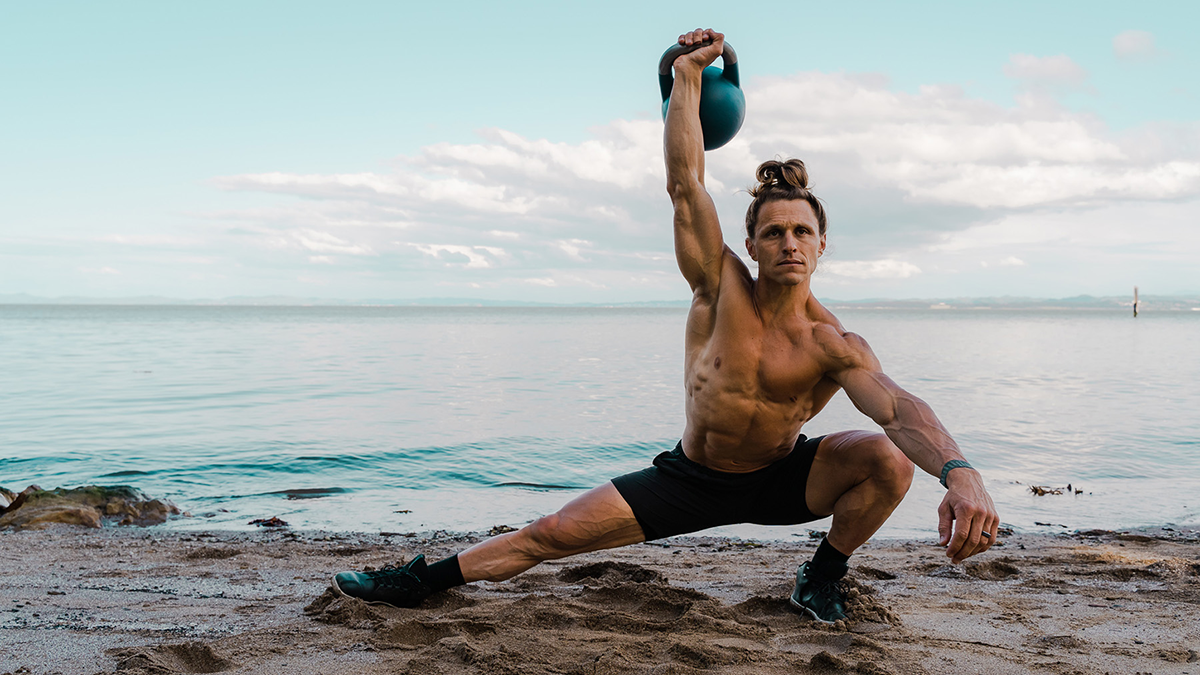


Most lower body training happens straight ahead. You squat down, deadlift up, lunge forward, and run in a straight line. Those movements are valuable, but your hips and legs also need to control force from side to side. That is where the Cossack squat can earn a place in your program.
A Cossack squat is a deep lateral squat in which you shift your bodyweight onto one leg while the other leg stays extended to the side. The working knee bends deeply while the hips move back and down. The straight leg creates a demanding position for the inner thigh muscles, while the supporting leg must produce force through the quads, glutes, calves, and muscles around the hip.


It is not a magical exercise and it is not automatically the best choice for everyone. There are no direct long term training studies showing that Cossack squats are superior to every other leg or glute exercise. However, the movement combines several useful qualities: unilateral strength, lateral control, hip mobility, adductor loading, and a large range of motion. For the right person, it can be an excellent addition to a well structured leg program.
What Is a Cossack Squat?
The Cossack squat begins with a wide stance. You shift your weight toward one side, bend that knee, and lower your hips while keeping the other leg as straight as your current mobility allows. Your supporting foot stays planted, your chest remains controlled, and your knee tracks in the same general direction as your toes.
At the bottom, the working leg is in a deep squat position. The extended leg creates a stretch through the adductors, which are the muscles on the inside of the thigh. These muscles help bring the leg toward the body, but they also contribute to hip stability and can assist with hip extension depending on hip position.
The movement is often treated as a mobility drill, but it can become a genuine strength exercise when performed slowly, through a controlled range, and with progressive loading. It sits somewhere between a squat, a lateral lunge, and an active hip mobility exercise.
Why Side to Side Strength Matters
The body does not only need to produce force vertically. Walking, running, cutting, climbing stairs, getting out of a car, changing direction in sport, and recovering balance all require the hips and legs to control movement in more than one direction.
Want Wider and Bigger Biceps? Try Sam Sulek’s ‘Pinky’ Curl Method
Traditional bilateral squats are highly effective for building lower body strength and muscle. Yet they do not expose the body to the same side to side demands as a lateral squat pattern. A Cossack squat asks the working leg to manage a large share of bodyweight while the pelvis shifts laterally. That creates a different coordination challenge from a conventional back squat or leg press.
This does not mean standard squats are incomplete or ineffective. It means that a lateral movement can complement them. A strong training plan does not need endless exercise variety, but including movements that challenge the hips in different positions can improve your ability to control those positions.
The Muscles Cossack Squats Train
Quads and Glutes on the Working Leg
The leg you squat onto does most of the visible work. The quadriceps extend the knee as you stand up, while the gluteus maximus helps extend the hip. The deeper you can squat with control, the more knee and hip flexion you must overcome during the ascent.
Research on squat biomechanics shows that changing squat depth changes joint moments and the relative demands placed on the hip and knee. Deeper squat positions generally require greater control at the hip and knee than shallow positions. This is one reason a controlled Cossack squat can feel surprisingly difficult even without external load.

The glutes are not simply activated because an exercise has a reputation for being a glute movement. They work when they are required to control and extend the hip under meaningful tension. In the Cossack squat, the glute on the working side contributes as you lower into the position and as you drive yourself back to standing.
Adductors and the Straight Leg
The straight leg is one of the defining features of the Cossack squat. As you sink toward one side, the adductors of the opposite leg are lengthened. This is why many people feel the exercise strongly in the groin and inner thigh.
The adductor magnus is particularly important because it is a large muscle with a role in hip movement and force production. The adductors should not be treated as muscles that only need stretching. Like the glutes and hamstrings, they benefit from being progressively strengthened.
That distinction matters. Passive stretching may improve flexibility in the short term, but strength training through an appropriate range can help you develop control and tolerance in that range. Cossack squats can be useful because they challenge the adductors in a lengthened position while asking you to stay balanced and controlled.
Hip Stabilizers
The muscles around the side of the hip, including the gluteus medius, help stabilize the pelvis during single leg and lateral tasks. In a Cossack squat, the pelvis must remain organized as bodyweight shifts onto one leg. If the working knee collapses inward, the torso twists excessively, or the pelvis drops sharply, you are likely losing control somewhere in the movement.
You do not need to chase a perfectly rigid position, but you should aim for a smooth descent and ascent. The goal is not to force your body into a shape that it cannot currently own. The goal is to gradually build strength and confidence in the range that is available to you.
Can Cossack Squats Build Muscle?
They can contribute to muscle growth, particularly for beginners, people returning to training, or lifters who use enough load and proximity to fatigue. However, bodyweight Cossack squats will eventually become too easy for many experienced trainees if they are the only lower body exercise in a program.
Muscle growth is strongly linked to sufficient training volume, effort, progressive overload, and consistent practice. A Cossack squat can provide a useful hypertrophy stimulus when it is loaded with a dumbbell or kettlebell, performed with a slow eccentric phase, paused near the bottom, or progressed through more repetitions and greater range of motion.
Research comparing different ranges of motion in resistance training suggests that training through a larger range can be at least as effective, and often more effective, for muscular development than consistently training with partial repetitions. That does not mean deeper is always better regardless of form or comfort. It means that controlled training in a useful range of motion can be valuable.
For maximum leg size, most people should still pair Cossack squats with more easily loadable exercises. Squats, Romanian deadlifts, split squats, leg presses, leg extensions, and hamstring curls all make it easier to apply progressive overload over time. Think of the Cossack squat as a highly useful tool, not the entire toolbox.
Could It Improve Mobility?
Cossack squats can help you develop usable mobility, but only when they are performed within a manageable range. Mobility is not just passive flexibility. It is the ability to access a position and control it with strength.
The movement challenges ankle dorsiflexion on the working side, hip flexion on the working side, and adductor length on the extended side. If your heel lifts, your back rounds dramatically, or you feel sharp discomfort in the groin, knee, or hip, you have moved beyond the range you can currently control.
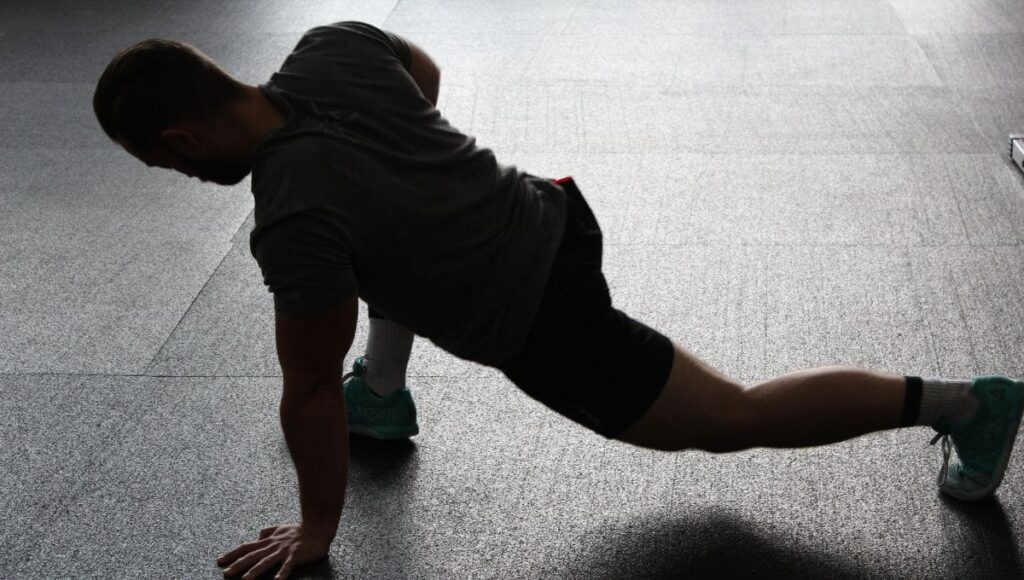
Progressive resistance training can improve flexibility similarly to stretching when exercises are performed through a sufficient range of motion. This makes strength based mobility work practical for people who dislike long static stretching sessions. Still, mobility changes take time. You cannot force them by pushing deeper into pain.
A wider stance is not always better. Start with a stance that lets you keep your working foot planted and your movement smooth. As control improves, you can gradually increase depth or width if it suits your structure and goals.
How to Perform a Cossack Squat
Set Up With a Comfortable Stance
Stand with your feet wider than shoulder width, but not as wide as possible. Turn your toes out slightly if that helps your knees track comfortably. Brace your trunk gently and keep your ribs stacked over your pelvis.
Shift your bodyweight toward one leg. Let the knee bend in the direction of the toes as your hips move back and down. The opposite leg can stay fully straight if your mobility allows, but a small bend is acceptable while you are learning.
Stay in a Range You Can Control
Lower only as far as you can maintain a planted working foot, a stable knee, and a controlled torso. Your chest may lean slightly toward the working side. That is normal because your center of mass must stay over the supporting leg.
Pause briefly in the bottom position if you can do so without losing control. Then push through the whole foot of the working leg and return to the starting position. Move slowly enough that you can identify where your form starts to break down.
Avoid Forcing Depth
Do not chase a dramatic bottom position just because it looks impressive online. Your hip anatomy, ankle mobility, previous injuries, and training history all affect what a good range looks like for you.
Sharp pain is a stop signal. A strong muscular stretch or effort is different from joint pain, pinching, or a sensation of instability. If pain persists, it is sensible to consult a qualified healthcare professional.
Who Should Use Cossack Squats?
Cossack squats can be especially useful for athletes who need lateral control, including martial artists, field sport athletes, skiers, and functional fitness competitors. They can also be valuable for strength trainees who spend most of their training in bilateral, straight ahead patterns.
They are a good option for people who want to strengthen their inner thighs rather than only stretch them. They can also work well as part of a lower body warm up, provided you keep the intensity low enough that it does not reduce performance in your main lifts.
Beginners can use a support such as a squat rack upright, suspension trainer, or stable post. Holding a light weight in front of the chest can also make the position easier for some people because it provides a counterbalance. Start with a shallow range and earn more depth over time.
People with current hip, knee, groin, or ankle pain should be more cautious. A Cossack squat is not a rehabilitation plan by itself. It may be appropriate later in rehabilitation, but that decision should be guided by the nature of the injury and the advice of an appropriate clinician.
How to Program Cossack Squats
Use Cossack squats after your main compound lift or as part of a warm up, depending on your goal. If you want to improve mobility and movement control, use bodyweight repetitions with a slow descent and a brief pause in your current end range.
For strength and muscle, perform two or three sessions per week, using two to four sets of six to twelve repetitions per side. Keep the repetitions controlled and stop with one or two good repetitions left before technical failure. Add a light goblet load once you can comfortably control the full bodyweight version.
You can also use them as a warm up movement. In that case, keep the volume low. One or two easy sets of four to six repetitions per side can help you explore the position without creating fatigue before heavy squats, deadlifts, or running sessions.
The most important progression is quality. Improve depth, balance, control, and loading gradually rather than trying to transform the exercise into a test of flexibility.
Are Cossack Squats the Perfect Leg and Glute Exercise?
No single exercise is perfect for every person or every goal. If your main aim is to build maximum lower body strength, a heavily loaded squat, deadlift, or split squat will usually be easier to progress. If your main aim is isolated glute growth, hip thrusts and hip extension variations may allow you to target that goal more directly.
Cossack squats are valuable because they do several useful things at once. They train the quads and glutes of the working leg, load the adductors in a lengthened position, challenge lateral hip control, and develop strength in a deep range of motion. That combination makes them unusually efficient.
They are not a replacement for every other leg exercise. They are a smart addition for people who want stronger, more capable legs that can move well in more than one direction. If you can perform them without pain and progress them patiently, Cossack squats may become one of the most useful accessories in your lower body training.
References
- Afonso, J., Clemente, F.M., Nakamura, F.Y., Morouço, P., Sarmento, H., Inman, R.A. and Ramirez Campillo, R. (2021) ‘The effectiveness of resistance training to improve muscular strength and body composition in healthy adults: A systematic review and meta analysis’, Sports Medicine, 51(10), pp. 2051 to 2081.
- Escamilla, R.F. (2001) ‘Knee biomechanics of the dynamic squat exercise’, Medicine and Science in Sports and Exercise, 33(1), pp. 127 to 141.
- Hartmann, H., Wirth, K. and Klusemann, M. (2013) ‘Analysis of the load on the knee joint and vertebral column with changes in squatting depth and weight load’, Sports Medicine, 43(10), pp. 993 to 1008.
- McKean, M.R., Dunn, P.K. and Burkett, B.J. (2010) ‘The lumbar and sacrum movement pattern during the back squat exercise’, Journal of Strength and Conditioning Research, 24(10), pp. 2731 to 2741.
- Morton, S.K., Whitehead, J.R., Brinkert, R.H. and Caine, D.J. (2011) ‘Resistance training vs static stretching: Effects on flexibility and strength’, Journal of Strength and Conditioning Research, 25(12), pp. 3391 to 3398.
- Schoenfeld, B.J. (2010) ‘The mechanisms of muscle hypertrophy and their application to resistance training’, Journal of Strength and Conditioning Research, 24(10), pp. 2857 to 2872.
- Schoenfeld, B.J., Grgic, J., Van Every, D.W. and Plotkin, D.L. (2021) ‘Loading recommendations for muscle strength, hypertrophy, and local endurance: A re examination of the repetition continuum’, Sports, 9(2), 32.
- Wolf, M., Brellenthin, A.G., Berryman, N., Hay, J., Robitaille, S., Sui, X. and Bouchard, D.R. (2023) ‘Partial versus full range of motion resistance training: A systematic review and meta analysis’, Sports Medicine, 53(4), pp. 747 to 763.
Key Takeaways
| Point | What it means |
|---|---|
| Main benefit | Cossack squats train lateral leg strength, hip control, and mobility in one movement. |
| Muscles trained | The working leg challenges the quads and glutes, while the extended leg places the adductors under a controlled stretch. |
| Best use | Use them as a lower body accessory, mobility strength drill, or low intensity warm up movement. |
| Muscle growth | They can support hypertrophy, but most lifters should combine them with progressively loaded squats, hinges, and split squats. |
| Technique priority | Keep the working foot planted, let the knee track with the toes, and only use a depth you can control. |
| Progression | Begin with bodyweight or support, then add pauses, range of motion, repetitions, and finally external load. |
| Caution | Avoid forcing depth or training through sharp hip, groin, knee, or ankle pain. |