

Strong glutes can make a major difference to how you move, lift, run, jump, and feel during everyday life. The gluteus maximus is the largest muscle in the body and is a powerful hip extensor, which means it helps drive your leg behind you when you stand up, climb stairs, sprint, or rise from a squat. Your gluteus medius and minimus also help stabilize the pelvis when you walk, run, and stand on one leg.
For beginners, dumbbells are one of the most useful tools for glute training. They are accessible, easy to adjust, and allow you to learn strong movement patterns without needing a barbell or complicated machine setup. You can create meaningful strength and muscle gains with dumbbells when you use controlled technique, train consistently, and gradually make the exercises more challenging over time.


3 Best Beginner Glutes Exercises with a Barbell
The three exercises below cover the most important ways to train your glutes. The dumbbell hip thrust teaches powerful hip extension in a supported position. The dumbbell Romanian deadlift trains the glutes and hamstrings through a long range of motion. The dumbbell reverse lunge builds unilateral strength, coordination, and pelvic stability.
Together, they provide an excellent starting point for anyone who wants stronger, more muscular glutes.
Why Dumbbell Glute Training Works
Muscles grow and become stronger when they are exposed to resistance that challenges them over time. Resistance training can increase muscle size and strength across a range of loads, provided the sets are demanding enough and the total training is progressed sensibly. For a beginner, this is good news. You do not need to start with extremely heavy weights or complicated exercises to make progress.
Barbell vs Dumbbell Shoulder Press – Which Builds More Muscle Mass for Beginners?
Dumbbells are especially valuable because they make it easy to find an appropriate starting load. You can begin with a light pair, focus on learning the movement, then use heavier dumbbells, more repetitions, more sets, or better control as your strength improves. This gradual approach is called progressive overload, and it is one of the key principles behind successful strength training.
Research shows that multiple sets of resistance exercise are effective for building muscle and strength. Training a muscle group more than once per week can also be useful because it lets you spread quality work across several sessions instead of trying to do everything in one workout. For a beginner, two glute focused sessions per week is a practical and productive place to start.
It is also important to understand that you do not need to take every set to complete muscular failure. Training close to failure can stimulate muscle growth, but stopping with one to three technically sound repetitions still possible is often a smarter choice for beginners. It allows you to practice better form, recover well, and build confidence with each exercise.
1. Dumbbell Hip Thrust
The dumbbell hip thrust is one of the most direct glute exercises you can do. It places the load across your hips while you extend them upward, making it easy to focus on squeezing the glutes hard at the top of each repetition.
Hip thrust variations are popular for good reason. Studies comparing hip thrusts with other lower body movements have found high gluteus maximus activity during the exercise. Training studies also show that hip thrusts can build glute muscle size effectively, although they are not the only exercise that can do the job. The best program is usually one that includes more than one movement pattern rather than relying on a single exercise.
How to Do the Dumbbell Hip Thrust
Sit on the floor with your upper back against a sturdy bench or sofa that will not slide. Roll one dumbbell into the crease of your hips and hold it securely with both hands. Bend your knees and place your feet about shoulder width apart.
Push through the middle of your feet and raise your hips toward the ceiling. At the top, your torso and thighs should form a roughly straight line. Squeeze your glutes firmly while keeping your ribs down and your chin slightly tucked.
Lower your hips under control until your glutes are close to the floor, then begin the next repetition. Keep the dumbbell stable throughout the movement. A folded towel or pad placed between the dumbbell and your hips can make the exercise more comfortable.
What Beginners Should Focus On
The most common mistake is turning the movement into a lower back exercise. Avoid aggressively arching your back at the top. Instead, think about moving your hips upward and gently bringing your belt buckle toward your ribs. Your glutes should create the movement, while your torso stays controlled.
Your foot position matters too. If your feet are too far away, you may feel the exercise mostly in your hamstrings. If your feet are too close, your quadriceps may take over. Adjust your stance until you can feel a strong glute contraction at the top without discomfort in your knees or lower back.
Start with two or three sets of eight to twelve repetitions. Choose a dumbbell that makes the final few repetitions challenging while allowing you to pause briefly at the top with good control.
2. Dumbbell Romanian Deadlift
The dumbbell Romanian deadlift is one of the best beginner exercises for learning the hip hinge. A hip hinge means moving primarily at the hips while maintaining a stable spine. This pattern is important for lifting objects from the floor, athletic movement, and building strength through the glutes and hamstrings.
The Romanian deadlift trains the glutes in a lengthened position as you lower the dumbbells. Research on resistance training technique suggests that using a controlled range of motion and challenging muscles at longer lengths can be beneficial for hypertrophy. The exercise also trains the hamstrings, which work with the glutes to extend the hip.
How to Do the Dumbbell Romanian Deadlift
Stand tall with your feet around hip width apart. Hold a dumbbell in each hand in front of your thighs, with your palms facing your legs. Soften your knees slightly and keep them in that position throughout the exercise.
Push your hips backward as the dumbbells travel close to your legs. Imagine you are trying to close a car door with your glutes. Keep your chest open, your spine neutral, and your shoulders pulled gently away from your ears.
Lower the dumbbells only as far as you can while keeping your back position steady. Most beginners will feel a significant stretch through the hamstrings before the dumbbells reach the floor. From there, press your feet into the ground and drive your hips forward to return to standing.
Finish each repetition by standing tall and squeezing your glutes. Do not lean backward at the top or force your lower back into an exaggerated arch.
What Beginners Should Focus On
The Romanian deadlift is not a squat. Your knees will bend a little, but they should not keep moving forward as you descend. Most of the movement should come from your hips traveling backward.
Do not chase depth at the expense of form. The correct depth is the point at which you feel tension in the hamstrings and glutes while maintaining a stable back. As your mobility, control, and strength improve, your range of motion may gradually increase.
Start with two or three sets of eight to ten repetitions. Use a slower lowering phase of around two to three seconds. This makes a lighter dumbbell more challenging and helps you learn the position without rushing.
3. Dumbbell Reverse Lunge
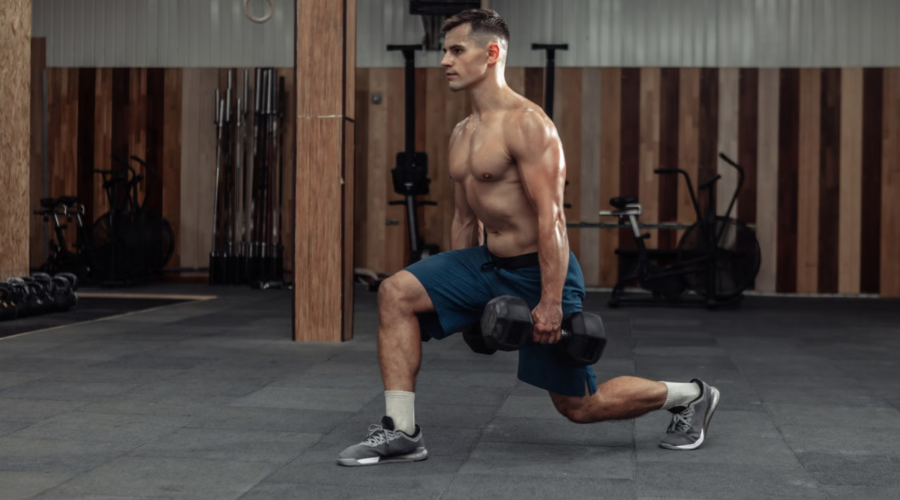
The dumbbell reverse lunge is an excellent glute exercise because it trains one leg at a time. Single leg work challenges the glutes to produce force while also helping stabilize the pelvis and control the position of the knee and hip.
A reverse lunge is often easier for beginners to learn than a forward lunge because stepping backward can reduce the braking demand that occurs when you step forward and lower into the movement. It also gives you more control over how far you step and how deeply you lower.
Research examining glute activity across common strengthening exercises supports the use of lunge variations alongside hip thrusts, squats, and deadlifts. While muscle activation alone cannot tell you exactly how much muscle an exercise will build, it can help show that these movements involve the glutes meaningfully when performed with good technique.
How to Do the Dumbbell Reverse Lunge
Begin standing tall with a dumbbell in each hand at your sides. Brace your midsection and take a controlled step backward with one foot. Lower your back knee toward the floor while allowing both knees to bend.
Keep most of your pressure through the front foot. Your front knee should move naturally in the same direction as your toes. Lower until you can maintain balance and control, then push the floor away through the front foot to return to standing.
Complete all repetitions on one side before switching legs, or alternate sides if that helps you maintain better coordination.
What Beginners Should Focus On
A longer backward step generally places more emphasis on the hip and glutes of the front leg, while a shorter step may create more knee bend and quadriceps involvement. Neither option is automatically wrong, but a moderate step length is usually the best starting point.
Avoid letting your front knee collapse inward as you lower. Keep your pelvis level and move slowly enough that you stay balanced. If holding two dumbbells feels too difficult at first, hold one dumbbell close to your chest in a goblet position or begin with bodyweight reverse lunges until the pattern feels stable.
Start with two or three sets of six to ten repetitions per leg. Rest long enough between sets that you can maintain control on both sides.
A Simple Dumbbell Glute Workout for Beginners
You can perform the three exercises in one session two times per week, leaving at least one day between workouts. Begin with the dumbbell Romanian deadlift while you are fresh enough to focus on your hinge technique. Follow it with dumbbell hip thrusts, then finish with reverse lunges.
Use two sets of each exercise during your first week if you are new to training. Build to three sets as your recovery and confidence improve. Rest for around one to two minutes between sets. The goal is not to rush. The goal is to perform repetitions that look and feel consistent.
A useful starting point is eight to ten repetitions for Romanian deadlifts, ten to twelve repetitions for hip thrusts, and six to eight repetitions per leg for reverse lunges. When you can complete the top end of the repetition range with strong form for every set, increase the dumbbell weight slightly.
If heavier dumbbells are not available, you can still progress. Add repetitions, increase the number of sets, slow the lowering phase, pause at the hardest point of the movement, or use one leg at a time in exercises such as hip thrusts. These changes make the muscles work harder without needing a bigger weight immediately.
How to Keep Making Progress
Your first priority should be technique. Strong glutes are built with repetitions that place tension on the target muscles, not with rushed reps that shift the load into the lower back or knees. Film a set from the side if possible, or use a mirror to check your position.
Keep a simple training log. Write down the dumbbell weight, number of sets, and repetitions you completed. This makes it much easier to see whether you are getting stronger from week to week.
Pay attention to recovery as well. Muscle growth is supported by adequate sleep, enough total food, and sufficient dietary protein. Training creates the stimulus, but recovery helps your body adapt to it. If you are constantly sore, exhausted, or unable to improve your performance, you may need more rest or a smaller increase in training volume.
The best beginner glute workout is not the one that leaves you barely able to walk. It is the one you can perform consistently, progress over time, and execute with confidence. Master these three dumbbell movements, and you will build a strong foundation for more advanced lower body training.
References
- American College of Sports Medicine (2026) ‘American College of Sports Medicine Position Stand: Resistance Training Prescription for Muscle Function, Hypertrophy, and Physical Performance in Healthy Adults’, Medicine & Science in Sports & Exercise, 58(3), pp. 1 to 20.
- Baz-Valle, E., Fontes-Villalba, M., Santos-Concejero, J., Balsalobre-Fernández, C. and Ayan-Pérez, C. (2022) ‘Resistance Training Variables for Optimization of Muscle Hypertrophy: An Umbrella Review’, Frontiers in Sports and Active Living, 4, 949021.
- Grgic, J., Schoenfeld, B.J., Davies, T.B., Lazinica, B., Krieger, J.W. and Pedisic, Z. (2018) ‘Effect of Resistance Training Frequency on Gains in Muscular Strength: A Systematic Review and Meta Analysis’, Sports Medicine, 48(5), pp. 1207 to 1220.
- Macadam, P., Cronin, J. and Contreras, B. (2019) ‘An Examination of the Gluteal Muscle Activity Associated With Dynamic Hip Abduction and Hip External Rotation Exercise: A Systematic Review’, International Journal of Sports Physical Therapy, 10(5), pp. 573 to 591.
- Neto, W.K., Soares, E.G., Vieira, T.L., Aguiar, R., Chola, T.A., Sampaio, V.L. and Gama, E.F. (2019) ‘Comparison Between Back Squat, Romanian Deadlift, and Barbell Hip Thrust for Leg and Hip Muscle Activities During Hip Extension’, Journal of Strength and Conditioning Research, 33(10), pp. 2595 to 2601.
- Refalo, M.C., Helms, E.R., Trexler, E.T., Hamilton, D.L. and Fyfe, J.J. (2023) ‘Influence of Resistance Training Proximity to Failure on Skeletal Muscle Hypertrophy: A Systematic Review with Meta Analysis’, Sports Medicine, 53(3), pp. 649 to 665.
Key Takeaways
| Focus | What to do |
|---|---|
| Best exercise selection | Use dumbbell hip thrusts, Romanian deadlifts, and reverse lunges to train hip extension, glute tension at longer muscle lengths, and single leg control. |
| Weekly training | Perform this workout twice per week, with at least one recovery day between sessions. |
| Starting volume | Begin with two sets per exercise, then progress to three sets as your fitness improves. |
| Rep ranges | Use eight to twelve controlled repetitions for hip thrusts and Romanian deadlifts, plus six to ten repetitions per leg for reverse lunges. |
| Progression | Increase the dumbbell weight once you can reach the top of the rep range with consistent technique. |
| Best priority | Build strength with controlled repetitions, a stable spine, and a strong glute contraction rather than chasing heavier weight too quickly. |